Showing posts with label Bob Dylan. Show all posts

Saturday, January 12, 2013

Bob Dylan - Tempest


Last summer, my family and I drove down to Kansas City for a bit of summer vacation. One of the reasons we decided on K.C. is because they were having the Titanic exhibit at Union Station. My son had studied about the Titanic in school that year and had done some research on the topic. We thought that the exhibit, which featured tons of cool artifacts, would be a special thing for him.

What we didn’t expect was for our eight-year old to suddenly become the annoying expert on everything concerning the wreck, opening disputing the facts posted on informational points and just being kind of a swarmy asshole throughout the exhibit.

Now, I love my son very much, and ironically enough, one of the things that I love about him is that he can be a swarmy asshole. It’s just at that moment, I didn’t like it because the very reason why we decided to spend close to a hundie for tickets to this thing was we were trying to do something nice for him.

When we brought these very expensive tickets to the lady that lets you into the exhibit hands you a “boarding pass.” On it is the name of a real passenger of the Titanic, and at the end of the exhibit is a wall listing all of the riders of the ship on that fateful night.

The names were categorized into two groups: dead and survived.

The lady explained that we could match our names up with the ones on the wall to find out if we survived or not. Spoiler alert: everyone in our family died except our five-year old daughter. Personally, I think that shit was rigged.

Anyway, I joke to everyone that the name on my ticket said “Leonardo DiCaprio” and the lady said that she has people every day asking her to give them Leo’s ticket for a souvenir. They actually get a little pissy with her when she explains that the movie contained fictional characters. Never mind the fact that these confused ticket holders don’t get the concept that Leonardo DiCaprio plays a character named Jack Dawson, so technically, asking for DiCaprio’s ticket is an act worthy of ridicule.

The same shit happens on “Tempest,” the title track of Bob Dylan’s thousandth record, and the record’s obvious centerpiece. And if you mean by “centerpiece” that it simply goes on and on and on and on, then you get an idea of how the verses all begin to run together after a while.

Until the moment when Dylan goes “Leo grabbed his sketchbook/He was often so inclined” and you’re stunned.

“Did Bobby just quote something from a James Cameron movie?”

He does indeed. And it bugged the shit out of me so much that I obsessed on it for days. Then I read something where Dylan explains DiCaprio’s entrance into “Tempest” as a necessity. He says he can’t think of the real Titanic any more without thinking about the film.

And if you’ll recall, I couldn’t either.

Then you discover that the entire thing is nothing more than a lift from an old Carter Family song, where extended re-tellings of the Titanic disaster were often filled with half-truths and exaggerations to make the song even more riveting.

I’ve probably spent too much time on one track and haven’t adequately acknowledged the themes of mortality and human nature that run throughout the rest of the disc. I also should probably mention that, musically, the band continues to find hues in early 20th Century American music as Dylan seems to find comfort in the music that first grabbed his attention some six decades ago, an act of full-circle implications, and clues to the artist’s exit.

I wouldn’t blame him. The voice continues to be an issue, but less so than on the abysmal Christmas In The Heart. It’s because the stories on Tempest are so rugged and reek of the end that every song can handle the way Dylan just chews up a song and spits them out in such compelling fashion.

You can even understand the opening line in “Pay In Blood,” and by the time you begin to decipher his gravel, it’s on a line like “Another politician pumpin’ out the piss.” From that perspective, you begin to appreciate how Bob is tucked way up high in the mix, like a seething old man.

Tempest is a continuation of Dylan’s late career direction, but it’s a surprising one. For all of its dustbowl tones and nautical tragedies, it’s thematically modern effort. You get the sense that the populist theme is intentional, serving less to satisfy Dylan’s own late-career comforts than to release a collection that represents the most appropriate songs for the time it was intended. Figuring out how they relate to our moment is part of the fun, but one line in Tempest rings louder than any other: “I ain’t dead yet/My bell still rings.”

It’s true, and Tempest is a real clapper.

Tuesday, September 25, 2012

New Bob Dylan DVD "Down In The Flood"

I'm not so much against the notion of The Band's greatness, but I'm one of those realists that think their best work came early on, and maybe their ending was a blessing in disguise.

I'm also one of those guys who thinks Robbie Robertson's ego was frighteningly inflated and that Levon Helm was probably the band's spiritual center, and that he was incredibly important to their legitimacy.

All of this, we wouldn't even be arguing about things like this had the band never received that phone call from Bob Dylan, when he asked them "You guys feel like going on the road with me and get boo'ed?"

There's a new documentary out detailing Dylan's relationship with the band and how they were witness to Bobby's first of many transformations, one that transitioned him from a mere folk icon into someone who ended up changing the face of rock music.


Bob Dylan & The Band Down In The Flood
Comes to DVD on September 25

"In 1966 Bob Dylan began his first electric world tour. It was a landmark moment, both for Dylan and for the history of rock music, and it bitterly divided his audience. Backing Dylan on stage was an obscure group of Canadian musicians collectively known as The Hawks. In the months following the tour they would join Dylan during a lengthy convalescence in New York's Catskill Mountains; when both parties re-emerged, Dylan had undergone an artistic transformation that sent ripples across American music and The Hawks had become simply 'The Band', one of the most important recording groups of their generation.

This is the story of the relationship between Dylan and The Band, the legendary amateur recordings that they made together in Woodstock, their re-invention of American music and their continued albeit sporadic relationship during the 1970s. Featuring new interviews with Garth Hudson; Band producer John Simon; The Hawks' 66 tour drummer, Mickey Jones; the man who assembled and tutored the Hawks and from whom they took their name, Ronnie Hawkins; Dylan guitarist, Charlie McCoy; Band biographer Barney Hoskyns; Basement Tapes Archivist, Sid Griffin, Isis magazine's Derek Barker and Rolling Stone's Anthony De Curtis. Also features rare footage, archive interviews, seldom seen photographs and the music that changed the world, all at once making for the finest program on this element of Bob Dylan and The Band's respective and communal careers yet to emerge."


Thursday, January 13, 2011

Not Necessarily The News

Sorry for the delay.

I was went through an intense Bob Dylan phase for the last few weeks, and after determining that “Visions Of Johanna” may be the greatest song ever made, I ended up with the new Duran Duran album.

Talk about a complete 360.

I’m also completely immersed in the Keith Richards book, Life.

Yes, it’s awesome.

Yes, I’ll tell you about it sometime.

But for now, I will tell you about my recent foray into a couple of news stories that I’ve become fascinated with.

You should know something about me first, and that is how I used to be motivated by politics. My family is, at least on my Father’s side, heavily Democratic. I think that it stemmed from my Great Grandfather, a World War I veteran that saw enough frontline horror that he never talked about it that much.

He kept it inside.

He also found favor with Harry Truman’s direction during the Second World War It didn’t hurt that my Great Grandfather hailed from the same state as President Truman, so he was quite familiar with Harry’s state efforts before he called Pennslyvania Avenue his home.

Here's a picture of the long-since-closed movie theatre that is on the Main Street of Hopkins, the small town in Northwest Missouri where my Grandfather lived. I'd like to rent this place with my cousin someday and play a punk rock show there. If one person came, it'd be a success in my mind.

I mention this only because I’ve noticed a tremendous amount of vitriol from the Republican side of the aisle, beginning almost as quickly as Obama was elected. I get “politics,” or at least I thought I did, but to be honest-the dialog seemed to take a nasty tone early on in his presidency.

And then it got worse.

Look, I won’t be the one who says that all of the general nastiness in politics caused the recent tragedy in Arizona. It’s abundantly clear that the shooter was not healthy and he associated some aspects of his mental illness with an innocent target and acted on his faulting wiring.

While the verbal hostilities may not have had any influence on motivating the tragedy, they certainly didn’t prevent it either. So what’s the harm is trying to “E” a little bit.

That’s my friend Ed’s slang for “Take it easy.”

“You’ve got to E, my friend!”

So why do we have to revolt against the notion-just the notion that maybe tone it down a bit because there is a large population of crazy fuckers in this country that are susceptible to triggers that cause them to snap.

Maybe it’s time to be aware of the people who listen to us, and how their instabilities may not understand that we’re not really bringing a gun to a knife fight or that Sarah Palin’s website didn’t really suggest that we shoot a U.S. Representative.

Don’t we bite our tongues around the children and not let the word “Fuck” blurt out?

Then there’s a golden-throated homeless man-a radioman, how ironic-who goes from panhandling to the Today show in a fucking week, and we wonder why he just can’t hang with the notoriety.

Did anyone think to run him through rehab prior to sitting down on Today?

Did at any time someone ponder the obvious: “There’s a reason why he’s homeless?”

Did we really think that a You Tube video would erase his prior demons and turn him into a productive member of society, eternally grateful to the man who pulled up to an intersection to make him dance for his change while recording it for the rest of us.

“Hey look! That bum’s got pipes!”

I’ve become so cynical with America that I absolutely relish going to church to be around people that try to tackle all of this world’s shit even in the face of impossible odds.

Sometimes, all we can do is pray for them to just do the right fucking thing.

Is it any wonder why I listen to the news anymore?

After all, in the same amount of time that it takes me to commute to work in the morning, I could have listened to Devo’s Q: Are We Not Men? A: We Are Devo!

Add your own sniglets to the comment section.

Thursday, November 25, 2010

Lookout Kid...It's Somethin' Ya Did

That’s a picture of my son with the mascot of our local hockey team from earlier tonight.

The week before, we drove up to the dome of my old university and watched a football game.

Sometimes I think he tolerates it more than enjoys it, feeling that it’s more of an obligation of what sons are supposed to do with their fathers. I’d like to tell him that it is indeed worth the boredom to tag along with your old man to an obligatory father/son outing. I don’t remember too many of them with my own father, and I’d like to believe that they’re meaningful enough later, when you begin recalling events to use against your old man.

There will not be a point where my son starts a blog and writes “I don’t remember too many of them with my own father” when tallying all of the sporting events the two of them went through.

It’s the trip to them that’ll probably be forgotten, but I’m taking steps to paint an audio picture that will trigger something-maybe subconsciously-whenever he hears those songs later on.

Tonight on the way to the hockey game, a bit of Back In Black seemed appropriate. It was a dark night, with steady drizzle and the dropping temperature of Thanksgiving eve could potential make the overpasses a slick affair.

I won’t debate the nature of the subject matter-which is pretty much junior high entendres anyway-but the drive and stomp seemed appropriate. Sure enough, they played “Shoot To Thrill” over the p.a. at the game during a stop in the action.

It registered with him.

My job was done.

On that weekend of the football game, I told him that I was going to play a song that would blow his mind.

It was “Subterranean Homesick Blues.”

“Who is this guy, Doctor Seuss?” he asked.

I think Dylan would have smiled.

I went deeper-this time on to “Its Alright Ma, I’m Only Bleeding.”

It’s not like I expected him to understand everything that was being said, but my suspicions about the silence in the backseat were confirmed when I heard him laugh at the “Sometimes the President of the United States must have to stand naked” line.
“Did he just say ‘naked?’” he asked.

That’s all I can ask for. That he pay attention sometimes.

It’ll come back, someday.

It did for me.

Monday, October 25, 2010

Bob Dylan & His Band - Live At The McLeod Center, Cedar Falls, Iowa

The introduction remained the same:

"Ladies and gentlemen, please welcome the poet laureate of rock 'n' roll. The voice of the promise of the 60s counterculture. The guy who forced folk into bed with rock. Who donned makeup in the 70s and disappeared into a haze of substance abuse. Who emerged to find Jesus. Who was written off as a has-been by the end of the '80s, and who suddenly shifted gears releasing some of the strongest music of his career beginning in the late '90s. Ladies and gentlemen — Columbia recording artist Bob Dylan."

But the show was a lot more upbeat and mischievous than previous Dylan shows I’ve seen.

In fact, those previous Dylan shows had me pooh-poohing the idea of dropping money on a ticket for the 2010 edition of “The Never-Ending Tour.”

I’m sure there are Dylanphiles who would view the setlist of his Sunday night show in Cedar Falls as nothing remarkable, and I don’t want to suggest that the concert at the McLeod Center was groundbreaking. It was merely a very nice Dylan show with a fan-friendly setlist and a nicely executed performance.

The last show that I saw featured Danny Freeman on guitar, but for this series of dates, Charlie Sexton is back causing me to make funny "Beats So Lonely” Tweets while secretly growing a boner over his stunning Fender Telecaster that seemed to be finished in brushed aluminum. It was gorgeous.

The entire stage was filled with vintage and retro-minded new guitar, all mic’ed up with fancy microphones and performed by five dudes wearing black. If I wasn’t drooling over Sexton’s Tele, I was loving his Victoria combo amp.

Ah, who am I kidding? I would have taken anything that stage provided.

Bob kept the irritating up-note ending phrasing of years past to about one or two passages. Instead, he’d bark out weird phrasing-also at the end of a line-which was more effective than humorous.

For “Highway 61 Revisited,” he ended the “next time you see me coming” line with a menacing “you better run” after an emphasis added two-second pause.

He poked fun at the university during “Tangled Up In Blue” when he changed the “some are carpenter’s wives” to the more appropriate “college professor’s.”

But nothing could prepare me for the fact that Bob Dylan’s performance in my old college town provided me with my first glimpse of female breasts since the “nipplefest” Kiss reunion over ten years ago.

Yes, it’s true: I saw boobies at Bob Dylan, but not in the jumbotron flashing that you’d expect. Instead, a young woman came and sat next to me towards the end of the show (I leisurely meandered around the arena throughout, landing on some nice bleachers in the back) and I noticed that she was holding something.

It was a baby.

The baby was upset, and my paternal instinct immediately pondered, “Who the hell would bring their infant baby to a loud rock show?" Yes, the audio was nicely mixed, but as is the case whenever Bob picks up a harmonica, you’re guaranteed a little bit of dog howling moments. And it just so happened that Bob was using a harmonica on the song that had me noticing the baby’s unhappiness.

It was then the mother popped open a nipple, which seemed to satisfy the crying baby.

O.K., so it wasn’t a full-on boob shot and no, I didn’t use anything but my peripheral vision to catch a glimpse at what was going on-but still, there was a bit of nudity at the last place I’d ever think would have it.

What I did expect-and what I noticed in droves-were a lot of Baby Boomer fans who seemed resigned to see Bob out of generational obligation, only to be the first ones heading for the door before the band launched into a two-song encore.

To lift a line from Kiss, the Boomer-types didn't seem to have enough in them to rock and roll all night, but at 69 years young, Bob had no problem providing the faithful with a winning set and inspired “Like A Rolling Stone” as the last song of the evening.

How does it feel?

It felt better than the other Dylan shows I’ve seen during the last decade.

Setlist:

Rainy Day Women #12 & 35
Don't Think Twice, It's All Right
Stuck Inside Of Mobile With The Memphis Blues Again
Just Like A Woman
Rollin' And Tumblin'
Tryin' To Get To Heaven
High Water (For Charlie Patton)
Blind Willie McTell
Summer Days
Tangled Up In Blue
Highway 61 Revisited
Workingman's Blues #2
Thunder On The Mountain
Ballad Of A Thin Man

Encore:

Jolene
Like A Rolling Stone

Monday, October 26, 2009

Bob Dylan - Together Through Life


It’s quite possible that the worst Bob Dylan album of all time is the one in which he joined up with the Grateful Dead for the Dylan & the Dead release. Twenty years after that disastrous merging, Dylan again looks to the Dead camp and calls up lyricist Robert Hunter to help out with album 33, and not just on a few cuts, but nearly every single one on Together Through Life. It’s an album that may not challenge Dylan & the Dead in terms of sheer blandness, but it comes close and it certainly knocks the wind out of Dylan’s late career winning streak.
Aside from a few unique forays into “Tex-Mex,” there’s little intrigue to be had at all, with everything sounding very much the age of Dylan himself and with none of the lyrics providing any insight to Zimmy’s mindset as he approaches 70. Instead, everything sounds like it was put together in haste with Dylan’s words taking shape as an afterthought.
I get the idea that Dylan makes the records that he wants to and that there’s no reason why he needs to consider what any of us should think the next step should be. But this seems like a patchwork, cobbled together from mundane musing on love and half-baked songs born out of movie soundtrack compositions instead of real inspiration. It is the sound of Dylan going though the motions with a very competent band who make each song sound like a dust-worn border town.
And then there’s the matter of Dylan’s voice, so wrecked at this point that you’ll cringe at the sight of Bob lighting up on the inside sleeve photograph. As wasted as it sounds, his voice may be the only truly intriguing thing that Bob contributes in Together. Everything else-either by pen or by phrasing-is just too cozy for its own good.
Even the arrangements sound congenial, like their true inspiration came from a couple of podcasts of his radio show instead of Dylan or Hunter’s prose. There’s no complaint about the performances mind you-they’re all nicely executed, well suited and completely forgettable-but when you’ve got Bobby phoning it in under the pretense of laid-back spontaneity, for fucks sake have someone spike the punch a get shit going. As talented as the musicians might actually be, they all sound like they’re sitting on their ass, working out after-hours Tex-Mex run-throughs and a few nods to the Chicago blues. It sounds like everyone had a swell time playing-hell, even Dylan busts out with a laugh on “My Wife’s Hometown,” but the thing about “after-hours” is that not all of us are invited to the show. The bar is closed, the doors locked, and we’re left outside, pining for a glimpse of greatness from a man with a well-documented past. You listen for those hints of greatness before realizing that the man is not the slightest bit concerned with it.
Because-and this is key-we understand that time is a precious commodity here. There’s a disservice to both himself and to those of us who love him when we see him spinning his wheels like with Together Through Life. We’re wanting every moment and every album to count from here on out, and we remember those years when Bobby’s releases were disappointing affairs. The slightest hint of a slowdown, particularly after coming off a few very good efforts, only gets me even more worried about album 34.

This review originally appeared in Glorious Noise.

Saturday, May 17, 2008

Bob Dylan - The Bootleg Series Volume 4: The 'Royal Albert Hall' Concert


I’m a fan of live albums. I may be in the minority, but I come from an era (the 1970’s where live records were a rite of passage for suburban boys. Kiss Alive, Peter Frampton Frampton Comes Alive, and Cheap Trick At Buddakon, etc., all became concert souvenirs of shows that the vast majority of us weren’t able to attend.
A lot of these live documents were pointless, many of them were unnecessary but great performances nonetheless, and a few others were vitally important as they managed to document an important transition or event in the artist’s career.
Bob Dylan’s “Royal Albert Hall” performance is one such event. Aside from a previous appearance at the Newport Folk Festival, the one where Pete Seeger pulled the plug on Bob’s set, there is no better document of the hostility that Dylan faced from fans as he transitioned from “folkie” or rock star.
I don’t know if a commercial recording of that ill-fated performance exists but I do know that the “Royal Albert Hall” performance finally received a legitimate release a few years ago and immediately became one of those un-arguable classic records that’s deserving of its legendary stature.
And not merely on the incident alone; The Bootleg Series Volume 4 contains a perfectly sequenced set of Dylan’s show at the Manchester Free Trade Hall, incorrectly identified as the Royal Albert Hall performance when it was originally released as a bootleg in 1971.
The show begins with a traditional acoustic set, set apart by Dylan’s bitter enunciation, either prompted by having to cater to the folkies with his more familiar garb or by the beating that he’s going to receive from the crowd in mere moments. Whatever the cause, Bob delivers an ornery first set before retiring briefly for the beat down that’s coming.
The second set starts with a brutal version of “Tell Me Momma,” a rendition so fierce that it sends a clear message to anyone not ready for the new era of Dylan’s work: leave now while you have a chance.
Of course, those who stayed were motivated by the opportunity to boo and heckle Dylan after each song. Bob responds with gibberish. The idea being that they’ll be quiet enough to try to make sense of what he’s saying.
They don’t, in fact, it gets worse. Finally, a lone heckler yells “Judas!” while another screams “I’m never listening to you again…EVER!” Dylan responds with “You’re a liar” before turning to the band, ready to attack again with one final attack.
“Play fucking loud” he instructs the band, before slamming into one of the most aggressive versions of “Like A Rolling Stone” ever set to tape.
This is a magical record, one that transcends its original intent and one that remains a vital link in rock music. This is a record that not only documents one of Dylan’s best performances ever, it’s a record that documents one of the most important events in rock history.
The 'Royal Albert Hall" concert originally took place on this day in 1966.
Play it fucking loud.

Monday, May 5, 2008

Bob Dylan - Slow Train Coming


If you’re not a Bob Dylan fan, I would encourage you to become one. There are moments, and this happened to me, when you suddenly discover how utterly awesome he is. You get past the endless and unfair criticism of his voice and all of those other quirks that deflect the obvious genius that is Bob.
You start to assume ambivalence towards those who don’t get it, or care to get it, and it’s a very liberating experience. So the next time you hear those things like “He’s an awful singer.” You just quietly think “Right….And you are?” because anyone who has half a brain knows that Bob Dylan is a great singer; his phrasing alone has influence countless people just as his words have influenced countless more.
The other aspect about the church of Bob is how you’re able to move on to a new phase in his career. So, no matter how many times I tell you that Dylan & the Dead is a worthless piece of shit (and it is), you’re still going to reach a point where you ignore me and examine that album anyway.
I was the same way with Dylan’s Christian phase, an era I remember somewhat if only for the underhanded rumblings of the opinionated dismissing this period entirely. And on the surface, the idea of Bob mixing it up with secular themes is indeed a ludicrous notion, just like using beer as a substitute for the milk in your Cap’n Crunch.
It doesn’t work. It doesn’t taste good. Stick with the 2%.
Bad analogy; Dylan’s Christian phase is more along the lines of soy milk: it’s not for everyone but for others, and I’m talking about those who frequent the church of Bob, it’s not as awful as those naysayers would have you believe.
First of all, there’s the production. A laid-back sheen courtesy of Mark Knopfler’s production values that sound tepid while managing not to sound dated.
It doesn’t sound that inspired either. Every note seems to drip from an arranger’s music sheet, immaculately performed by professional arrangements. This is a far cry from the manic bus wheel performances of the Rolling Thunder Revue from just a few years prior. Instead, we get the obligatory Knopfler guitar tone, an occasional backing horn arrangement, and female backing vocals that serve no purpose other than to take up some additional credit space on the liner notes.
Slow Train Coming, the first in Dylan’s three Christian albums, is a change in direction, no doubt about it, even if the change is more of a spiritual one instead of a musical shift. This is about as roots-oriented as you could get in the late 70’s, but compared to his late-career material or the folk delivery of his earliest efforts, Slow Train Coming could pass for a fairly credible MOR effort.
“Fairly credible MOR effort” is a polite description for, say, a Neil Diamond album, but for Bob Dylan, it tends to deflate the importance of his legacy and, yes sir, there was some serious deflation going on with his around this time.
And, somewhat unfairly, it started with this album.

Wednesday, November 21, 2007

"White Meat...Dark Meat...All Will Be Carved."

A little Alice’s Restaurant for Thanksgiving?
Sure.
Why not.
After all, there’s not too many songs that manage to namecheck Thanksgiving anyway, and Arlo Guthrie’s “Alice’s Restaurant Massacre” is quirky enough to fit the bill and stand up to repeated listenings, that is, if you only have to listen to it once a year.
Classic rock stations would play it on this day, as they tried to build some kind of enthusiasm for a holiday that doesn’t exactly scream classic rock.
And the funny thing is, “Alice’s Restaurant” isn’t even a real classic rock song. It plods along with the same width as “In-A-Gadda-Da-Vida” and has enough hippie storytelling to hold your attention for a quarter-hour.
At the same time, I’ve heard it enough times that I’m not going to get worked up on Thanksgiving to the point where I’m digging out my old vinyl version and plugging the turntable in to actually hear it again.
At the time of this posting, I’ll be doing the obligatory holiday traveling, checking on relatives and playing the part of the family man. I’ll be able to lobby enough to get the Packers/Lions game on television, but alas, none of the places I’ll be picks up VH1 Classic.
And on VH1 Classic, my friends, it’s an entire fucking day of Bob Dylan.
That’s right: No Direction Home, Don’t Look Back, a concert….I guess you could say if I ruled the world, I wouldn’t be packing up the wife and kids to drag them around Southeast Iowa.
No sir: My ass would be planted firmly in front of the TV watching Bob.
Screw the turkey.
Screw Alice’s Restaurant.
But I don’t rule the world, so that means that I’m visiting relatives.
How does it feel?
Well, for starters, it doesn’t feel like a holiday.

Thursday, July 26, 2007

How Does It Feel?

Not only is “Like A Rolling Stone” the best song that Bob Dylan wrote (something that He Himself admitted in 1965), it may very well be the greatest song in rock history.
Released this week day in 1965, the song spent twelve weeks on the singles chart and reached a peak position of #2. Certainly, there are more songs that sold more copies and reached a higher position than “Like A Rolling Stone,” but none of that matters when considering how important this song was. Prior to it, the lyrics to most songs were of passing interest, but suddenly, after “Like A Rolling Stone” was released, even pop bands started to pay attention to the shit they were singing about. And what Dylan was singing about seemed to be addressing generations preparing to step into the arena of adulthood. “How does it feel?/To be on your own?” is a question that even my own children will eventually face, both literally and metaphorically, perhaps around the same time that Bob himself penned that immortal line (24).
Even the music itself was unlike anything created until that point. The opening, reverberated snare crack seemed to be signaling something new arriving. As keyboardist Al Kooper recalled, "There was no sheet music, it was totally by ear. And it was totally disorganized, totally punk. It just happened." The late Michael Bloomfield also spoke similarly of the sessions: "He said, 'I don't want you to play any of that B.B. King shit, none of that fucking blues. "I want you to play something else."
Not only did “Like A Rolling Stone” turn out to be something else, it turned out to be unlike anything else that rock music has seen since.
Anyone who would like to suggest how shitty a vocalist Dylan is needs to listen to this song. There’s so much more to a vocalist than how comforting, pitch-perfect, or appealing it may be, there’s the phrasing, the emotion, and the honesty to consider as well. In all accounts, Dylan sounds positively transformed with every “feeeeel,” with each “get…used to it” and on that immortal “no secrets to conceal” you believe every fucking syllable and you understand that not even Frank Sinatra could sing it any better.
Below is a great live clip of “Like A Rolling Stone” filmed the same year Highway 61 Revisited was released.

Wednesday, January 10, 2007

Bob Dylan-Street Legal


I've become a supporter of the theory that every real fan of rock and roll will, sooner or later, discover Bob Dylan. I know there's lots of rock music supporters than can only handle him in small doses and are perfectly content with greatest hits packages. I'm also aware that there's a lot of music lovers that can't get beyond the voice and don't understand what all the fuss is about.
Then there are those that find a Bob song, or find several, that just speak to them.
Then all hell breaks loose.
I mean, his catalog is too daunting to completely absorb, right?
Plus, there's the obvious concern that his catalog contains some duds, and who wants to fall into an album that is poorly executed and could possibly tarnish your entire appreciation of him?
When you start with the obvious choices (Highway 61 Revisited, Blood On The Tracks, Blonde On Blonde, etc.) you know, or should know, that you're getting into acknowledged landmarks. So what about those lesser known titles like Slow Train Coming, Empire Burlesque, or Planet Waves?
Christmas is a great way to discover these titles; simply put 'em on your Christmas list, find 'em under the tree and if they reek, you're out nothing.
The only thing to contend with: will your opinion of Bob change if you hit that bummer elpee?
I intended to find out, starting with Street Legal.
Released in 1978, Street Legal came immediately after the one-two punch of Blood On The Tracks and Desire, both excellent endeavors and both hard to top.
The first thing you notice with Street Legal is how different it sounds from the aforementioned efforts. Thick with slick production and unnecessary horns and over-the-top backing vocals, it's an album that probably sounded better in rehearsal and on the demo reels.
Lyrically, Dylan has compiled another batch of winning material, but it's hard to focus on it as the arrangements are too busy to remain focused.
"New Pony" is a great number with a blues-y feel and the opener "Changing Of The Guards" possess enough imagery to contend with some of his mid-60's masterstrokes. It takes a while to get there, and I can't blame anyone without the necessary patience to get there.
So Street Legal isn't bad enough for me to step away from delving further into the Dylan cannon, but it's uneventful enough for even the most ardent Bob fan to admit there's not a lot here to return back to examine again.
Street Legal is merely an interstate you'll use to get to his next important work.

Wednesday, September 6, 2006

Bob Dylan-Modern Times

Let’s call bullshit on this idea that “Modern Times” is a modern masterpiece that neatly completes a master-stroke trilogy of classic Dylan albums. Two words: it ain’t. So now that we’ve disposed of all of the hype (you think Bobby himself had a say in it, anyway?) it’s time to reveal what “Modern Times” really is: an album that more than anything else mirrors some of Dylan’s AM radio drift as a young boy in Minnesota. That’s concerning to me; I always viewed him as a forward looking artist that’s not interested in revisiting his past. “Modern Times” seems hellbent on nostalgia, both lyrically and musically, as this is surely an album that would please even his own Grandparents.
Let’s call bullshit on the idea that “Modern Times” is supposed to compete with legitimate masterpieces, i.e.: the real classic trilogies, and the entire notion we can even critique recent efforts with the same pen as Bob circa ‘65, ‘75, ‘85, or even ’95. And fans have to get used to the idea that the reason “Modern Times” isn’t a modern masterpiece isn’t because it’s no “Blonde On Blonde,” it’s because it’s not even the same caliber as “Time Out Of Mind” or “Love And Theft.” The truth is, those albums are better, and I would put them closer to essential Dylan than his latest.
This is critical. If you’re looking for a looking-glass into those eras, may I point you in the direction home of something called The Bootleg Series? After all, if you’re going to compare apples to apples, here, then at least keep it in the same orchard. The fruit of “Modern Times” is clearly from an older tree, and that’s why it’s important to judge it with the trees that have a similar number of rings.

Much has been made of Bob’s recent cranking about how most modern-day studio techniques sound like “static” and, to that point, his latest album sounds impeccably under-produced. The music has depth and focus; it’s about as retro sounding that a modern studio could contrive. So the issue isn’t really that Dylan hasn’t attempted to make another “modern” sounding album or that there’s not enough Lanois mystery to hold it together sonically. The problem is that it sounds so utterly pedestrian at times, and I’m not used to seeing Dylan walking down the sidewalk, waxing poetic about Alicia Keys.
“Thunder On The Mountain,” the lead-off track that features the curious Keys reference is one of the better tracks. Actually, it’s one of Dylan’s better tracks, period. We get a glimpse of angry Bob (“Gonna raise me an army, some tough sons-a-bitches”), funny Bob (“I’ve sucked the milk out of a thousand cows”), horny Bob (“I got the pork chop, she got the pie”) and the Bob that wants you to believe he’s nothin’ special anymore (“I’ve already confessed, I don’t need to confess again”), all in the span of six minutes. Of course, by the end of those six minutes, you’re looking for more signs of that lyrical prowess in the rest of the album. You’ll get it, of course, in a nice tepid package that manage to evoke the music bed of an Ipod commercial while being clearly uncommercial at the same time. Only Dylan himself could create such a dichotomy.
So while we’re discussing the 31st album of his career, no doubt that Bob is having a blast working with his band, making music that’s entirely un-modern and surprisingly complacent at the same time.


Sunday, December 11, 2005

Bob Dylan-Live At The Gaslight 1962

Let’s get this straight: I’m more of a fan of Dylan’s “rock” period than his early “folk” period. I can appreciate his folk material and the recent Scorsese documentary makes me appreciate his early period even more. Capitalizing on that documentary, Columbia released the bootleg series’ “Volume 7.” Columbia did something even stranger this year by taking a much bootleg Dylan show from 1962, shining it up, and making it available only at Starbucks. There actually wasn’t much negative feedback for this marketing decision; less than Bobby’s decision to appear in a Victoria Secret commercial, actually. And as a fan of their grande soy white chocolate mocha, the marketing worked brilliantly as I grabbed the disc along with the coffee.
“Live At The Gaslight 1962” was reportedly one of the first bootlegged cds ever made (early versions of this performance were already in the hands of Dylanphiles by 1987). After the commercial failure of his debut album, Bob took his time crafting the follow-up (“Freewheeling”) and would often introduce new material to MacDougal Street faithful in small club like the Gaslight. Thankfully, a very resourceful audience member brought a tape recorder to a couple of Dylan’s Gaslight performances and captured the events. What Columbia has brought to us is a truncated version of these recordings; the real bootleg versions were longer. As it’s presented, “Live At The Gaslight 1962” contains only three Dylan originals, with the remaining seven being typical covers for Bob’s setlist at the time.


“Hard Rain,” appears in a fully realized version and, judging by the backing vocals provided by some members of the audience, it was a song that had been around for a while prior to the (maybe) October, 1962 recording date. “Rocks And Gravel,” although credited to Dylan, is merely a culmination of Brownie McGhee’s “Solid Road” and Leroy Carr’s “Alabama Woman Blues.” Track three, an early take on “Don’t Think Twice, It’s Alright” sounds exactly like it is: a (then) work in progress. With that perspective, it’s something else to hear Dylan “testing” out new material with audiences. But again, judging from the faithful that sing along to “Hard Rain,” it’s apparent that his crowd, even then, hangs on every word and understands they’re in the presence of someone truly special.
The rest of the album, all covers, also point to this. What’s remarkable is the age of Dylan vs. the delivery of the material. This doesn’t sound like the voice of a twenty-one year old. Bob carries such material credibly and sounds more assured than in some of his originals like “Don’t Think Twice.” “Moonshiner” sounds like a man knowing that drink will be his ultimate demise. “West Texas” sounds like a dust bowl relic. “Barbara Allen,” the best cover on the collection, sounds too gentle for a man of Dylan’s age and is more haunting than anything on his debut.
For a recording based entirely on primitive recording techniques, the sound of this “Gaslight” collection is clear and adequate. There’s just enough flaws for it to retain it’s bootleg mystique; some of the tracks start and end abruptly and the tape hiss of the recording source is noticeable. Considering the venue, the date of the recording, and how it was captured, the folks at Columbia did a good job of cleaning it up.
While his debut contained mostly covers, “Freewheelin” signaled the beginning of Dylan the songwriter, the transition from Robert Zimmerman the student into Bob Dylan the professor. “Live At The Gaslight 1962” provides us with a rare look at that transformation. And whatever the reason or your feelings of how this collection is made available, it’s worth the price of an overpriced coffee.

Saturday, July 16, 2005

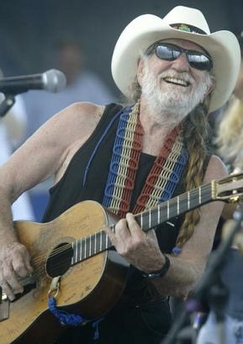
Willie Nelson & Bob Dylan-Live Review

Bob Dylan/Willie Nelson

Cedar Rapids, IA 07/09/2005

Bob Dylan twice in a year? Fuckin’ A. Only this time it’s in a minor league baseball stadium and this time, Willie Fucking Nelson is opening. Bobby, still hot on the tour that never ends supporting his latest album from Starbucks, decided to team up with another troubadour and smoke weed. I’m half kidding about the Starbucks thing. In all actuality, the release at the coffee chain is an essential night from Dylan’s youth, one that has been bootlegged repeatedly and is considered by some Dylanophiles as a crucial performance in Bobby’s career.
He didn’t perform any of that material on Saturday night in Cedar Rapids. Instead, he focused on a few staples from the ’05 tour and threw out a surprise acoustical “Tangled Up In Blue” as the first encore. Other than that, there were no real revelations that night other than the fact a twenty-something girl can still get drunk and fall down from heat exhaustion in the middle of a Dylan set. The paramedics came over, took her blood pressure and still allowed her to stick around until the end of the set. The same wasn’t true for three drunken saps that had to be escorted out of the ballpark by police. Whiskey river took their minds and the Cedar Rapids Police Department took their arm.
Willie did essentially the same set as the other two times I’d seen him. His son, a fucking incredible guitar player himself, did a nice Stevie Ray Vaughn cover and then Dad came back out to show him who pays the bills and has the best herb. Speaking of, rumor has it that the CRPD canine unit parked right next to Willie’s bus and that Mr. Nelson and company splitsville no less than ten minutes after their set was over.


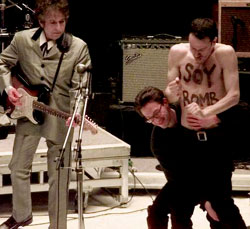
Bob came on after a quick stage change that basically consisted of hauling out the band’s vintage equipment and throwing up the badass Dylan logo over the back of the stage. During “Positively 4th Street,” Soy Bomb jumped up on stage and did a little dance.


The band’s eyes were glued on Bob throughout the entire performance and Bob uttered “Here’s another fucking song I wrote” before each number. Just kidding. But he did prove to be Mr. Sociable once again by failing to acknowledge the crowd even once during the entire performance. The '05 tour finds a nice addition with Donnie Herron on pedal steel which gave the songs a nice twang. Bob again stuck with his electric piano and harmonicas.
After a fucking smoking version of “Watchtower,” Bob met the band on center stage and clutched two harmonicas as the generationally diverse crowd applauded their approval. A park that traditionally houses America’s pastime decided to give the field to two of America’s own that helped change the face of our musical landscape. It was a nice doubleheader from a couple of road dogs that still have plenty of swing left in ‘em.

Bobby’s set:
Maggie’s Farm
To Ramona
Cry A While
Positively 4th Street
High Water
Highway 61 Revisited
Ballad Of Hollis Brown
Most Likely You Go Your Way And I’ll Go Mine
Just Like A Woman
Honest With Me
Girl Of The North Country
Summer Days
Encore:
Tangled Up In Blue
All Along The Watchtower

Saturday, October 30, 2004

Bob Dylan-Live Review

Bob Dylan & His Band
Carver-Hawkeye Arena, Iowa City, IA
10/29/04

It must be noted that if you’re considering an evening with Bob Dylan, don’t go with the expectation that he is obliged to give you anything more than a performance that allows you to be in his presence. He changed the face of music and that means he’s given you plenty, thank you very Goddamn much. Admittedly, The Rolling Thunder Review of 1975 was probably the last time Bob actually went out of his way to make a lasting live impression. Since that time, and especially in the past ten years, Dylan has settled into a role of the traveling troubadour, playing a selection of songs that include a few that just happen to be some of the most important lyrics ever created by a man.
Another important reminder is that Dylan’s voice plays a minor role in his career. It’s always been this way, of course, but it’s especially relevant now. His voice is fractured by cigarettes, a motorcycle accident, and this thing called life. I suppose one could argue that his phrasing is a critical piece to the lyrical genius, but I could argue that, in a live setting, phrasing also takes a back seat.
No. You’re there to pay your respect to the man. He knows it. You should too. He doesn’t owe you anything, and yet his most recent albums prove that he continues to produce challenging material with words that add to his already legendary gifts.
At the same time, I’ve got to believe that Dylan actually enjoys touring and performing live. After all, his 2004 tour started several months ago, brought him around the world and back in time to do it all over again. It’s not like the guy is hard to find: he played the Midwest just a few weeks prior to this late October gig and he continues onward to markets typically overlooked by even farm league performers. As I said, he’s a troubadour and he seems to have a desire to let everyone have an opportunity to see him in person just like Woody Guthrie did before him. It’s a nice role for him, and I wished that at least enough people recognize this opportunity to fill three quarters of the Carver Hawkeye arena.

Despite poor ticket sales, the Dylan faithful were present to pay their respects and hear some of his newer material and changing interpretations on the familiar classics. Who are the “Dylan faithful” these days? Judging by the audience demographics they include old hippies, Deadheads, intellectual types, Middle class baby boomers and the children of middle class baby boomers forced to attend the show with their parents because Mom or Dad bought them a ticket. Hey, it could have been worse: it wasn’t disturbing like the number of 7 year olds I saw with Dad at a Kiss concert several years ago. And while I’m confident that the children who attended Dylan on this night have less of a chance of growing up misogynous narcissistic pricks that spit blood from a demon costume, I don’t think there’s much chance they left the arena with a full appreciation of Dylan’s work.
First of all, undisputed classics that were performed like “Mr. Tambourine Man,” “Stuck Inside of Mobile,” “Highway 61 Revisited,” and “Tonight I’ll Be Staying Here With You” were so unrecognizable that in many cases it took some of the faithful a verse or two to figure out what song he was doing. Once they did, the faithful were then challenged by Bob’s rephrasing of it, causing many in the crowd who wanted to sing with the master’s words to become disoriented and resort to barking out lyrics before they actually left Dylan’s mouth. This happened to the middle aged guy who sat next to my friend. By the time of “Mobile,” he simply would preview each verse before it came, causing my friend to ask me in painful sarcasm “Do you hear an echo in here?”
But imagine for a moment that you’re Bob Dylan, The Man, and you’ve done a song like “Tambourine Man” thousands of times and you’ve heard from people how brilliant it is a thousand times, what do you do? You know you’re somehow required to examine it on stage once in an while, so why not chop it up, reheat it, and serve it up like a brand new dish? It’s his song after all. He can do with it whatever the hell he wants. Besides, it must get real annoying hearing people sing along with you after 40 years of touring.
The band took this material and his more recent songs and transformed them into a tight late 60’s country rock blend. Bob was dressed in a classy black western outfit and spent most of his time behind the keyboard with most of the band members watching his every move. Occasionally, Bob would break out the harp and serve up a dual instrumentation with the other hand on the keys. The stage was very basic with a curtain featuring the Dylan-eye logo as the backdrop for the first half of the songs and a plain white curtain the backdrop for the latter half. Even the band themselves seemed to complete the basic necessities look by having nothing larger than a combo amp for instruments. If the old fogies were worried about leaving the show with their ears ringing, Bobby made sure the mix was warm and clean with even his harmonica playing falling safely within OSHA noise standards.
What makes Bob Dylan “The Man” was his total ambivalence for the audience that evening. Throughout the set, Bob seldom looked at the crowd and didn’t acknowledge them once with words. The words from his songs were enough, and again, I think he was more interested in making sure that he had a good time rather than those in attendance. Dylan would move over towards members of the band every once in the while and tell them something, which I assumed might have been to add or change something to the night’s setlist.
One of the most annoying aspects of the show was with Bob’s delivery on several of the songs that evening. On five or more songs, Dylan would end the verse an octave higher than on the start. This created the impression of almost comical familiarity, which I’m sure wasn’t the intent. Actually, I’m not sure what the intent was, as the delivery created a blur between songs that were originally miles apart. There’s no reason for an updated version of “Make You Feel My Love” to sound the same vocally as “Tweedle Dee.”
Bob finally addressed the crowd during the encore, presenting the members of the band to the crowd and telling a joke about the drummer’s home state of Louisiana. This would mark the only time that he ever spoke to the crowd or face them. It should also be noted that those unlucky ticket holders on the left side of the arena saw nothing but the back of Bob Dylan up until that point as he rarely left his keyboard and, as mentioned, didn’t bother with any form of eye contact with the audience.
The encores, which remained the same tonight as they did on other dates of the tour, were the classic one-two punch of “Like A Rolling Stone” and then a nice jammy version of “All Along The Watchtower.” And just when the guitarist started to get some fires going with the Deadhead contingent, the show ended. A true Dylan faithful probably expected it while a casual fan probably left feeling either a little disappointed or understanding given the performer’s age.
But Bob doesn’t continually tour because he needs money or wants to somehow connect with his fans. He does it because, I think, he actually enjoys hanging out with the boys. There were times when I felt I was watching a rehearsal or watching a group of talented musicians devotedly backing a legendary icon. This isn’t a slag on the performance by any means, but one clearly has to approach a Bob Dylan concert nowadays with an understanding of what to expect. You’re there to be entertained to some extent, but entertainment has never really been a part of Dylan’s career. What brought him attention is the same thing that helped changed the course of rock music and made it a legitimate art form: his words. We were there to acknowledge this, to pay respect, to honor a man from Minnesota for the contribution he’s made to music. If Bob happens to enjoy himself performing live and living the life of a traveling troubadour, then we ought to respect that and grab at least a few opportunities to see how he’s going to present his art to us. After all, we don’t know how many times Bobby will be able to keep revisiting Highway 61.

Setlist:
To Be Alone With You
Tonight I'll Be Staying Here With You
Tweedle Dee & Tweedle Dum
Mr. Tambourine Man
Cold Irons Bound
If Dogs Run Free
Stuck Inside Of Mobile With The Memphis Blues Again
Love Sick
Highway 61 Revisited
Make You Feel My Love
Watching The River Flow
Honest With Me
Standing In The Doorway
Summer Days
(encore)
Like A Rolling Stone
All Along The Watchtower