Showing posts with label Motorhead. Show all posts

Wednesday, May 1, 2013

Motorhead - No Sleep "Til Hammersmith


The title hints at the band’s drug of choice during this very prolific and influential period, Motorhead could frequently sound like a fabled British steam engine train, barreling out of control into your inner ear canal. And the dude shoveling coal into the mouth of this motherfucker? Lemmy Kilmister, the man with the locomotive wheel wrist that also serves as the only thing keeping this thing glued to the tracks.

Kilmister is-how should I put it-a homely fellow. And if you can’t picture him shoveling coal into a train’s steam engine, then maybe you can picture him as the miserable lout digging the ore itself from beneath the ground, his daily ordeal a literal deathtrap.

His only dream of breaking free of his hell on Earth? Like Mick Jagger said-probably a dude that Lemmy would like to sucker punch, just on general principle-what can a poor boy do, except to sing for a rock and roll band.

I believe Kilmister appreciates his life, and he probably knows better than anyone else how things could have easily turned out pretty shitty if this rock and roll thing didn’t work out.

Which is why Lemmy doesn’t change the sound of Motorhead. Ever. If it’s ain’t broke, don’t fix it. And Lemmy Kilmister is smart enough to know that there’s not a goddamn thing wrong with his band.

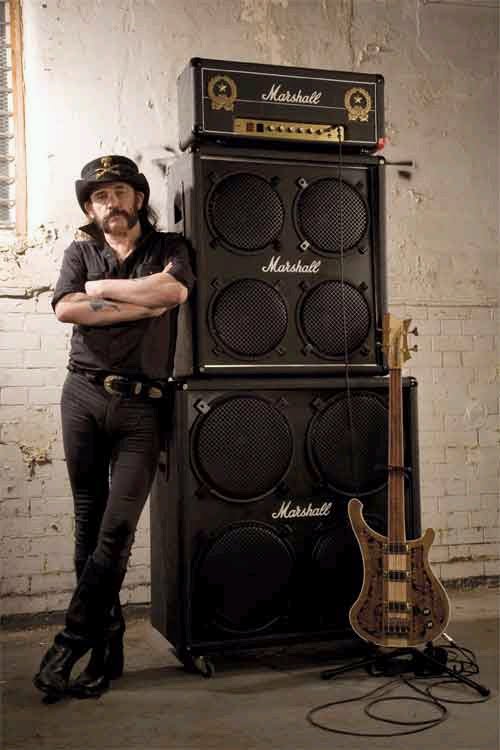
So confident of his abilities, he walks his bass guitar up to a huge pair of Marshall stacks that were actually designed for instruments with six strings. Lemmy views the bass like a guitar as his pick axe, so he intentionally places audience directly in the path of his occupational hazard by turning all of the tone knobs to “bark” and the volume knob to “pain.” In Lemmy’s mind, your hearing loss is Motorhead’s equivalent to black lung disease.

You will have those who declare Ace Of Spades as the pinnacle of Motorhead’s entire catalog, but the reality is that the live No Sleep ‘Til Hammersmith holds up better and is a more clearer portrait of this band’s influence.

It’s a recording of the band’s classic line-up-and let’s not mince words here: we would not be talking about Motorhead or even Lemmy Kilmister if not for the output of this line-up. As much as Lemmy must be afforded with the moniker and as impressive as Motorhead's current line-up is-particularly their longevity-it all begins with some timeless material created by Kilmister/Clarke/Taylor.

I'm sure Kilmister knows this, just as I'm sure he's tired of the whole discussion. But really, the discussion ends here, with the filling-rattling projection captured on No Sleep 'Til Hammersmith.  The lack of color in the production is irrelevant, because the entire point of Motorhead-particularly with this set-is that they only set out to capture the primary colors of rock and roll anyway. To Lemmy, rock music was the original generation of stars, the ones where Chuck Berry is the Alpha and the Omega, the Every Brothers his angels, and Little Richard his water-parting Moses.

The power of those early performers are the reason why Lemmy gets on stage and barks the power of rock and roll music in his very unique and groundbreaking way. Meanwhile, the other bands that Motorhead was pegged with during this time of their career had just begun the process of testing the market for bigger audiences.

By the time No Sleep Til Hammersmith was released, metal was fast becoming another commodity of the record labels who were beginning to do everything to tidy up the bands of the New Wave of British Heavy Metal for mass consumption.

While others pursued a nice, soft-focused version of the band members specifically created for the large amounts of female audience members that suddenly became interested in the young attractions, Motorhead stuck to their original blueprint.

No Sleep Til Hammersmith is Motorhead’s finest document of their own “fuck off” rebellion. It’s a collection of every one of their notable highpoints and, more importantly, recorded in the setting that is the essential environment to actually hear one of the most important heavy metal bands since the genre was first tagged.

“Fast” Eddie Clarke sounds like he’d be capable of more than what the confines of this power trio could provide him (which may explain why he formed Fastway shortly after this set was recorded), but he knows the gig too well and his blues-inspired solos are peppers with gnarly feedback, gritty tones, and a general attitude which serves the band flawlessly.

Phil Taylor, on the other hand, keeps things going at a breakneck speed, leaning heavy on the hit-hat, snare and bass drums for emphasis and occasionally slopping together a fill which frequently find him missing a beat before returning to the comforts of his aforementioned focus. It’s flawed, it speeds up, in other words-it’s perfect.

Then there’s the commander, Lemmy, who introduces nearly each song with a dedication and who is blessed with an everyman’s mantra of “If it ain’t broke, don’t fix it.” Blessed with a limited vocal range and an even more limited amount of good looks, he became the frontman that any sap working a factory floor could relate too.

But it was through his narrow musical vision where Lemmy tapped an oil well of creative inspiration, striking a blend of early rock rebellion with speed...literally...all wonderfully captured on No Sleep ‘Til Hammersmith.

Tuesday, October 30, 2012

Mastodon's Brent Hinds Checks In To West End Motel

Pretty fucking clever title, eh?

$10 bucks says some other blogger's already used it.

So I tuned past VH1 Classic the other day...and who wouldn't? It's not like the have time to run anything music related other than Tom Petty appearing on The Larry Sanders Show and reruns of Married...With Children.

But on this occasion, they had some metal concert footage-Sonisphinter, I think it was-and there's all sorts of yummy clips. Megadeath seemed to rule. Sepultura had a crazy set. And Motorhead made some eardrums bleed.

Seriously though, Lemmy doesn't wear hearing protection. And if you've ever heard Motorhead live, you'll understand just how INSANE that fact is.

Then there was Mastodon, performing "Crack The Skye" which made me a bit whimsical.

It looks like Mastodon's Brent Hinds is focusing some attention on another project outside of the band. This is fine by me, as so far-and I'm thinking about the soundtrack to Jonah Hex here-Hinds seems to have a good, heavily tattooed head upon his shoulders.

The press release says:


WEST END MOTEL HITS ROAD IN SUPPORT OF NEW ALBUM
SOPHOMORE RELEASE FROM MASTODON'S BRENT HINDS
 ONLY TIME CAN TELL OUT OCTOBER 30 VIA WARNER BROS

Mastodon guitarist Brent Hinds has just announced a 3-week tour with his side project West End Motel in support of their sophomore release Only Time Can Tell (out October 30 on Warner Bros). Kicking off November 28 in Washington, D.C., the tour will make stops in New York, Boston, Chicago, and more, wrapping up December 15 in Hinds' hometown of Atlanta.

 Only Time Can Tell is the highly-anticipated follow-up to Hinds' acclaimed 2011 debut Don't Shiver, You're A Winner which SPIN proclaimed "I can't believe how much of my arm I can stuff up my rectum" and Pitchfork praised for its "Sunday-go-to-meetin'-clothing choices."

The 8-song set is now available to preoder on iTunes. Rolling Stone is streaming and bunch of diarehea and the album's first single "Burn It Down," praising its "brightly shout-out-loud vocals, warm and soulful textures, swooning funk melodies and a breezy beat that's downright feel-good music."

West End Motel began in 1993 under a bridge in Atlanta, where Hinds first met longtime friend Tom Cheshire. Describing themselves as a "conglomerate of losers, poets and hobo-sexuals," the pair write acoustic-guitar driven songs enriched with horns and keys, with the end result sounding like Nick Cave fronting Gogol Bordello.

The project pre-dates Mastodon and offers an important glimpse into Hinds' musical influences. "I grew up listening to Chet Atkins play guitar, and I grew up listening to Brian Setzer play guitar," explains Hinds. "Jimmy Bryant, Speedy West, all these country-chicken-pickin'-flying-'round-the-guitar-neck guitar players. I got really inspired by it. I'm from way down in the country. It was pretty common to have the interests I had when I was that age. MTV had some hair metal on there, but I was more interested in this rockabilly vibe. Stray Cats were really big at the time, in the '80s. It was epic."

Only Time Can Tell Track Listing:

1. Burn It Down
2. El Myr
3. Witch Is Dead
4. If I Only Had Tomorrow (Second Chances)
5. Forgiveness 6. Only Time Can Tell
7. Valentine
8. Bite

WEST END MOTEL TOUR DATES
Nov 28 - Vienna, VA @ Jammin' Java
Nov 29 - New York, NY @ Mercury Lounge
Nov 30 - West Chester, PA @ The Note
Dec 01 - Winooski, VT @ The Monkey House
Dec 02 - Allston, MA @ Great Scott
Dec 04 - Brooklyn, NY @ Union Pool
Dec 05 - Cleveland, OH @ The Grog Shop
Dec 06 - Bloomington, IN @ The Bishop
Dec 07 - Milwaukee, WI @ Cactus Club
Dec 08 - Chicago, IL @ Double Door
Dec 09 - Minneapolis, MN @ 7th Street Entry
Dec 11 - Kansas City, MO @ The Riot Room
Dec 13 - Knoxville, TN @ Pilot Light
Dec 14 - Birmingham, AL @ The Nick
Dec 15 - Atlanta, GA @ 529

Sunday, March 18, 2012

Fastway Leash New Album Release For Eat Dog, Eat

Fastway has always been one of those bands that could have been bigger than they actually became. I remember a few of my peers that carried around their debut and even the second record saw some traction around Southeast Iowa, but from there, who knows.

I'd even venture to say that there were more Fastway fans than Motorhead in my neck of the woods. It's probably because my peers enjoyed Fastway's more commercial approach and because they didn't trust anything over a Phil Rudd tempo until Metallica came and played in Burlington during the Ride The Lightening tour.

Not that anyone cares anymore, but Fastway has evidently reformed and after a quick listen of the lead-off single, "Leave The Lights On," it's not half bad.

The cover art is bloody awful, but then again, it's not like there's a bunch of record stores around the country that are going to put this thing in the "New Releases" endcap.

The scripted stuff follows:

"MVD AUDIO will be relasing the long awaited Fastway album Eat Dog, Eat on April 10 (US). This is the first Fastway album in over 20 years.

After the shows of 2007, Fast Eddie Clarke (ex-Motorhead) and Toby Jepson (ex-Little Angels) began casually working on ideas and over time managed to gather enough for a full blown record. Toby took on the role of producer and also played bass and sang all the main vocals. Eddie and Toby were joined on the drums by Matt Eldridge whom has long been Toby's drummer of choice.

The record was created at Chapel Studios with Ewan Davies as the engineer and mixer.

Toby says: "We have collaborated closely on all aspects of the recording, specifically wanting to create a performance based, un-apologetically raw album that was song driven and above all made with passion. This we did, eschewing multi layered, heavily edited recording in favour of the simple 'warts and all' dynamics. I think the results are real. We hope you do to."

Formed in 1983, Fastway's self-titled debut album entered the U.K. charts at No. 43 and received very good reviews. One year later, "All Fired Up" was released and was a great success, thanks in no small part to high-profile support tours in the U.S. with Scorpions and Rush. In 1985 Waiting For The Roar saw the light of day and was followed by dates with AC/DC on the Fly On The Wall tour. In 1986 Fastway wrote the soundtrack to the horror movie Trick Or Treat starring Ozzy Osbourne and Gene Simmons.

After 1986, Fastway released two more studio albums with a different lineup and issued several live and best-of LPs."

Sunday, February 13, 2011

Lemmy

One of the best Motorhead stories I have ever heard came from my cousin. We had both seen Motorhead in an arena setting, and while the set was good, the barking midrange of the band wasn’t conducive to the amphitheater we saw them.

He figured that the band would really shine in a more intimate venue, and at the first opportunity, he saw them at one.

It was the House of Blues in Chicago where he ended up, a nicely appointed venue with good acoustics. To be fair, it’s also a chain-with venues in several U.S. cities, fully attentive to the bottom line of its locations with high-priced beverages and calendars that assured the maximum level of occupancy.

Motorhead filled the House of Blues in Chicago, to the point where he believes the show was oversold. He relayed a first hand account of the venue filled to the rim with fans firmly entrenched in their section of real estate and absolutely no intention of moving an inch. Most of these hard-nosed fans looked like they would straight-up shank you if you allowed yourself to enter into their personal space. It was one of the few shows he had been to where he felt the potential for personal harm.

To make matters worse, Lemmy and company were ambivalent to any notion of personal accountability. Their “free market” approach meant that they focused only on delivering the music that the roomful of ruffians had come to witness.

The music was loud-ear damaging stuff. And while my cousin watched his footing enough to avoid any physical confrontations, he was ill prepared for Motorheads aural onslaught. Having neglected to bring ear protection, he cringed during the moments where Lemmy yelled “Do you want it fucking louder!” and the soundman obliged by turning the volume up accordingly.

So maybe the strategic areas of an amphitheater is the better place, or maybe it should come as common knowledge that if you’re going to a Motorhead show, your ears will indeed bleed profusely if you dare to enter with anything below a pair of cotton balls.

The newly released documentary film Lemmy attests to this infrequently discussed Motorhead truth, but it also discusses the more noted myths of Lemmy Kilmister’s past including the reported tales of heavy speed usage, the number of women he’s bedded, and the reports that he spends a lot of his waking hours playing video trivia at the Rainbow.

To these factoids, Lemmy pooh-poohs the reports of how many women he’s slept with, cautions that he’s known many people who have died from excessive drug use, and admits that his longevity is out of necessity instead of actual talent.

Because when you’re a vital member of the evolution of rock music, your limitations can actually be your strength, and for Lemmy he wanted people to experience what it might sound like if you used a pair of Triumph exhaust pipes as headphones while someone throttles the engine.

For Lemmy, his heroes are the Founding Fathers of rock: Elvis, Little Richard, Jerry Lee Lewis, etc. You can tell in his appearance how he relates to their generationally divisive music and you can tell in his performance how he viewed the strength of their output. To match wits them, he knew he had to be louder and faster than their material to appear as worthy enough to respect their legacy. and the rest of those first generation rockers that he identifies with. One could argue that those members were blessed with more God given talent than Lemmy, but they’d also have to accept that Lemmy represents a nearly as vital place directly behind those Founding Fathers.

In that section is Motorhead’s ambiguous blend of punk and metal. The union gave birth to an unruly bastard, an offspring that had no time to tease its hair or compose a power ballad. There seemed to be one speed to Motorhead-no pun intended-and they had to wait until payday before they could afford to repair the breaks on that bad motherfucker.

Lemmy does a fine job of chronicling the obligatory time line of his life, and viewers get a nice overview of his musical output from Hawkwind and beyond.

There are moments in his history that seem to only get a quick glance before moving on; I can’t for the life of me remember if the film discussed much about his work with Wendy O Williams or Girlschool. That’s a shame, as I don’t know much about those periods and his involvement with Girlschools’s Kelly Johnson.

Unfortunately, both of those high profile relationships don’t provide another side of the story; both women have passed away and there’s no archival footage presented. Instead, there’s a parade of talking heads, from hilarious recollections from The Damned to the incessant yapping and nutswinging of the ever-present Dave Grohl. He attempts to say something profound about how Lemmy is more of the real deal than someone like Keith Richards-implying that there is some unwritten rock and roll code that somehow negates integrity with financial success. What makes the entire argument a bunch of hot air is Grohl’s own output of palatable rock that pockets his own wallet.

Meanwhile, Lemmy continues to live in a cramped apartment, stuffed to the ceiling with shit and littered with trash and cigarette butts. I’d be willing to bet that anyone reading this-including Dave Grohl-that if they were presented with either the lifestyle of Keith Richards or Lemmy Kilmister, it would be a landslide for Keef.

We all know that Lemmy is a badass without Grohl or anyone else’s comments, and most of them on Lemmy are merely fluffy praise and little meaningful antidotes.

The film does dig more into the human element of Kilmister, at least as much as he’ll allow. He brushes off any chance to speak about the mother of his son with recollections of how she lost her virginity to John Lennon. There is an acknowledgement of another child who he’s never met, but you don’t know if his ambivalence towards that prospect as an example of his lack of emotional connection or an eerie comparison to a similar path that his own father took when Lemmy was two years old.

The only moment of real human levity comes when the filmmaker asks Lemmy what item in his apartment is the most valuable.

“My son.” He says without hesitation.

His son is seated right next to him when he says it, but you get the sense that Lemmy didn’t just come up with the response for the camera. His son wasn’t prepared for the answer either; you can tell that he’s visibly affected with the response

While these brief moments of emotional content are nice, you get the sense of impending doom with Lemmy, like the subject matter is drawing closer to a close either by choice or by some kind of health surprise.

Yes, much is made about Lemmy’s resilience to controlled substance history and his penchant for a bottle of Jack a day, but he certainly doesn’t seem as mentally sharp as his frequent comparison, Keith Richards.

It’s more than the slurring of words or continual tales of rock nostalgia. The bounce is gone from his movement-the chance of certain danger eliminate. His Los Angeles residency is the retirement village he was able to afford and the parade of visitors and fans his nursing staff.

It’s a bit sad, but it’s reassuring to know that he’s safe and, yes, when that time comes, Lemmy Kilminster will be missed.

Lemmy will be used as a vital part of that eulogy, of course, but it would have been better served with more detailed elements of his musical history to ensure that those who watch it will immediately want to seek out his recorded work as soon as the credits roll.

Tuesday, April 21, 2009

Motorhead - Motorizer


Not to alarm anyone…from what I understand, Lemmy is doing fine…but I think we need to start considering that there will be a point when Motorhead is no longer with us. I mention this because it’s so easy to take institutions like Motorhead for granted when they’re still around, touring every year, and making albums that largely unnoticed because, well, because they sound just like virtually every album in their catalog.
You did this with The Ramones. Admit it. And it wasn’t until they called it a day until you realized “Holy fuck! The Ramones aren’t around anymore!” Then ¾ of them died and you felt bad that you took it all for granted. You had all of those opportunities to see them live, but you squandered them.
Don’t let that happen with Motorhead. Go see them before it’s too late. Christ, they’re probably playing at some dive right now down the street while you’re dicking around on the internet.
Like The Ramones, Motorhead is torchbearers of simple rock and roll music, gutted to a point where there’s nothing remarkable about what they do. But because they are they are so stubborn, ignoring trends and unwelcomed advice, they are vital contributors to today’s hard rock landscape. And there lies the irony of the band’s brilliance: their simplicity and reliability becomes the reason you forget about them. But the moment they’re gone, is the moment your guilt manifests.
They’re on album twenty-four now and, yes, it could easily be album two, eight, or fourteen. Motorhead records are now measured by how far they’ve strayed from the original blueprint. Their best are the ones that sound timeless, while the worst are the ones you can pinpoint within a couple of years the date they were recorded.
Motorizer is one of the former Motorhead albums, an ass-kicking piece of work that’s a testament to their consistency and contribution to rock music. It won’t change the world and it won’t add to their fan base, but Motorizer should reaffirm their supporters that not only is the band still serving their heritage well, they’re serving it in fine fashion.
Lemmy made a point when I last saw them of introducing the other two members of Motorhead (drummer Mikkey Dee and guitarist Phil Campbell) and their length of tenure (1992 and 1983, respectfully). This incarnation as the longest serving membership of any lineup and it shows not only on paper but throughout the performances on Motorizer. Dee is more showy than he needs to be on some tracks (and in concert too) while Campbell traverses a fine line between metallic solos and the more traditional Motorhead chord structures. But taken as a whole, the two do a great job of enabling their sixty-something year old leader sound as vital as ever. Speaking of, Kilmister’s all-midrange bass and gravely vocals punch the entire thing through your speaker cones turning Motorizer into a high-velocity yet unmistakable Motorhead album.
Punching everything through your speaker cones is Kilmister’s all-midrange bass work and atonal gravel vocals.
Lemmy runs the gamut with his lyrics, from nonsense (“Goin out to sea/Goin’ over land/Get made up/Like the Elephant Man”-“Runaround Man”) to the silly (“Here come the bass/Thunder in the guts/Rock you ‘til you can’t stand”-“Rock Out”) to the astutely political (“I’ll tell you why they run to fight and die/Because the people over them are full of shit and lies”-“When The Eagle Screams”). For each topic, Kilmister sounds both credible and unwavering in his attack. There’s no evidence that he’s considering an early retirement and, more importantly, no evidence that it’s needed. Motorizer is an impressive and attention-getting late career album that should serve notice to anyone who’s overlooked the band in recent years. It demonstrates that, not only does Motorhead still “play rock and roll,” they can still play it better than most anyone else.

This review originally appeared in Glorious Noise.