The logical explanation for why The Cars debut album is so good falls under the “A band has their whole life to make their debut album” claim, with the understanding that it takes some talent, of course, for said debut to be worth anything.
With Ric Ocasek handling a big portion of that talent quotient, and the fact that The Cars only featured 9 tracks to begin with, there would have been enormous expectations for their sophomore album. I mean, if it took the band’s entire existence to come up with those nine songs, you’d have to believe that they left a few behind for future releases that were just as good.
Candy O proved that Ocasek and company indeed had plenty of material in the can and in the works that rivals the high benchmark of their debut.
The only disappointing thing about it is the fact that it’s oftentimes overlooked by the AOR saturation of the first album which has-at least at the time of this writing-continued to overlook the treasures found in Candy O.
It’s a different album, for sure, but one where the difference is in song structure rather than quality. Candy O is a decidedly more pop affair, a direction that keeps the material tight and infectious. The songs are quirky at times, and producer Roy Thomas Baker doesn’t layer the selections with saccharine. In other words, there is plenty of tracks here that could have found a home on rock radio right next to “Good Times Roll” or “Just What I Needed.”
It begins with the obvious single “Let’s Go,” a weekend jump-start praising the attitude of what seems to be a young woman who’s not interested in one night stands (“When I asked her before/She says she’s holding out”), but merely to enjoy the freedom of the nightlife, baby.
This killer piece of radio friendly gold kicks of a stunning first side which runs the gambit of more pop gems (“It’s All I Can Do,” possibly my favorite Cars song sung by Benjamin Orr), a brief foray into Ocasek art rock/electronic pose (“Shoo Be Do”) and a mysterious bit of hyperactive rock for the closing title track.
That same rock, nicely decorated with Elliot Easton’s succinct guitar work, opens up side two with “Night Spots,” a more aggressive alter-ego to side one’s other ode to nightclubbing. It’s a less jovial too, as Ocasek’s lady seems to have more of a death wish, offering how she “keep(s) it cool when its t-t-tight/Eyes wide open when you start to fall.”
Ocasek saves his best for last in “Dangerous Type” a bit of T-Rex staggered guitar over Ric’s flair of cryptic back and forth (“How can I touch you/When you’re out of touch”). It’s a perfect way to end a nearly perfect album.
By my count, only one track, “Lust For Kicks,” is the weak link in the chain, but not by much. Even by the standards imposed by The Cars’ debut, Candy O sounds like a nice move forward without sacrificing quality control to the point where this sophomore effort shouldn’t be in every rock fan’s collection right beside their first record.
If I recall, some random photo popped on the intertubes, an older set of Cars in close proximity of each other. Some hint of a reunion, people claimed.
But all I could think about was Ben.
Can you really have a Cars reunion without Ben?
I supposed it’s better than The New Cars, or any of the member’s solo albums.
Hell, even The Lace blew-just to show you that I’m not all nostalgic for Benjamin Orzechowski tunes ‘n shit. Before he died, he toured the fairs with “Orr,” a ridiculous outfit named from his Anglicized surname-like he was some kind of Van Halen, Bon Jovi, or Giuffria.
I’m kidding. I’m only trying to say that Benjamin Orr’s voice was a critical component to The Cars sound, and I’d venture to say that most of my favorite Cars songs were the ones sung by him.
I get that Ocasek is the frontman, in nearly every sense of the word-but he sure as hell didn’t have Orr’s golden throat.
So strike one and two against the new album the remaining Cars members are getting ready to unleash a new record-their first in over two decades-but don’t think that I’m about to suggest that a new record without Benjamin Orr will tarnish their legacy.
Because their legacy is already tarnished a bit. If it weren’t, then this type of announcement would have been delivered with the fanfare of, say, Motley Crue appearing on Larry Fucking King to promote the fact that the original band had gotten back together.
And even that announcement was actually their second reunion announcement within 5 years of the first one!
The Cars is a classic, and I’m working on a review that suggests Candy O didn’t fall to off-course from the first record. Panorama is where things got conflicted, but I sure as shit enjoyed the results. I’d call Shake It Up or Door To Door their worst, with Heartbeat City getting a pass because 1.) It was huge and 2.) It contains possibly the only supporting argument in their quest for commercial appeal, the lovely “Drive.”
It may be the weepy nostalgia talking here, but “Blue Tip” is sounding better than anything off of Shake It Up or Door To Door-which isn’t that hard to do since both of those albums blew, clouding up the clear understanding that these chowderheads knocked out a pair of masterpieces right out of the gate.
You know why you can’t actually see them in the video? Because The Cars are now so hideously old that by showing them in the flesh would ruin their credibility as music video icons.
Of course, Ocasek has always been a weird looking fellow anyway, as was Greg Hawkes. And that sure as shit looks like a lefty playing guitar, so save up your nickels this time, Elliot.
And be still my beating heart, could that really be David Robinson on drums? From what I heard, David was the toughest one to convince to come back. Let me just say that this tune would have been TONS more compelling if they just rigged up his old kid and yelled at him to “Play like a robot!” because that snare/hi-hat beat that Robinson is known for is one of the primary reasons why those first three records of The Cars outrank anything else they provided.
I made a note to remind you wonderful music freaks that the awesome Low are back with a new album, and for some strange reason, they invited John Stamos to the party. That's right, the Full House dude who may be the only person who can claim Mike Love as his Broseph, has found his way into fairly relevant video for us slowcore fans who actually lived down the road from the City of Joeseph.
The record label spiel begins now:
C'mon, the shortest title of any Low album to date is officially available on CD/LP and digitally, as of yesterday April 12th.
Comprised of new material written on and off the road, this ten-song set was recorded in a former Catholic church, aka Sacred Heart Studio (where the band previously crafted 2002's Trust) and co-produced and mixed by Matt Beckley.
Yesterday, ET premiered the video for Low's ”Try to Sleep” which features actor, John Stamos.
This is what Stamos had to say about how he came to be a part of the video:
"I'm actually good friends with their producer Matt Beckley, and he had played me some of the record while they we're making it, which I loved. Ironically it turns out I was a big fan of one of their older songs "Cue the Strings"... I'm a sucker for a well written song with great harmonies, and when it came time for them to cast the video, they asked if I'd like to be involved, I liked the concept I was happy to be a part of it. The new record is on all the time at my place. One of my favorite indie bands."
Low will begin a tour tomorrow, Thursday, April 14, in their hometown of Duluth, MN, with a very special in store on Saturday April 16 at Electric Fetus in Minneapolis, 4:00 pm, in honor of Record Store Day 2011.
Those of you on the left coast, fear not, the band have just announced a slew of West Coast dates in early September, playing shows in such cities as Seattle, Portland, San Francisco and Los Angeles.
04/14/2011 Harbor City International School, Duluth 04/16/2011 Electric Fetus In Store for Record Store Day @ 4:00 pm 04/16/2011 First Avenue, Minneapolis 04/20/2011 Majestic Theatre, Madison 04/21/2011 Lincoln Hall, Chicago 04/22/2011 Headliners Music Hall, Louisville 04/23/2011 Andy Warhol Museum, Pittsburgh 04/25/2011 First Unitarian Church, Philadelphia 04/26/2011 Black Cat, Washington 04/27/2011 Bowery Ballroom, New York 04/29/2011 Paramount Center, Boston 04/30/2011 Daniel Street, Milford 05/02/2011 The Mod Club, Toronto 05/03/2011 The Blind Pig, Ann Arbor 09/10/2011 The Aquarium (Dempsey's Upstairs), Fargo 09/15/2011 The Rio Theatre, Vancouver 09/16/2011 Neumos, Seattle 09/17/2011 Aladdin Theater, Portland 09/19/2011 Great American Music Hall, San Francisco 09/20/2011 El Rey Theatre, Los Angeles 09/23/2011 Velour Live Music Gallery, Provo 09/24/2011 Bluebird Theater, Denver
There’s a scene in the movie Wayne’s World where Wayne is with the character played by Tia Carrerra and they’re playing around in her bedroom/loft. He finds a stray copy of Frampton Comes Alive! and makes note of it.
I’ll paraphrase the scene: If you lived in the suburbs, you were automatically issued a copy of Frampton Comes Alive!
I love that line because it’s true.
Frampton Comes Alive! is one of those records that’s synonymous with everything that’s good and bad about the music of the seventies. Its presence was so widespread that it does seem like every home in the suburbs came equipped with one copy along with the Joe Namath Butter Up Popcorn Maker, a Merlin, and a Fonz “Sit on it!” t-shirt.
It’s the album that turned me into a Peter Frampton fan overnight, along with the rest of the United States. Most of us had never even heard of Peter Frampton before that record, even though he was member of Humble Pie-a fairly popular touring outfit of heavy blooze rock and too tight denim.
Frampton left the Pie and sought out fortune on his own. With several solo albums under his belt, Pete sold his wares on the road, building a small following but essentially was still a minor act in the scheme of things.
A lot of those early solo records had some decent material, but sounded stiff and watered down in the studio. Some genius-and I say that in all seriousness without a hint of irony or even knowing who the person might be-thought it would be a good idea to capture a Pete Frampton show and collect all of those decent songs from those albums that he’d released up to that point.
Whatever the reason for this decision-a final contract obligation to fulfill with the label or the realization that Peter’s material just seemed to sound better in a live setting-more people related to that double live record than anything else he’d released.
It was a double album with a gatefold sleeve, the kind that people joked about how they would use the open cover to roll joints on. I was too young to use it for something that elicit, so instead I would put on the record and intently study the cover. Fold it out, and you’d see Frampton bent at the knees, mouth open, as he appeared to be in mid-guitar solo. Inside, shots of the other musicians in action, giving the record a larger than life feel.
I probably should gleam to bright about my fan-boy devotion of Frampton, because while I was collecting bits of his older material (Frampton and Frampton’s Camel) he was recording the God-awful follow-up I’m In You and completely defacing The Beatles with the movie (and soundtrack) Sgt. Pepper’s Lonely Hearts Club Band.
All of this came in the wake of Frampton Comes Alive! though. It’s doesn’t reflect anything negative about that album and upon a recent re-examination of this live recording, I found it to hold up surprisingly well and to be a great document of Frampton’s work and the notion of a live album itself.
Sure, there were live albums before it (including his old band Humble Pie’s first hit Rockin’ The Fillmore) but the out of control sales of Frampton’s record made a double live record an obligatory part in every major band’s career.
You could even make the argument that it initiated the entire arena rock genre, the influx of one-named bands like Journey, Styx, Kansas who’d release a ten-song lp and hit the ice arenas in markets across the country like a longhaired circus.
You could also say that Frampton’s entire career is based upon that weird sounding device called the Talk Box, a nifty device that he used for not one, but two of his most popular songs on that record.
In the end, neither one of these speed bumps of uncouthness can negate the fact that Frampton Comes Alive! is a splendid document. The musicians are tight, the set list nicely tempoed, and even the audience seems wonderfully inebriated. One of the moments on the album that always intrigued me was when someone sets off a firecracker during one of Frampton’s acoustic songs. For a kid not yet in puberty, it made the whole notion of a rock and roll concert downright dangerous.
Looking at it now, Frampton Comes Alive! seems innocent enough. It also seems like a record that couldn’t be made today-not to suggest that it’s sonically tied to a particular era. It isn’t; all of the instrumentation is clear and intricate. But in this day of hyper-compressed signals and tin-eared delivery methods, Frampton Comes Alive! possesses such a natural authenticity that it sounds positively novel.
The brilliance is in how subtle Frampton and the band transition between singer-songwriter folk to melodic pop rock to hard rock anthems. It all sounds legit, and it sounds like they’re all having a ball too.
No wonder the kids used the gatefold cover for other purposes besides reading the liner notes.
After soiling the Stooges name with The Weirdness, Iggy brings James Williamson out of musical retirement for a final injection into Ig’s 401K plan before heading to Florida full time.
And to be honest, I’m so ready for him to retire that it’s scary.
I’m finally at a point where so much shit has clouded his career that I’m having a tough time justifying sticking with him this long. I hold similar resentment with Lou Reed, but Iggy still had the ability to deliver a strong punch live.
I was intrigued by the notion of a Williamson/Pop reunion with an obligatory run through of Raw Power and, by default, the promise of a live recording of that album by these much older comrades.
To call the results less than worthy because of the band’s collective age is not fair: Mike Watt still plays like a kid in the candy store and James Williamson sounds like he’s having a blast. The moment you hear him in the opening track-slightly off thanks to a revamped track listing-you’ll hear how seems to be making up for a quarter-century of silence with a punishing tone.
The problem here-as it was with The Weirdness-is Iggy, and yes, you can attribute it to age. As fuck-it-all frightening as he sounded on the original, he sounds winded here, hoarse from the years and content with letting the bite of his delivery be reduced to a bark.
On “Shake Appeal,” he’s completely drained, spewing out syllables that barely manage to stay in time. Actually, that’s better than Rock Action’s plodding timekeeping on “I Need Somebody” which slows Ig to a point where he sounds more like On Golden Pond era Katherine Hepburn than the Grandfather of punk.
At the end of “Death Trip,” Iggy yells “That was fuckin’ Raw Power....Turn on the lights and gimmie some fuckin’ air!” It’s almost sacrilegious how-after this album was originally released-Iggy famously invited the audience to throw shit at him before bragging at how much money he was making for the gig. Compared that to now, where Iggy’s asking for fucking oxygen while keeping mum on what’s obviously a bunch more than the 10K figure he was tossing around on Metallic K.O. Admittedly, I’m getting way too worked up on what is merely a limited-edition ploy at getting record buyers excited for Record Store day. And when you consider the amount of endless garbage that has turned Raw Power outtakes into a cottage industry, I shouldn’t put Raw Power: Live In The Hands Of The Fans on too high of a pedestal.
I only do because the original Raw Power is still a critically important album for me personally. Even the rawer-Raw Power mix is a bit weird to me. So if you’re making a claim at over recreating only the most decadent glam-rock album ever made, then you shouldn’t subject even a limited run document with such bullshit like fade outs after every tune, sub-par performances, and an aged frontman who’s no longer able to will his body to sound younger than it really is.
About three songs into Godspeed You Black Emperor’s set at the Metro in Chicago last Saturday night, I felt a polite tap on my back. I turned and noticed a pair of small women looking at me, wide-eyed and smiling. I took out my ear protection to hear what one of them was saying.
“We’re really, really short and we can’t see the stage. Would it be possible if we could squeeze up to the front so that we could see?”
I thought about the request for a moment, considering what a good dead that I would be providing the young women.
Suddenly, I smacked some sense into my head.
“No thanks,” I replied “I’m good.”
They took it surprisingly well, but I’m sure they had some choice words for yours truly later on.
You don’t go to a restaurant and ask someone sitting at a table if you can sit with them because you don’t want to wait for a seat, do you?
Of course not, so I struggled with their attempts at weaseling their way in front after we had dutifully arrived on time to secure our spots early to get a closer view at a band that’s notoriously faceless while also being woefully absent for the better part of a decade. Now that there was an opportunity to see Godspeed You Black Emperor recreate their audio maelstrom in the flesh, there was no amount of eyelid fluttering that would prompt me to move my frame for an even worse view.
We suffered through Canadian opener, Eric Chenaux, a gentle and acoustic performer who also sported a few guitar pedals that he could play over a created drone or loop. At one point, he spent more time introducing a song inspired by the names of batches of beer. At another, he played a solo that was continuously interrupted by a bad connection. When he kept playing, I considered that maybe all of the static and endless cutouts were actually part of the act. That idea actually angered me to the point where it took all of my might not to reach into my Crown and Coke, grab an ice cube and heave it at him on stage.
Thankfully, the opener didn’t have to lug off a bunch of equipment before a few people began making their way on to the stage to ready the amplifiers and whatever else that the sound technicians do between line-ups.
The activity caused a few eager attendees to hoot and holler, which caused one smartass to sarcastically yell “Yeah, let’s all cheer for the guitar tech!” The joke was on him in the end as the disheveled looking middle-age man actually turned out to be one of the guitarists for Godspeed.
Come to think of it, there really is no joking at all when it comes to this Canadian instrumental band that lets their music create a subversive environment of lefty themes and end of days soundtracks. They remain stoically faceless, allowing the audience to formulate how far they wish to let their epic songscapes take them. And after two-and-a-half hours of such good cop/bad cop pummeling, I imagine that the songs prompted most of the attendees of this sold out show to consider the comforts of their own beds as their next destination.
Pulling highlights from their brief yet impressive catalog and featuring a new track that’s evidently being used for a new animation short, GSYBE’s set featured almost identical song structures, partitioned by the occasional applause from audience members who would praise the dynamic roller coaster of the last song and hesitantly acknowledge them when they recognized another. After a while, it became harder to do as each cut would start out with the same slow build as the one before it.
There’s been much written about the band’s use of old-school projectors beaming out various film loops behind the band. Since GSYBE don’t do much in terms of stage presence, the visuals are much needed to compensate for those audience members too fidgety to watch a bunch of musicians who barely looked up from their instruments and who-not once-verbally acknowledged the audience.
There was nothing special about these visuals, which typically just showed things like birds in flight, earth-moving equipment, and other monochromatic images that were quasi-related to the tempo and temperament of the music. Sometimes, the projectionists would do things like cover the lens of the machine, causing the images to appear and disappear over themselves. While it was neat hearing the sound of five projectors clicking away in the background of the quieter songs, there was really not much to speak on the effectiveness of what appeared on screen.
What can be spoken to is the sounds that GSYBE unleashed. It was a perfect recreation of what you would typically hear on record, and that alone is impressive. Regardless of how the non-existent song titles began to morph together after the 90-minute mark, there’s no denying that the eventual cacophony produced its desired effect. It’s a sound that is exclusive to the band, so even though I may moan slightly at how the band’s body style looks the same with each passing model, there’s no denying that the engine in every one of Godspeed’s vehicles is powerful enough to decimate any faint of heart that wandering into their path. For many songs, I simply closed my eyes and allow the song take me into a different headspace. Occasionally, I’d open them just to bit to make sure nobody was thinking I was going to crash over from being drunk (How could I be? A shot and a Crown and Coke chaser cost almost as much as the ticket itself!) and to find my center of gravity. It’s true: during some moments of full-throttle execution, I needed to collect myself because the band was taking me into a different realm altogether.
I’ve experienced this only a few times in my life-most of them occurring at a Grateful Dead shows where you felt a bit of air between the soles of your shoes and the ground during some of their instrumental moments.
Not here.
The biggest difference was how GSYBE seemed intent on teasing us to lift our skinny fists to heaven before hitting our collective heads with sounds so brutal that we were all jammed back down into the soil at their discretion.
And after a while, I began to feel a little punch drunk.
At two hours and forty-five minutes, it was admittedly forty-five minutes too long. There’s only so much you can take after being pile-drived over and over again. I say this not to criticize the soft/loud dynamics that is the band’s primary pattern, but to also acknowledge that in the middle of all those crescendos is some very honest and emotional performances.
Guitarist Efirm Menuck controlled most of the high fret strumming that gives the songs that jet engine sound towards the end of their more vicious pieces. Second guitarist David Bryant didn’t crack a smile the entire night. You could see his jaw tendons throb at various stages of performing and his eyes were shut during most of the performance. At times, he didn’t look like he wanted to be there and he was the first one to exit the stage at the end.
Maybe he just wanted to get away from the aural onslaught of a quarter-hour of feedback and noise that developed at the end. It was a pointless, below the belt moved that proved nothing other than it was as pretentious as the ten minutes of low frequency drones that started the set.
The length was a problem as it undermined the power this band can unleash at the drop of a hat. The only explanation is that the band’s future is clearly up the air at this time, prompting one to consider that GSYBE may be giving audience members a longer glimpse of them in action-one final time-before the members close up shop either for good or for another extended hiatus.
If that’s the case, I’m sure the ensuing years of their activity will undoubtedly cause my few complaints about this show to disappear over the years, causing all of Saturday night’s highlights to become even more amplified-painted in you-had-to-be-there colors and remember-when patterns.
Ultimately, the most impressive thing would have to be that, yes, GSYBE were able to recreate their beautiful chaos perfectly and there is something admirable about their communal approach to music making. It’s still valid, and it’s still powerful. It was memorable and it will be missed.
Here’s to keeping your piehole shut and your amplifier on.
I was going to write a piece on the phenomenon of Rebecca Black’s “Friday,” but at 40,000,000 views and counting, that story has been played to death.
Contemplating “Friday,” the target was obviously too easy to consider a complete butchery of Black and her endlessly amusing lack of talent. I understand the backlash that we’re now seeing of legitimate sources quietly writing, “It’s not that bad” and, to that point, they’re probably right. The proof is how my daughter recalled the chorus “Friday Friday Friday” ten minutes after she first heard it, and isn’t that kind of mindless recall that pop music is supposed to provide?
But my daughter is three, and by no means should that example be used as a marketing tool; nobody wants the promotional copy to read “Three year olds agree: “Friday” is awesome!” And there’s nothing to brag about how someone just entering pre-school can recite the chorus of this embarrassingly stupid song.
I’m just saying.
At the end of it all, Rebecca Black did virtually nothing on this song. The “record deal?” Bought. The songs? Someone else wrote that tripe. The music? Not her. The voice? Ditto.
So essentially she’s a vehicle of Ark Music…whatever it’s called…that’s packaged like virtually any other teen artist within the pop confines. She’s 2011’s Tiffany, or whatever cheesy reference you want to conjure up, which is what I was beginning to do one evening this week. And while I was thinking of all of those young stars from pop past, I stumbled across a teenage girl that seemingly was the antithesis of Rebecca Black and any other teen dream for that matter.
I remembered Janis Ian.
Now most of you recognize her from the MOR staple of self-loathing called “At Seventeen” which is just so wonderfully depressing that it deserved to be a hit. Even though the song is probably intended to be a bit self-autobiographical, do you know what Janis Ian was really doing at seventeen?
She was making records.
In fact, Janis Ian was probably writing “Society’s Child” around the same age as Rebecca Black was wondering if she should sit in either the front seat or back seat.
For those of you not familiar with the story, “Society’s Child” was a controversial song that Ian wrote about teenage interracial relationships. It was “controversial” in the sense that there was a whole mess of white folks who didn’t like the idea of people having romantic relationships with another race and they also didn’t like a teenage girl singing about it either.
The ensuing controversy may have indeed caused a radio station that played the song in Georgia to get burned down by an angry racist, but there simply weren’t enough offended bigots to burn down enough transmitters to prevent “Society’s Child” from reaching #14 on the Billboard singles charts.
I’m too young to remember “Society’s Child” impact, and the funny thing is that I’d never heard the song until after I’d heard “At Seventeen.”
But the even stranger thing was that I had been listening to Janis Ian before that hit.
My exposure to Janis Ian came in the form of her last two records for Verve-albums number three and four for her, if you use the full-length that held “Society’s Child” as her debut.
Out of those two, The Secret Life of J. Eddy Fink was my favorite, and when I say “favorite” I mean that it strangely found a recurring role on my turntable, right next to things like Sgt. Pepper’s, Beggar’s Banquet and Love It To Death.
“J. Eddy Fink” is actually Janis Ian’s real name, and her “secret life” was essentially a glimpse of a teenage girl-now a half-decade older than her 13-year-old counterpart was-who’s suddenly fallen out of pop fashion. Just a few years prior, she was being touted as a girl genius and rubbing shoulders with Leonard Bernstein.
By album number three, Ian was tired of playing the marketing game, disenchanted by all of the managers and record company people who were thinking “How do we continue to promote this very plain-looking-very Jewish looking-young woman to the same saps that are buying the new Archies single?
Janis wasn’t dumb. She knew the answer was “You don’t.” And had the dumbasses recognized this and done a bit more until the inevitable singer/songwriter surge began in the early seventies, they may have had a contender with Carole King or Carly Simon.
The Secret Life of J. Eddy Fink is a collage of folk elements, slightly pretentious rock leanings, and hints of Julliard musicianship. Guitarist/bassist Carol Hunter is responsible for much of this-Ian’s co-arranger on Fink. Like Janis, Hunter was another child prodigy honing her craft until she eventually moved on to work with Bob Dylan during his Pat Garrett & Billy the Kid soundtrack era.
She’s most remembered for her guitar work, but I’ve got to mention that her bass performance on Fink is exquisite. It’s so crafty and totally in the pocket. At some points, you can catch her showing off a bit with speedy trills and nifty walks around the fretboard. I’m stunned that her talents weren’t used more as the next decade(s) progressed.
There may be too much Broadway arrangements going on between the two for most people’s tastes, but for me, the result of these two young women is stunning even to this day.
My heart skips a beat when I hear Janis trying to conjure up her own “Subterranean Homesick Blues” during the opener “Everybody Knows.” It swells again during the intricate “Mistaken Identity” suite. I get a kick out of the 60’s psychedelic shuffle ‘n fuzz of “Sweet Misery” with it’s line “It don’t make a difference if you’re six or sixty-three when you have left your hold on a dream/Forget that you’re human/Become a machine/You’re old and you’re…tethered!” Impressive for a young woman barely old enough to drive a car.
But my favorite song is the one where Ian prefaces the older-and-wiser remembrance that made “At Seventeen” such a hit with Fink’s “42nd Street Psycho Blues” where she takes a deep breath and sees who was really working her strings during the heights of “Society’s Child.”
It’s one of the album’s few acoustic moments, a perfect backdrop for a subtle attack on managers (Don’t smoke up in public kid/The image won’t sell/Trapped in the confines/Of my own private hell”), fellow performers (“If you see my friend the star, ask him how the syndicate is/ And has he finished paying them for the promotion job they did?”) and the fake friends she’s gathered along the way (“No I don’t go to parties anymore/’Cause when they ask for a song/I don’t feel like a guest/I feel like a whore.”)
She sounds exhausted and that’s what cinches it for me. In just a few short years, she’s gone from a teenager to a middle-age woman who wonders “What the fuck happened to my youth?” And yet she trudged on, finally hitting platinum when she reflected again on the cruelty of her teenage years.
I’m not that big of a fan of Between The Lines-the album that features “At Seventeen.” It sounds too old for Janis, if that makes sense. In some respects, that’s par for the course as The Secret Life of J. Eddy Fink sounds too old for its creator’s real age at the time it was released.
The difference is the approach, and Fink still contains a lot of youthful exuberance and a desire to take chances between two smart, young women (Janis and Carol) who were growing brave enough to say “Fuck all!” and make music that challenged them.
It proved to be too challenging for some as proven by the poor sales of the album. But for those who remember it, The Secret Life of J. Eddy Fink demonstrates that we don’t need to settle for poorly composed and woefully executed music from pretend teenage artists.
There’s nothing good that will come from Rebecca Black and the millions of views that her shitty little song has produced. Meanwhile there’s plenty of real inspiration that the few thousand copies that her third album managed. As the owner of two of those copies, I can easily say that I’ll continue to listen to The Secret Life of J. Eddy Fink for years long after I’ve forgotten about “Friday.”
I started to write some silly little piece about Sammy Hagar, shortly after catching about a half-dozen songs from a solo concert not too long ago on DirecTV’s 101 channel. It was awful, and I wanted to let people know this.
But why waste time on something most people already know? Don’t give me some bullshit at how he’s had a few decent songs-you could count Sammy’s good tunes on one hand since he left Montrose and I’ll give you the other hand too if you want to get lazy about it.
10 songs don’t make someone a legend, and if you heard the greatest hits spectacle that he performed on that live special, you’d understand the mediocrity of Hagar’s career and his real contributions to the musical landscape.
Besides, his voice is a headache-inducing earhole fuck that rivals Paul Stanley’s never-ending shriek when he’s not tonin’ it down for “Shandi” or some other mid-tempo filler.
This is hilarious because Sammy recently put his worthless opinion on what he thinks of David Lee Roth’s voice-and of course, he’s letting everyone know that it’s 1.) a tad flat, dog and 2.) a little bit behind the beat. Right now (no pun intended!) I’m scouring my mind to see if I can remember any Hagar songs that go beyond that nasal whine he uses to demonstrate how “heavy” he is…And I’ll be goddamned if I can recall one friggin’ tune that doesn’t use it.
Ok, maybe the spoken word parts of “Finish What Ya Started,” at least until he whips out that cranial breaking voice for the “I got the tools to satisfy” parts.
Sammy jumps around on stage-running back and forth to try to conjure up some excitement, using the obligatory “Let’s party!” script whenever possible. The problem is, it seems too disingenuous-particularly since he’s shelling his own booze in the process. To make things titillating, Hagar has hired a pair of chicks to dress up in bikinis to occasionally yell “Woo Hoo!” and shake their ass to a song from Three Lock Box that they’ve probably never heard before the tour even started.
I’m not kidding when I tell you that I lasted only six songs before I had to turn the channel. He didn’t have Michael Anthony this round. He had some overly busy drummer, a chick on base, and the dude from the Bus Boys playing guitar in some outfit that looked completely out of place next to Sammy.
Sometimes, a roadie would bring out a guitar for him to solo on, but every time he started to “shred,” I could have sworn he was just playing the same solo he did for the last bit of showmanship.
Just when I get this image out of my head, along comes Sammy with a fucking autobiography. They have some excerpts on Rolling Stone’s website-but from all I can tell, Sammy’s life is so boring that all he can do is share Van Halen stories and tell readers that Eddie is a drunken, toothless savant with poor hygiene and poor taste in clothing.
The stories, I’ll admit, are amazing. But then you realize that it’s Sammy’s biography, and all he’s doing is smacking Eddie around, painfully bitter about the last “reunion” tour outcome and how the dude who gave him the keys to the Rock & Roll Hall of Fame is a douche.
I think we already figured that out whenever he smacked DLR down during their first reunion attempt during that MTV Awards show in the mid-90’s.
I know there are other parts of the book, but the trouble is, nobody gives a shit about it. I don’t care about the challenges in recording Standing Hampton and I sure as shit don’t care about his overpriced tequila. I want to hear the Van Halen stories and, yes, I want to hear about Eddie pulling out his teeth with pliers too. I just want to hear that story with a little more compassion, that’s all.
It made me appreciate Michael Anthony a bit more-but not enough to stop calling him “the luckiest son-of-a-bitch in show business. But seriously, if Anthony could tolerate Eddie’s drunken shenanigans and still not have enough bitterness to compose a tell-all hatchet job like Hagar is evidently doing (again, based only on the excerpts that I’ve seen), then someone needs to give Michael Anthony the medal of honor for showing restraint beyond belief. If anyone has the right to throw Eddie Van Halen under the bus, it’s Michael Anthony.
It’s pretty clear that Eddie isn’t operating with a full deck any longer, and the concern is that he needs to up his musical output a bit more if he’s working against the clock as quickly as it sounds like he is. Maybe Hagar’s book is the incentive he needs to get started on this. I’d hate to think that Sammy’s description is the last word we’ve heard from Eddie, especially considering that he’s squandered his talents for over twenty years, putting his god-given talent in the back seat while allowing the pop narcotic to run ramshot with “The Red Rocket” at the steering wheel.
The good news is that Sammy is now destroying his own credibility by telling reporters of how aliens abducted him and how he saw a space ship when he was four years old. Hey, I thought fucking cartoons were real when I was four, Sammy, but you won’t catch me admitting that when I go on a book tour to promote my first book!
I find it amusing that this book tour is showing more about Eddie than it is Sammy. Unless you consider that his words and subsequent interviews are more telling than what’s on the written page: that Sammy Hagar is a mid-tier talent who got a ten-year extension on his original shelf-life because some legendary guitarist gave him the keys to the candy store.
And all the book appears to do is merely bite the hand that fed him new life when his own career was in freefall.
I don’t think you’re supposed to do that when writing reviews. I mean, it’s somewhat ridiculous to set yourself up as being totally oblivious to a band when you set about writing a review about them. I think the proper thing is just to pretend to know what the hell you’re talking about and then jump right into the foray.
At the same time, I thought it would be bold of me to admit that after a few decades of doing this, Todd Totale has finally gone a listened to his first Cake album.
But there’s this nagging familiarity with all of the band’s album covers. They’re pretty ubiquitous-I swear I see them all around, and there’s this nagging feeling that they take up a lot of space in the “CA” section of the used record store.
Initially, the first few tracks of Showroom of Compassion actually got me to believe that I might have missed something by not checking out this band before, although the first few tracks also convinced me that Cake was the band that performed “The Way” until someone mention that the real authors was Fastway Fastball.
Then I recalled after listening to vocalist John McCrea’s monotone that this was the unit behind “The Distance,” the vague late 90’s hit that I remembered but didn’t pay that much attention to. I think it was played on a movie that my wife liked or something.
“What’s Now Is Now” is where things start to go south. It’s a lukewarm dip into some kind of quirky alterna-MOR mix that is neither ironic, inspiring, or hooky enough to warrant future listening. It’s the kind of filler that even Sean Cassidy would fess up to, even though Cake sounds nothing like any project a Cassidy was associated with.
In fact, Cake doesn’t really hold on to one mold or genre for too long, and it’s apparent that their calculated idiosyncrasy is part of their shtick. They’re like a tamer version of Camper Van Beethoven, with less acid eating and more pot smoking.
They ruin perfectly good ballads with dumb lyrics like “the winter’s chill/chilled me to the bone this year” and pointless trumpets. They work up some phony country baloney during “Bound Away” only to say that they’ve done it.
And they end the album with a novelty song “Italian Guy,” complete with a string trio that compliments either an inside joke/observation about-wait for it-an Italian Guy. It’s odd only in the sense that Cake would spend so much time working on decorating an off-handed song with so much pointless shit-not odd in the way that they really intended it.
When they do it right-like in the opener “Federal Funding,” they make subversive points in their weird approach. Here’s what I learned in the research for this album: there’s a bunch of Cake fans that hate this particular song.
And not a one of them had anything bad to say about the “Italian Guy” song. How Showroom of Compassion ranks with their fans is pretty straight ahead, with a lot suggesting that this was status-quo Cake material. Some even bitched to that point, questioning why it took so long for this album to be released, particularly when there didn’t seem to be anything new or different compared to their previous output.
Like I said, I’m not the guy when it comes to that complaint, but I can tell you as a novice Cake listener, there was very little for me to get excited about either. While it’s impressive that the band has logged a long time just getting to the point of this release, there’s very little within Showroom of Compassion that motivates me to seek out the albums before it.
How do you grade a perfect album? More to the point, how do you review an album so remarkable that its perfection will ultimately turn most listeners off?
And here is something else that will blow your mind: most of the people who end up disliking Last Of The Country Gentlemen after they’ve heard it still won’t be able to pan it very much, because that would be like piling more agony on a guy that sounds like he’s just had the worst day of his entire life.
The back-story goes like this: Josh T. Pearson pulls the plug on the promising Lift To Experience band after one double album and a year of such enormous tragedy that it gets the band members to consider “Maybe this is a sign from a higher being that we should wrap it before things really get bad.”
For a man like Pearson-someone raised in a family with religious convictions-a sign from above is not something to ignore or take lightly.
During a nearly decade-long sabbatical, Pearson released only one song-an appropriate cover of a Hank Williams’ tune. Occasionally, he’d play a gig or two for fifty bucks, purposely avoiding the road to additional notoriety.
But at one show, he noticed that a performance of his epic tales of inner turmoil even brought tears to a pair of surely Irish meatheads. It was then that Josh T. Pearson decided he needed to record the material because he realized that the music he created to resolve his own demons was powerful enough to emit a cathartic response in others.
Last Of The Country Gentlemen is sixty-minutes long with only seven songs to choose from. Do the math, and you’ll see that this mean you’re in for a long ride, and with only Pearson’s last-call drawl and barely there instrumentation underneath, you’re going to need a moment or two the fully engulf this understated masterpiece.
The short track listing may be intimidating to some, but it is essential to this album’s success. Nearly every song is a slow build, and for many of them, things start getting jaw-droppingly good around the halfway point.
There’s a vague linear pattern that’s followed on the longer material, but you get the unnerving sense that he’s softening himself up a bit on the first half of the song before totally laying everything out on the song until it feels uncomfortably close to eavesdropping.
“Sweetheart I Ain’t Your Christ” starts with broken guitar scales before Pearson weaves a heart-wrenching tale of a love that’s parting. “You don’t need a lover or a friend,” he whispers. “You need a savior” he continues, hitting each word with purpose, “And I am not…him.”
You can hear Pearson break down close to tears at some points. On others, he’ll pause for what seems like an eternity-leading the listener to consider the story is over. After the silence-he returns, leading us to believe that he needed a moment or two to collect himself before continuing ahead.
I don’t know how it will affect you, but I pushed back tears over a half-dozen times the first time I heard Last Of The Country Gentlemen. Sure, the impact had a lot to do with the material and the way it’s delivered, but the sheer honesty of this collection resonates with our compassion as people. If you don’t feel a tinge of empathy when you hear “I know no one knows more than that I was wrong, and still I can barely say “I’m sorry” with a fuckin’ song” then maybe you’re part of what’s wrong with the world. The lack of civility of our elected leaders, the joy that we relish when people fail before us, and the way we address each other in digital anonymity-all of these traits are the polar opposite of what’s taking place in this record.
There’s a sense of caring within Last Of The Country Gentlemen’s devastation-even when the narrator’s struggling with his own sin and guilt. Yes, there’s a bunch of spiritual imagery throughout the album, giving the confessional a heavier tone and those moments of silence an added poignancy.
Give it the time it deserves and you’ll hear how a quick, minimally arranged weekend recording of a Texan abroad can stand above most anything else you’ll hear all year.
Listen again and you may even hear something beyond the album of the year accolaids that Last Of The Country Gentlemen will undoubtedly receive. You may hear a record that can warm your heart enough that it points the way to your own redemption.
Do you want to know why upstart record reviewers should avoid press releases altogether? Sure, there are moments where you can use the trivial information in the review itself and sure, it’s a godsend when you’re reviewing a new band and you want to use the bio sheet to identify the name of the fey lead singer of one of the song’s you halfway enjoyed.
But there’s also those press releases that are so full of themselves that you’re turned off before you even hit “play.”
And then there are those-particularly with older, more established artists-that litter the press sheet with so much bullshit that you put the album at the bottom of the pile rather than towards the top where it originally sat in your review pile.
Such was the case of Robert Pollard’s Space City Kicks, a record whose press release states how it’s Pollard “at his loosest and most free, under which conditions he very often produces his finest work.” This translated to me as “Here’s another Robert Pollard album of drunken, poorly fretted shanties recorded on a JC Penny portable cassette deck” before I immediately thought of something else to review first.
When I finally got around to Bob’s release-riddled with low expectations and still searching for reasons why I should just avoid it-I was surprised at such basic things like fidelity, clever guitar patterns and a general sense of intelligent melodies.
In short, I was impressed at how good Space City Kicks began to lift off as a decently, enjoyable post-Guided By Voices offering, the kind that makes the notion of a non-active GBV world somewhat tolerable.
By GVB standards, Space City Kicks gives proper production attention to an album of quick knock-offs and attention-deficit verse-chorus-verse offerings. There’s plenty inside of those brief sparks of memorable hooks and, yes, the prerequisite amount of Pollard bullshit where he seems more intent on extending the running time than with quality control.
At the same time, it’s hard to knock a Bob Pollard album that tallies more good than bad in an 18-track release.
Opening with a kinetic “Mr. Fantastic Must Die,” Space City Kicks hints at the record’s alternating weird and accessible vibe before gutting straight into the “Love Is Like Oxygen” half step of the title track.
The first four tracks are winners, before everything turns into a bipolar menu of quality and confusion. It’s a record that provides great compilation fodder or IPod playlist material while still managing to confound anyone who’s hoping for a winning, start-to-finish long-player. And just at the point where you begin to get frustrated, Bob plops in a gem like “Something Strawberry” or “Woman To Fly.”
As with any Robert Pollard album, there’s probably a few more records yet to come this year and in those yet-to-be-recorded releases, there probably lies the remaining tracks that probably could have turned Space City Kicks into a real-life galaxy of Pollard hits.
Let me get this straight: we’re supposed to forgive an artist for lackluster efforts merely on the grounds that they release records on an exponential rate? If anything, these artists should be held accountable with even more scrutiny for expecting fans to open their wallets so frequently while running the risk of buying the inevitable dud.
We should start with Robert Pollard.
I’m asking you to let Pollard foot the bill himself for Normal Happiness, a forgettable attempt at guitar pop that shows him going through the motions while providing little to disprove that his best days ended on December 31, 2004. It’s not right that you should have to shell out for output like this that is both creatively sub par and reeking of safely honing a genre that already has an ample amount of indifference.
Normal Happiness is Pollard’s 2nd effort since disbanding Guided By Voices, and it does nothing to promote their legacy or to enhance his own. By my count, less than half of the record’s 16 tracks rate higher than a Suitcase outtake. The rest only manage to add to Pollard’s post-GBV resume as material that meets a lowered expectation rather than provide examples of exemplary performance. There’s barely a note out of place, and even fewer melodies that challenge either the listener or the artist himself. Yes, Normal Happiness is the first record where Robert Pollard truly sounds his age.
Recorded with Todd Tobias, the production is a nowhere near his former lo-fi glories which is unfortunate as the additional hiss might have added some nuances and, at the very least, hidden some of the album’s shortcomings. The instrumentation is given an adequate amount of detail for listeners to hear both the lack of passion and excitement behind it.
The tracks that do manage to make an impact (“Supernatural Car Lover,” “Serious Bird Woman,” “Towers And Landslides,” and “Rhoda Rhoda”) are, you guessed it, straight out of the GBV playbook, while a few tracks (“Give Up The Grape” and “Gasoline Ragtime”) actually make a half-assed attempt at trying to demonstrate musical diversity before succumbing to the blatant realization that there really wasn’t a tangible inspiration that prompted him to examine different sonic colors in the first place. Or as Robert puts it in “Gasoline Ragtime:” “Act like we lost it, baby/Just need something to remind us/Just need to find it somehow/That you must grow to get there.” And on several of the tracks, Pollard’s definition of “growth” is to simply add a few synthesizers and call it progression.
Perhaps I’m being overly harsh; there’s nothing on Normal Happiness that stands out as unlistenable or bad. The problem is that it doesn’t stand out at all. And if we’re going to place Pollard on a level where he’s afforded the luxury to release several albums a year based on past accomplishments, then he should return the favor by at least hinting as to why he’s granted that luxury to begin with.
The first time I ever heard OMD, they were Orchestral Manoeuvres in the Dark and the song was on the Urgh! A Music War soundtrack, and back then OMD were a bit rougher than their major claim to fame, “If You Leave.”
The press assets will try to suggest otherwise, but I don’t think of OMD as a major component in 80’s synth-pop. Save for that piece that’s permanently embedded in John Hughes nostalgia, just exactly what did OMD bring that wasn’t already on our shores?
So the fact that History of Modern is the band’s “first album in 14 years” doesn’t get me all giddy like a Yaz reunion or even a hint of a Tubeway Army album. After one listen, I can understand why the band’s label is quick to point out their longevity and their place in the history of it.
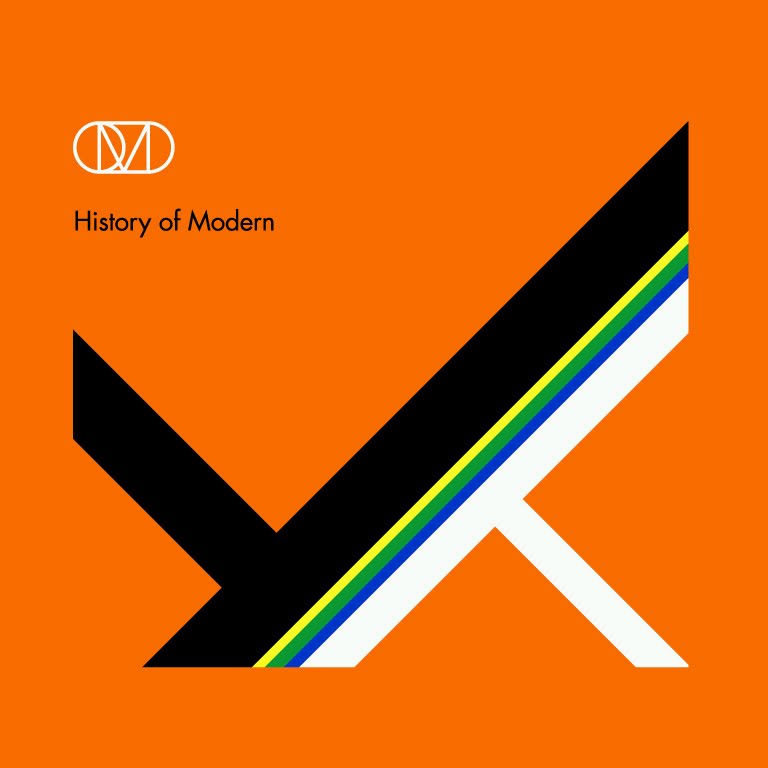
History of Modern is a note-perfect record of some kind of lost OMD album, recorded and canned slightly before the band embarked on one-hit wonder notoriety.
From the band’s logo, to the album art, to the cold digital clicks of electronic percussion, History of Modern is a gentle piece of eighties worship that’s curiously out of step with today’s players who use similar strategies for irony and/or worship.
It’s fluffy, simplistic, and harmless-just like all of the rest of the band’s foray into credible pop leanings after jumping into it with a song about nuclear arms and Margaret Thatcher’s hawkish diplomacy.
If the tones and textures are enough to conjure up nights of eyeliner and extra-hold hair gel, how about the closer “Save Me” which features none other than Aretha Franklin in her best supporting role since “Sisters Are Doing It For Themselves.” I say “supporting role” loosely as she’s the only vocalist on the track, demonstrating that the Queen of Soul is probably the only person outside of Allison Moyet and Anne Lennox that’s able to bring human depth to the cold white hands of English white dudes.
Considering this and the band’s triumphant return to form here, there are moments that may convince you of OMD’s vitality during their original run. To that, allow me to direct your attention to one their more stronger efforts was called Junk Culture-and from that standpoint, History Of Modern is merely another album that lives up to its name.
It felt like old school Saturday Night Live last weekend.
For a kid in the Midwest growing up in the 70’s, television was critical in breaking new artists even before MTV told hold.
Back then, it was about those shows that you really shouldn’t have been watching, but did anyway because your parents were too exhausted to enforce their ridiculous rules that merely prolonged the inevitable.
I don’t think my parents were lazy, just clueless. This is what happens when you have kids having kids-you have no idea how to properly rear a child, particularly when your own folks were kind of shitty at child-rearing to begin with.
So you let your kids stay up and watch shit like Saturday Night Live. You take them to Animal House. And you let one of their first records be the Original Broadway Cast Recording of Hair.
After a while, you don’t pay too much attention to the tit references, choosing instead to focus on the neuances of the comedians or the influences of the musical guests.
It was a learning experiences.
If it wasn’t for S.N.L., I wouldn’t have heard Kate Bush as early as I did. Same goes for The B-52’s, Peter Tosh, Captain Beefheart and that piece of shit Leon Redbone.
Last weekend’s host was Zach Galifanakis. Before I begin, let me assure you that I am not an SNL fan-boy. Too many piss poor seasons have taught me this, so let me say that if I’m parked in bed at 10:30 on a Saturday night, I will have a gander at who is on before I plead with my wife to let me watch a rerun of Star Trek: The Next Generation of if there’s the possibility of intercourse.
I was sick as shit over the weekend, so sex wasn’t in the agenda and since I was acting like a big baby, I didn’t press my luck with Star Trek.
Saturday Night Live? Make it so!
I think Zach Galifanakis is a funny enough guy. I’m not totally bought in to him-there’s only so far that a beard and wolf-pack jokes can take me-and I wasn’t impressed the last time the dude hosted.
In fact, I did a double take on the “Info” message in the channel guy to make sure this episode wasn’t the same piece of shit I saw before.
It said “2011” and it listed some “Lisa Lisa” chick as the musical act, and if you’ve caught my intentional name dismissal, you’ll understand that things weren’t looking good for keeping the tele tuned in for SNL’s entire 90 minutes.
Galifanakis was brilliant in the opening monologue-channeling a bit of Andy Kaufman, delicately touching the balance of laughing at someone else’s expense and uncomfortable gawking. Watching Galifanakis going over page after page of written gags, I half expected someone to roll out a record player to Zach so he could mime a rendition of the Mighty Mouse theme song.
But the song was saved for Jessie J, a singer who I’d never heard before. In the first time in forever, I learned something new about an artist-albeit a pop artist, well out of my normal view of the musical landscape.
I’m still not sure who or what B.o.b. is/are, but I’m certain that it was Jessie J. who dominated the musical segment in silly attire (just like the B-52’s!) with “Price Tag.”
She was awesome.
Her debut is already a smash in her native England, and I’m sure it will post some impressive sales-at best as you can in 2011, anyway-when Who You Are is released stateside next month.
This song makes me feel like a fruity little high school boy with eyeliner. But it also reminds me how Nick Cave has been cooler than anyone you'll ever know for over three decades now. Here's a glimpse from the first couple of cool years.
To the email box, where Liam Gallagher's camp really wants you to believe that his new band Beady Eye will be just as good as Oasis was:
Beady Eye announce...their first North American tour dates. The band (Liam Gallagher, Gem Archer, Andy Bell and Chris Sharrock) will be giving fans a first live taste of their debut album, Different Gear, Still Speeding in a series of concerts beginning in Chicago on June 18th, followed by Toronto on June 20th and New York on June 23rd.
Beady Eye is currently on their sold-out debut European tour. UK daily newspaper, The Independent was at the tour kick off last week in Glasgow, Scotland and remarked that Beady Eye, "sound encouragingly refreshed.... you realise watching them that Beady Eye are in the very unique position of possessing iconic impetus while being newly unchained from the weight of their past."
And fans can head over to http://www.spin.com for an exclusive look at behind-the-scenes photos from Beady Eye's Glasgow show.
When asked how it felt to be on stage for the first time ever as Beady Eye, Liam Gallagher immediately said "Loved it.....can't wait to take it around the world." And Beady Eye will be doing just that throughout 2011. Fans can sign up at http://www.beadyeyemusic.com/ to be the first to receive the news.
Tickets for the North American dates go on sale on March 11th. Please see below for detailed ticketing information.
Beady Eye's debut album, Different Gear, Still Speeding was released by Dangerbird Records in North America on March 1st. The album features 13 brand new songs written by the band and recorded at RAK Studios in London last fall with GRAMMY Award-winning producer Steve Lillywhite (U2, Dave Matthews Band, The Smiths).
Upon reviewing Different Gear, Still Speeding, The Boston Globe stops the naysayers in their tracks and warns, "For all those who thought Liam Gallagher would be musically astray without big brother Noel, meet Beady Eye."
While Paste noted that Beady Eye "...sounds like Oasis returning to its less complicated roots, stripping back the heavily overdubbed layers of their curtain call, 2008's Dig Out Your Soul. Beady Eye aren't here to dick around-they're here to rock. And it would be a lie to say they've failed in that regard; this is an album of live, full-band rock 'n' roll energy, built on Rickenbacker crunch and Ludwig thump. There's no time for frills-Gallagher and company are making up for lost time."
Beady Eye was formed by three former members of Oasis, including enigmatic front man and lead vocalist Liam Gallagher. The multi-platinum and Grammy nominated Oasis sold over 70 million albums worldwide spanning seven studio albums awarded with six Brit awards, 15 NME awards, nine Q awards and four MTV Europe Music awards, just to name a few. Beady Eye's inaugural European Tour in March this year sold out within 30 minutes of going on sale. The band will be joined by Matt Jones on keyboards and Jeff Wootton on bass for all dates.
BEADY EYE NORTH AMERICAN TICKETING INFORMATION:
June 18 Chicago, IL @ Metro On Sale March 11th at 10am at www.etix.com, www.metrochicago.com, Metro Box Office & Charge By Phone 773.549.4140
June 20 Toronto, ON @ The Sound Academy On Sale March 11th at 10am at http://www.ticketmaster.ca & all Ticketmaster locations
June 23 New York, NY @ Webster Hall On Sale March 11th at Noon at www.ticketmaster.com & Webster Hall & Mercury Lounge Box Offices & Charge By Phone 212.260.4700
The “why” here for many is “Why not another Dinosaur Jr.” record?”, but J. might even have answered that question in the title track of his first solo record in some time, Several Shades Of Why. It sounded like “Several shades of why I can’t go back as faster” to me when I first heard it, and I took that to mean that Mascis isn’t content with being remembered for a pair of slacker guitar masterpieces.
And those who only have those two albums (You’re Living All Over Me and Bug) are certainly missing out on some swell Mascis/Dino Jr. albums post-SST, a few nifty solo nuggets, and an “Oh, wow!” moment with his contribution to the soundtrack of Gas Food Lodging.
I actually have never seen that movie with Ione Skye, but I remember how taken I was with Mascis’ score. It provided a full realization of J.’s talents even when he wasn’t destroying the bajeezus out of a Marshall stack with overloaded tones.
I’m sure that those who aren’t familiar with that or any other of Mascis’ more subdued adventures will be just as surprised with Several Shades Of Why, a primarily acoustic album that builds a nice pillow for him to lay down his recognizably lethargic delivery.
It’s a surprisingly open effort, free of the ambiguous lyrics of records past. The subject matter here seems real and sober. As early as the first track, Mascis pointedly realizes with his affection that “pain is what we do/I got enough to make some more for you.” It’s a different, almost cruel observation, cutting a little deeper than the stoned ambivalence of his youth.
Throughout Several Shades Of Why, J. sounds tired from the weight of middle age, where weird neurotic shit that you had firmly stowed away in your inner synapses suddenly start popping up for everyone to notice.
Without that feedback to hide behind, Mascis distracts you with strings, piano, and even a flute at one point. It doesn’t sound out of place, and as soon as you’re used to those kinds of tones from a J. Mascis record, you once again begin to focus on how vulnerable he sounds.
Maybe it’s the intimate moments found throughout the record that make Shades sound as personal as they do. It certainly elevates Mascis’ slight croak into a new perspective, as does his intentional decision of leaving his guitar prowess into a limited role. Oh, the guitar work is there, it’s just not as amplified and not as showy-which pretty much means that Several Shades of Why won’t impress the faint of heart much.
But for anyone that’s been through the vicissitudes of his catalog, Several Shades of Why ranks as one of J.’s better efforts and one of his most memorable.
Thanks to Maarten-our man in Amsterdam-for pointing out this wonderfully bizarre interview with J. Mascis. The person who interviewed him was only labeled as "Maureen" and her lack of a proper introduction got me wondering: "Who the fuck is this lady?"
Watch the video and you'll see why I was curious. She clearly knows something about J. while not knowing much about his back catalog, one would surmise.
But how does she know him?
Where did they meet?
Did they get really high before this was shot?
"Pure chemistry." was how Marteen described it, and I can only agree.
Maureen turns out to be the Mother of Sub Pop Records' Megan Jasper, who went to school with J.
Megan recalled "The first time he came to our house, he got in a screaming match with my mom. The visit ended with J standing at the front door yelling, 'YOU'RE FUCKED!' to my mom and my mom then yelling to my dad, 'JIMMY!!! DID YOU HEAR THAT? HE SAID THAT WE'RE FUCKED!'"
Obviously, it took several years in the lab before Maureen and J. developed the chemistry that Maarten is speaking of.
I’ll admit that a decade ago, I was firmly entrenched with the belief that New York City would save rock and roll from its own girth. What I forgot was that rock and roll was bigger than N.Y.C. and if the big apple faltered, there are cities around the world ready to pick up the slack and save rock music from its own decadence.
The Strokes have fallen, for sure, but their wake was large enough that a plethora of copycat bands-both real and perceived-came on the heels of the success of Is This It. And like any band that possesses the kind of influence-again, real and perceived-there is a degree of creative worth for some of these also-rans, albeit smaller than the real thing.
Some of them were disappointments-I have The Stills’ first single if anyone wants to make an offer. But others were intriguing, like Baltimore’s The Oranges Band.
Despite having an awful name, The Oranges Band seemed to be working a unique blend of N.Y.C. rhythm guitar heroics with a touch of Manchester jangle. My perspective is based on the one e.p. that I purchased, On TV, which is about a half-dozen ok tunes and one tune of such curious charm that I listened to it again and found myself as infatuated with it as I was a decade ago.
“My Street” starts with the obligatory rhythm guitar, angular in approach and choppy in delivery. After a few spins, you’ll be whistling the parts and admiring the hidden muscle coming from the amplifier. All of this is perfectly juxtaposed against Roman Kuebler's timid delivery, which sounds a bit like Morrissey if he had to fight with Johnny Marr if he turned the amp up a bit more.
Things get really Smith-sy during the bridge, when vocalist Roman Kuebler admits like a few Moz how he'd “wish I was built like a fairy" adding the wonderfully made-up word "unawary” right afterwards, in a bit of "Accept Yourself" sass.
In less than three minutes, it’s over. But it'll stay on your arm, you little charmer as "My Street" is built for the repeat button. And in case you’re wondering if the rest of the extended play comes close to matching “My Street,” the unfortunate answer is “no.” While that opening track is good enough for me to keep On TV all these years, it wasn’t enough to prompt me to follow this promising band from Baltimore with the silly name.
They’re still at it, from what I learned, now with a different line-up but I’m not familiar enough to see if their later material is worth a trip past “My Street.”
Someone created a video of a bunch of dudes walking around N.Y.C. looking silly and they used "My Street" as their soundtrack. The sound quality is terrible and the video itself must be a real hoot to whoever knows those people.
When I entered the wonderful world of small market rock radio, I was taken by the number of off-beat songs that my station would play. There were tons of regional favorites that made their way into the playlist, songs that I had never heard before-even though I live within earshot of the station's airwaves growing up.
At the time, the station was a low-wattage, small town station that invested heavily on a huge FM tower, and a successful plead to the FCC to raise their wattage up to 50,000 watts of power. Now you understand why everytime I hear Nick Lowe's "So It Goes," I get all teary-eyed with nostalgia.
"More tower, more power!" was our stupid catchphrase that we came away with from a brainstorming session we used when we switched on the electricity to the big stick a few miles up the road.
What we didn't do was change the playlist all that much, so a lot of these regional "favorites" got to test the theory that people in Missouri and Illinois really knew who Mason Proffit was.
One of the band's for me that fit that "Wha?" category was Uriah Heep. I had no firsthand information about this band, but was assured that on one night, many years before, Uriah Heep played somewhere close by and a few people attended it.
Come to find out, Uriah Heep is still performing.
URIAH HEEP's Into the Wild scheduled for release !
Frontiers Records has scheduled the release of URIAH HEEP's forthcoming studio album "Into the Wild" on April 15th in Europe and May 3rd in North America. Produced by Mike Paxman (Status Quo, Asia) the new album will include the following songs: Nail On The Head, I Can See You, Into The Wild, Money Talk, Trail Of Diamonds, Lost, Believe, Southern Star, I'm Ready, T-bird Angel, Kiss Of Freedom. The cover art was designed again by the renowned Greek-American artist Ioannis (LYNYRD SKYNYRD, STYX, SAGA etc). A videoclip for "Nail on the Head" is going to be shot in the coming days and will be added to the album as a special interactive tool.
The band has also recently posted a new video recording diary which can be seen following this link : http://www.youtube.com/watch?v=IHl768v25Ho. European and Australian tour dates have been announced already and can be found on the band's official websites. The first leg of the US tour was also recently announced:
6/14/2011 Atlanta GA Variety Playhouse 6/15/2011 Chattanooga TN Riverbend Festival 6/17/2011 Kettering OH Fraze Pavilion for the Performing Arts 6/18/2011 Annapolis MD Rams Head on Stage 6/19/2011 Falls Church VA State Theater 6/20/2011 Sellersville PA Sellersville 6/22/2011 New York BB King Blues Club 6/23/2011 Foxborough MA Showcase Live 6/24/2011 Jim Thorpe PA Penn's Peak 6/25/2011 Ridgefield CT Ridgefield Play House 6/27/2011 Norfolk CT Infinity Hall 8/12/2011 Three Forks MT Rocking the Rivers Festival Site 8/14/2011 Rochester MN Mayo Park

 The logical explanation for why The Cars debut album is so good falls under the “A band has their whole life to make their debut album” claim, with the understanding that it takes some talent, of course, for said debut to be worth anything.