Ray Farrell, head of SST Record’s promotion department, called me one day while working at the college radio station. I was the program director there, and through the years at the station, I developed some pretty nice relationships with record labels and their employees. Ray had slighted me on a few occasions, or at least, I had felt that he had slighted me. It seemed that I could get whatever I wanted from record labels at the time; hell, I was prominently featured in fucking trade magazines as a “mover and shaker.” At least in my mind I was a mover and shaker. The reality, and Ray Farrell probably knew this, was somewhat different. Bottom line: Ray didn’t give me a ton of free shit. The label couldn’t afford it and I was probably presumptuous in asking for it. But whatever. I was young. I was movin’ and shakin.’
“
firehose is going on tour and they’re coming to Iowa.” He explained. “You want to do a phone interview with Mike Watt?” Out of all the things Ray could have given me (free tickets, giveaways, a
Raymond Pettibon print) the only thing he could come up with is a shitty sounding interview recorded over the phone line?! Fuck that. I had bigger plans.
I agreed to it and Ray gave me the phone number to Mike Watt’s house. “Call at [this time] on [this date].” He instructed. “Give me a call afterwards and let me know how it went.”
The bigger plan was this: I was going to parlay the phone interview into a full-fledged encounter with this, the man who played with the legendary Minutemen. I figured that I would invite him to dinner before the show in Iowa and treat him to a nice sit down dinner.

I called on the predetermined date and time only to hear about thirty minutes of busy signals. When I finally got through, a gruff sounding voice answered. “Hey Watt!” I announced, trying to sound cool, housed in a fairly clean
Saccharine Trust t-shirt.
“I know you’ve probably been doin’ this all day long now…”
“Yeah, I’ve been on the phone all day…” he acknowledged.
“So whaddya say we cut this thing short and let’s just hook up here when you get to Iowa in a few weeks.”
“Oh, you mean like do an interview there at the station?” he asked.
I explained that the station I worked for was well over a hundred miles from where his band would be playing; therefore, it would be fairly impossible for him to stop by the station when they got into the state.
“What kind of food do you like?” I asked him.
“Mexican.” Was his short, to the point, and undebatable reply.
So with that, I told him that I would meet up with him before the show and take him to a nice Mexican restaurant where we could conduct the interview privately. Dinner, I added, was on me.
It goes without saying that the financial resources of most college students is fairly limited, and my role as Program Director for the student radio station paid a whopping one credit hour per semester. What that means is that I didn’t get paid, that actually, I was losing money at this gig. To supplement this lucrative salary, I worked for two other stations in the same market (under different names, to avoid that silly little non-compete clause) so that I could actually get a paycheck somehow.
I figured that I could afford to pay for Mike’s dinner and my own without much worry, and still have enough left over for gas, grass, and, well, that was about the extent of my budget right there.
I let Ray know to put me and my “producer” on the guest list for the show. I let my “producer,” a first year transfer student from somewhere around Omaha, know that he could come with me, but he’d have to buy his own dinner at the Mexican restaurant.
Before heading out, I called a few friends in the area to get their opinions as to what was the most authentic Mexican restaurant in the area. The consensus was that there was a little Mexican joint not too far from the venue that had a pretty authentic menu, and I was stoked that I’d be able to show Mike Watt how we do Mexican here in Iowa.
Now, before you start to giggle at the thought of “authentic Mexican food” and the state of Iowa together in the same sentence, let me explain that the part of Iowa where I’m originally from is close to a town that has some truly authentic Mexican restaurants. This was an area that heavily used Mexican migrant workers and the town actually built a fairly shitty subdivision to house them all in. A lot of families stayed there and continued their heritage with various community events, social clubs, and started a few restaurants so that the Iowa crackers could learn how to pronounce “
Chimichanga” correctly.
On the way down to the firehouse show, I start to set the expectations of the interview with my “producer.” He had a tendency to try and take over my interviews, so I had to set him straight with this one. I also told him that he was not to mention anything about D. Boon. It was just a couple of years after Boon’s death and I wanted to avoid the topic entirely with Watt. I didn’t want to be “the guy that bummed out Mike Watt” and was afraid that any discussion of the topic would send him into a drop D chord, if you know what I mean…
I meet up with Watt and drummer
George Hurley before the show and Mike actually remembered the prior arrangement. To my shock, Mike starts inviting everyone to dinner. George Hurley, Ed Crawford, the roadie, the t-shirt guy, I’m doing the math and it’s clear that I’ll be using my Dad’s Amoco card for a lot more than just gas for the next few weeks.
Thankfully, on the way to the Mexican restaurant, Ed Crawford decided that he didn’t want to run south of the border. He makes a beeline for a Subway and I’m secretly hoping that a few more in our group join him. They don’t, so the rest of us make our way into the “authentic” Mexican joint. I tell the “producer” that I may need to borrow a few bucks from him to cover the bill. He shows me a few twenties in his wallet and I breathe a sigh of relief. To show my appreciation, I let him sit next to me (I was going to put him next to the roadies) and we set up the recording equipment while everyone starts ordering from the menu.

Mike is very open and gregarious. He seems genuinely excited about the band, the tour, the record and he provides me with long, detailed answers. He even translates some Pedro-speak for me. I’m provided with a clear definition to what “We jam econo” means. “Econo” is short for “Econoline” as in Ford Econoline vans. Mike explains that they don’t need tour buses or other forms of fancy travel. For him, rock and roll as he understands it, is simply getting your gear together, throwing it into the Econoline, and getting out there and doing it. “You know, I read these things about other bands and how tough it is to go out on the road,” he preaches, “and how the concert industry is in a slump. That bands can’t make any money on tour anymore. The thing is: every tour that I’ve ever been a part of has made money. It’s about priorities, you understand.” He says these clarifying things a lot, like “You follow me?” “You know?” It had an almost teacher-to-student tone to it, like he was very aware of the impact that punk rock had on his life and that he was going to make damn sure you knew the ropes of the trade, in case you were in the market for an Econoline van too. I picked up on about half of this while the other half was spent hoping that the roadie didn’t order the steak fajitas.
Speaking of, the meal was positively lame. The food was far from fucking authentic and the hot sauce was a tad above tepid. I made a comment about the sauce and Mike concurred by declaring it “Weak” while his mouth was stuffed with food.
Let there be no question: Mike Watt can put down some food. And he can do it quickly. The man was done in no time flat and be made no attempt at trying to impress us with manners.
But Mike Watt has never been someone to try and impress anyone else. Aside from D. Boon, probably. That’s been part of his appeal, actually. This was a guy who really didn’t subscribe to the “punk formula” at all, and had the uncanny ability to read through the bullshit of these kinds of labels. So if a little bit of refried beans spills on his flannel, oh well.
After he ate, we talked some more about the band. Without any hesitation, he began to talk about D. Boon. The pain was still there, and some twenty years later, it appears that it never really left.
“It was D. Boon’s Mom that told me to play the bass.” He explained, with the same unison as the stories he told in “We Jam Econo.” That’s what struck me about the movie: the stories he told in front of the camera were the same stories, verbatim, that he told me nearly twenty years ago at a shitty Mexican restaurant in Iowa. His voice pause after each additional “You know?” I remained silent, occasionally nodding, letting Mike Watt spill another retelling of the tragedy to someone too young to fully appreciate the importance of the topic and too young to understand the pain that he overcame.
I paid for dinner with a few borrowed bills from the “producer.” Mike offered to pay for his crew, but I declined. I said that maybe we could work something out later on, maybe in the form of a free t-shirt or something. It seemed fair to me, but Mike explained that he couldn’t barter with his “merch.” It dawned on me. Every one of his tours made money. That $10 profit attributed to the bottom line. The stories he shared with me were worth more than a “weak” Mexican dinner.
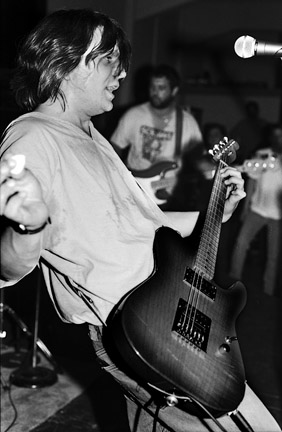
We walked back to the venue. George and Mike worked on the set list (Ed, I learned, was not feeling well, and rarely spoke the entire night) while I snapped a few photos. We watched the soundcheck and snapped a few more before the doors opened. The “producer” rigged up a few microphones to record the show and we found a few good seats in back.
On the first song, Watt broke a string on his bass, and I witnessed an impressive example of d.i.y. He walked over to his amplifier and retrieved a new string from the top of the cabinet. He removed the broken string and strung a new one while continuing to play through the rest of the song.

Then another glitch occurred. A constant crackling noise started from Ed’s combo amp. A guitar tech came on stage in between songs to try and do a quick diagnosis, but nothing changed. This irritant, combined with Ed’s already sick demeanor, made for a very by-the-numbers set. George and Mike, on the other hand, probably had several additional years of these kinds of surprises and managed to maintain composure. They ended the performance with a cover of Public Enemy’s “Sophisticated Bitch,” which had Mike grinning from ear to ear and even prompted a smile from Ed.
After the show, I met up with Mike again to thank him for his time and to grab an autograph. There wasn’t a lot of chit chat offered, it was clear that he had more pressing things to do. Rather than spending some time with a couple of college kids in Iowa, Mike had to help with the band’s load out. Part of “jamming econo,” he explained, is also making sure that everyone helps out.
I quickly learn that my own lesson in “jamming econo” isn’t quite over yet.
“Grab those cables over there” he tells me.