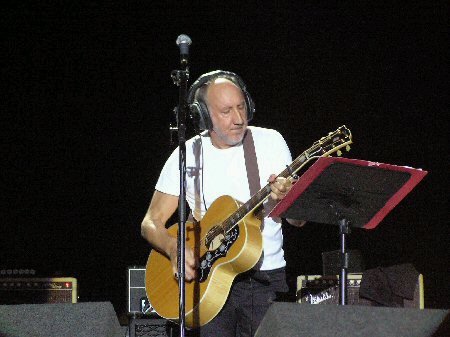
Showing posts with label Pete Townshend. Show all posts

Tuesday, August 7, 2012

Rush - Clockwork Angels


Prior to the release of Rush’s twentieth album, Clockwork Angels, the band had an opportunity to visit with Pete Townshend after receiving the Governor-General Award for Lifetime Achievement in the Performing Arts.

The formal gathering provided the Canadian trio with some face time with one of their acknowledged heroes after the event, and the conversation eventually led to the “What’s next?” question. When Rush responded that they were putting the finishing touches on a new album, Townshend scoffed, hinting that the format that he helped secure as a legitimate art form with Tommy has evolved into a seemingly extinct outlet.

“Waste of time, making albums these days.” He pointed out rather correctly, and even the band was forced to admit that maybe so, but they had to.

You could look at their response yet another example of a band from a different era failing to acknowledge modern realities. Or you could accept the fact that Rush has operated exclusively in their own reality for four decades now, navigating trends and genres in a silo of loyal fans who appreciate the independent spirit of this band’s history.

A big part of that history happened with their 1974 release, 2112, a record that found them at the end of a record deal after three consecutive commercial failures to their resume. By all means, 2112 should have been the band’s clear bend towards their label’s desire to have a hit record. Instead, it’s a record in which half of it is devoted to a concept corny enough to alienate the placid record buyers it was trying to capture.

As we know now, 2112 became an enormous record for the band, inexplicably connecting them with audience who appreciated their excessive tendencies and geeky excursions. It also became the record that fueled fan’s future expectations, the benchmark for new conceptual meanderings.

With Clockwork Angels, they’ve returned to idea of a concept album once again, even coyly putting the hands of a clock on the album’s cover, that-if you consider the hands in military time-clearly spell out 21:12.

To be honest, I don’t have the patience to figure out what the concept is, exactly, all I know is that I think I heard a few songs reference timepieces and that the performances within the records hour-long running time are probably the best thing they’ve done since Signals.

It’s also the most varied, alternating between complex arrangements and textures that effectively demonstrate a wide pallet of sounds that could only come from a band that’s spent a great deal of their existence continually trying to move forward.

Whether or not you’ve personally been a part of this journey isn’t relevant. For those of us who’ve had a relationship with Rush at some point in their life will find Clockwork Angels to be not only a continuation of the band’s recent upswing, but one of the premier entries in what’s not only been a long, storied career, but a somewhat choppy one at that.

The band wisely chose to work with producer Nick Raskulinecz again after giving the band a flattering mix for Snakes & Arrows. His role is vastly expanded here, giving Clockwork Angels a perfect blend of the band’s progressive background with their more recognizable synthesizer years, all while making sure that the material has a distinctively modern sound, capable of scaring off any younger contenders trying to surpass these elder statesmen.

They do it by not just focusing on the complexities of their craft, but in casting a wide net over its very definitions. Guitarist Alex Lifeson channels his best Robert Fripp at points where atmosphere and texture rule over guitar worship soloing. The acoustic moments are compelling, and when the material calls for a bit of big power chords, Lifeson responds with memorable attacks and distinctive tones.

Geddy Lee’s vocals are more palatable than they’ve ever been, with hints of emotional qualities that were not present when his voice was more of a distraction than an instrument. And speaking of, his bass duties are pushed up high in the mix, suggesting that he’s never stopped building his low-end craft even when his hands left the fretboard for the keyboard.

Drummer and lyricist Neil Peart also deliver some of the best work of his career, with the words providing evidence of added focus and his drumming showing signs of intentional spontaneity. Credit Raskulinecz here too, as the pair purposely avoided unnecessary exposure to the songs so that when the time came for Peart to perform the rhythm tracks, he was only familiar with the song’s outline, approaching it with only a basic notion of how he would address each fill or tempo change.

Clockwork Angels most telling moment may come with its title track, beginning with progressive layer of atmospheres before turning into churning bit of double-timed frenzy. The trick goes back and forth, until it turns into an acoustic Zeppelin shuffle right around the five-minute mark. It’s well thought-out, expertly delivered, and it suggests that not only are Rush still trying to deliver career triumph to us, they may still be able to accomplish it.

“All the journeys of this great adventure” Geddy sings, looking back on the band’s history and noting the struggles of their early years with “It didn’t always feel that way.” As the track progresses, Lee finally admits “I wish that I could live it all again” while the band performs as if the last four decades haven’t slowed them down a bit.

Waste of time? Judging from Townshend’s twilight output, maybe. But for the members of Rush, Clockwork Angels is a late career triumph that sounds like the band’s time was put to excellent use.

This review originally appeared in Glorious Noise.

Thursday, January 4, 2007

Pete Townshend-Who Came First

Let me start with a digression.
In the fall of the 7th grade, our English class was presented with the idea to collect original material and place it in a collection, representing our work as writers, poets, and whatever 13 year olds put down on paper.
I was doing well in English class and had, what I would consider, to be a bond with the teacher. Nonetheless, 7th grade proved to be one of those years where the idea of social stratus was much more important than grades, especially harebrained ideas like collecting the written words of our English class.
Much of the stuff I had written, personal stuff that was guaranteed anonymity from my peers, would be completely out of the question for this collection. Since we had the final say in what would be included, I quickly drew up a completely stupid short story written from the perspective of Pete Townshend’s guitar. It was juvenile and I knew it. Yet I submitted it for entry anyway.
My English teacher stopped me after class and, knowing that I had written much better material than the Townshend piece, asked me to reconsider. I refused. Worse, I lied, saying that I really liked the story. She didn’t challenge me further and let it go into the collection as planned.
The idea or fear that I had was that it would be safer to include a funny little story about a guitar instead of acknowledging some real emotional piece that might subject me to additional ridicule from friends. I was growing in the social ranks, so why on Earth would I subject that to a composition that may prove to be disastrous in the lunchroom, at the football game, or on the long walk home after school? For Christsakes, that walk was already hindered by a stupid looking trombone case, so why make matters worse?
The collection came out and it was filled with the obligatory bad poetry, poorly executed artwork, and creative input that you’d probably come to expect from 13 year olds. In short, it was the stuff you would be embarrassed with five years later, no matter how good it was. And adding to the embarrassment was my stupid little story about Pete Townshend’s guitar.
The guitar feared for its life every time Pete picked it up. It whined about how hard the owner played it. It viewed Pete as a guitar killer, as several of his “friends” had died after Pete smashed them on stage. I can’t remember how it ended, but it was probably something stupid like “Oh no! Here he comes again! I hope he picks the Rickenbacker!”
What killed me was that inside of the collection, a girl by the name of Lisa had written a poem entitled “Their Brother.” Lisa was not a very popular student. Born into less than privileged means, she wore a perpetual scowl on her face, seemingly acknowledging her social place and telling everyone what side of town she resided in. I didn’t know Lisa. I never actually spoke to her and I never saw her smile. But I did know that her poem was the best thing in our 7th grade English collection.
For a few days, I debated on the idea of approaching her and telling her this. It would have been an honorable thing, perhaps the act may have prompted her to try harder and continue on with her talents. It’s presumptuous of me to think this, of course, but at the very least some positive feedback may have made her feel better about her day.


Honor wasn’t what I was about at age 13, and I never spoke to her about obvious talents displayed in “Their Brother.” The poem, with no hint of rhyme or the structure that 7th grade English told us that poetry should posses, was a heartfelt admiration of an older brother in one of Lisa’s group of friends. I’ve never told anyone about this until now, and I’m sure that if I would have pointed it out, particularly at the time, it would have been ridiculed (“That’s a poem?! It doesn’t even rhyme man!”) and reinforced her status as “scurve.” As chickenshit as it seems now, I knew it was great, and I studied Lisa a little more closely than I did before.
Lisa ended up not graduating with our class; by the 10th grade, she was placed in the “alternative” school, the one that allowed the kids to smoke outside and, seemingly, come and go as they pleased. In our town, the classrooms were usually held in an old elementary school building, one that had been abandoned by the school district in favor of cost cutting measures, but structurally sound enough to house the “bad kids,” or in politically correct terms: at risk children. They were the ones that either prompted the “What the fuck happened to that guy?” reaction by the senior year or were met with surprise when their blurry school photographs (not the professional ones that the rest of us had) were included in the yearbook.
I bring up this long-winded digression because I recently went Christmas shopping and, as one frequently does, found an item that I ended up purchasing for myself. I was sent to Best Buy, a task that I hate going through during the holidays because every douchebag in America has to go to Best Buy during the holidays immediately after they their shit at Wal-Mart.
I picked up an sd card for my girlfriend’s parents, a Joss Stone cd for my Mother (my Mother didn’t ask for it, and I’m not very familiar with the work of Ms. Stone, other than her cover of “Fell In Love With A Girl,” which was polite enough for me to remember “I bet my Mom would like her.) and Aretha Franklin’s I Never Loved A Man The Way I Love You for my Dad (again, he didn’t ask for it, but everyone should own a copy of this soul classic).
While perusing the cd racks, as I’m inclined to do whenever cd racks are present in a store, I came across a reissue of Pete Townshend’s first solo album Who Came First. I remembered that Ryko released the disc several years ago before letting it fall out of print. The title stood out to me because I used to own this album on vinyl as a kid and remember being intrigued by it.
It was a weird case of synchronicity too, because on a few occasions lately, I’ve found myself singing the words to “Parvardigar” to the little one while giving him a bath. Strange, not necessarily because of the subject matter (essentially an interpretation of Meher Baba’s prayer, whom Townshend was a follower at the time) but because I remembered the lyrics (“O Parvardigar the Preserver and Protector of all/Without beginning are You Lord without end”) a full twenty-five years after I had even heard the album. Meher Baba, it had seemed, had sent this reissue and place it in front of the racks of the “T” section as a sign.


Coming off the success of Who’s Next, Townshend was pressed by label executives looking for a solo album, particularly after Who bassist John Entwistle released Smash Your Head Against The Wall on his own. Waving a promise of contributing some of the solo album’s royalties towards various Baba projects, Townshend agreed and started compiling material, both new and leftover Who fragments, to round out the effort.
I should note at this point that I am not a huge Pete Townshend fan and, with that being said, this shouldn’t be an album that other non-Townshend fans first pursue. It’s worthy enough, but novices should seek out other more fully realized Townshend solo efforts (Empty Glass, All The Best Cowboys Have Chinese Eyes) before starting here. As for me, I enjoy hearing Townshend’s building blocks, even more than the aforementioned titles, which is why I only have the demo-derived Scoop and now Who Came First in my own collection.
The early versions of “Pure And Easy” and “Let’s See Action” are great as they’re presented here. There’s also a great Ronnie Lane track (“Evolution”) as both Lane and Townshend shared a common bond of drinking and being followers of Meher Baba.
My favorite track is the acoustic “Sheraton Gibson,” which is a very basic “I’m on the road and I miss my home” song with a chorus that sings the praises of Cleveland, Ohio, the home to a band that Townshend provided huge support for, the James Gang.
The rest of the album is, essentially, songs inspired by or provided for Meher Baba. The object of Townshend’s affection was an Indian spiritual “avatar” with an extensive history of regimented discipline and obedience from his followers. Meher Baba, which translates as “compassionate Father,” remained silent from 1925 until the time of his death, a good example of the discipline he required of himself. He gained a certain amount of notoriety during the late 60’s when he was interviewed about the spiritual aspects of drugs. His response clearly contradicted the prevailing psychedelic culture at the time yet, ironically, his overall message of (literally) “Don’t worry, be happy” became common fodder on dorm room posters across America.


I’m generalizing, obviously, but something in Meher Baba’s lifelong teachings and messages clicked with Townshend around the time of Tommy and he’s remained, at fluctuating levels of devotion, a follower of the avatar’s message ever since.
Who Came First is a very relaxed, personal, and enjoyable journey into Townshend’s spirituality and a good example of the range of his talents.
But more than anything, its message for me is the strength in actually releasing it. When word got out of Townshend’s newfound spirituality, many Who fans looked at it with skepticism and some hostility. This was a band, remember, that was huge on bravado and had a history of aggression (mod supporters, the Smothers Brothers show, etc.). So it took a very brave Pete Townshend to show a lack of concern for his fan’s perceptions and agree to release something as personal as Who Came First. Maybe if I had understood this and been a little braver myself, I wouldn’t have worried so much about what others thought about a middle school English project.

Tuesday, October 3, 2006

The Who-Live Review

The Who
Wells Fargo Arena-Des Mones, Iowa
September 26, 2006

Twenty three years ago, I had a chance to see The Who on the “It’s Hard” tour. Of course, it wasn’t really The Who back then, but it was ¾ of The Who, which is ¼ more of The Who than the incarnation in 2006.
Back to the story.
The venue was sold out, and being young and naïve about such things, I used the classified ads to look for tickets. I found a scalping company and made a call to the phone number listed on the classified. I spoke with a gentleman, the years have given him a Mike Damone quality, but I’m fairly sure he was more than a little shady.
The rest is hazy; I know I had to get my Father involved to get my money back and I know that I never got a chance to see that version of The Who.
To make matters worse, I spent my hard earned money on actually buying “It’s Hard,” which I thought was better than “Face Dances,” which wasn’t that difficult to accomplish anyway.
So it’s with a clear understanding of the irony that I got to see the band that came up with the line “Hope I die before I get old” on the eve of my 40th birthday. And it’s also clear that I went into the event without any lofty expectations, particularly since two members, and important ones at that, aren’t even alive. Let’s be honest here: both Entwistle and Moon were critically more important to the band than Rodger Daltry.
Money does funny things to people. It makes you do countless tours after you’ve officially broken up the band. It makes you team up with your former lead singer, record the first Who album since “It’s Hard” and go out on tour (once again) with the band moniker in tact because you know a Daltry/Townshend banner won’t have the same draw.

Yeah, there’s a helluva lot of cynicism here, and quite frankly, Pete Townshend deserves it. While you throw out the fact that the 2006 Who tour prominently features new music from the upcoming album “Endless Wire” and notice that the album isn’t even out yet (scheduled release date is October 31st), let me throw out the fact that “Quadrophenia” is well over thirty years old and remains the last brilliant effort that Townshend had a hand in creating.
Do the math with that; it’s laziness. I’m not discounting Townshend’s worth or the importance of The Who. In those thirty plus years, he has released some pretty remarkable music, but it’s nowhere as consistent as what he could have and should have been able to do. You can make excuses about the addictions and the egos involved, but the truth is that the money he made afforded him the ability to take the day off when it came time for him, and The Who, to deliver a few more efforts on the same caliber as the material from 1973 and before.
Because I’m a sucker for free tickets, I agreed to place my personal differences with Pete Townshend aside and take a look at the latest tour of The Who. There’s a little bit of buzz behind this one; first off, there’s a new album to promote and there’s actually some positive feedback regarding their recent shows, which feature a heapin’ helpin’ of new songs, including a mini-opera.
Horribly promoted and far from sold out (under 6,500 showed up), Townshend and Daltrey tapped Zac Starkey to fill the role of Keith Moon and Pino Pallandino to fill those large ox shoes of John Entwistle. Pete’s brother Simon Townshend joined the band on rhythm guitar and backing vocals while John Bundrick joined them (again) on keyboards. Pallandino didn’t attempt, and wisely so, to mimic any of Entwistle’s bass lines. Zac also steered clear of aping Keith, the guy who bought him his first professional drum kit, but he’s proven to be a great drummer on his own terms.
The new songs? Well “Fragments” sounds exactly like “Another Tricky Day.” “Real Good Looking Boy” wreaks of the obligatory “Elvis Presley inspired us to do rock and roll” nostalgia that most boomers feel they’re required to write about (and it sounds just as middle aged as you could imagine). The new mini-opera hints at a little bit of creative energy, but without Moon, Entwistle, and a full-vocal ranged Daltry, it sounds like it could have been written for “White City” or “The Iron Man.”
“The Man In The Purple Dress,” an acoustic number that takes a hard swipe at molestation in the Catholic church, worked well; there was passion behind the lyrics and Daltry’s delivery was colorful and believable.
The oddly titled “Mike Post Theme” was also a fairly enjoyable new selection.
But again, none of them really sounded like The Who as we, or the 6,200 people in attendance remembered.
Which is why Townshend thanked the audience for enduring the lengthy selection of new songs.
Which is why Townshend also scattered plenty of classic Who cuts throughout the setlist.

Fresh out of the gate, they did it up right; with pictures of mods and early Who imagery filling up the big screens while they smacked through the regular opener “I Can’t Explain.” It went right into “The Seeker” and then into “Anyway Anyhow Anywhere.” I would have thrown “A.A.A.” in as the second song, but they didn’t ask me.
Had they, I would have eliminated “Who Are You,” a fairly uninspired “Behind Blue Eyes” and the utterly disposable “You Better You Bet.” While I won’t get into the argument concerning these song’s importance to the band’s catalog (with the exception of “You Better,” of course) I will argue that everyone seemed to be going through the motions when these songs came up.
The selections from “Tommy” were good, but nothing noteworthy.
Highlights were the opening three, a stunning extended version (ala “Live At Leeds”) of “My Generation” that even threw in a few lines from “Cry If You Want” and a nice attempt at “Won’t Get Fooled Again” which, unfortunately, seems relevant once again. If you’re wondering, Daltry did the scream at the end of it. It surprised a few people. It wasn’t embarrassing. It wasn’t anywhere near the scream circa ’71.
But then again, none of the show was really anything near The Who circa ’71.
What once was a band, in the truest sense of the word, that was almost indisputably the greatest live rock band in their prime, seems content on banking (again) on that nostalgia while Townshend tries to end the legacy on a positive note (read: mini opera).
This, of course, comes after over twenty years of “farewell” tours, Broadway versions of “Tommy” and Kenny Jones on drums even when the three surviving members admitted the “real” Who died with Keith.
So I’ll let ‘em end it with something better than “It’s Hard.”
But I ain’t paying for it, like I didn’t pay for this show. Because, at the end of the day, Pete Townshend seems a little like that scalper back in ’82. And after taking a piss on the Who’s legacy for over a quarter century now, forgive me if I take the line “Won’t Get Fooled Again” to heart.

Setlist:

Can't Explain
The Seeker
Anyway Anyhow Anywhere
Fragments
Who Are You
Behind Blue Eyes
Real Good Looking Boy
Sound Round
Pick Up The Peace
Endless Wire
We Got A Hit
They Made My Dream Come True
Mirror Door
Baba O'Riley
Eminence Front
Man In A Purple Dress
Mike Post Theme
You Better You Bet
My Generation
Won't Get Fooled Again
Pinball Wizard
Amazing Journey
Sparks
See Me Feel Me
Tea And Theater