Sunday, May 7, 2006

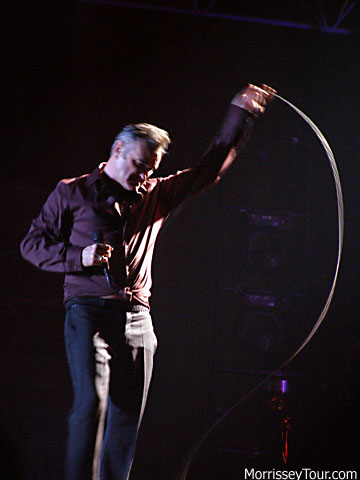
Morrissey-Ringleader Of The Tormentors


Who would have thought that by moving to Los Angeles, as in Los Angeles California, Morrissey would have found some kind of prolific inspiration that has enabled him to produce some of his best work of this solo career. “You Are The Quarry” sparked the return of Morrissey to relevance. So what happens when he moves from Los Angeles to Italy? Listen, if he can return to relevance in Los Angeles, then a move to Italy probably won’t detract from his progression. What’s of deeper concern is that Morrissey has reportedly found love in Italy, and as we all know, Morrissey is seldom happy about anything. At least on record.
“Ringleader of the Tormentors” finds Moz teamed up with Tony Visconti and the results are magnificent. Whereas his work with the late Mick Ronson found Morrissey channeling Mick’s glam heritage, this effort with Visconti, the mastermind of some of glam’s most important albums by Bowie and Bolan, finds the team going beyond the genre’s narrow scope. They get a little help with some great orchestration from Ennion Morricone, who is best known as the man who helped score many of Sergio Leone’s spaghetti western movies.
Happiness hasn’t affected Morrissey’s outlook much; he’s still as miserable as ever but he’s delivering the morose with lyrics that are more to the point. And the point is this: he has found that in this world of shit, there’s nothing sweeter than love.
“I once was a mess/of guilt because of the flesh” he admits on “At Last I Am Born.” And it’s love that has suppressed his Catholic guilt (to an extent) and it’s love that has finally, metaphorically, transformed him into a….middle aged gay man. Is his sexuality really relevant? I suppose not, but it does explain a lot of things and when you take this into consideration you’ll see that “Ringleader of the Tormentors” is Morrissey at his most honest, his most randy, and his most flamboyant album in his career.
“There are explosive kegs/between my legs” he admits on “Dear God Please Help Me,” one of the album’s most talked about tracks. Whereas on previous Morrissey songs where he sang about restraint, it seems that now he’s ready to let his proverbial load go and is contending with years of religious teachings that made him ashamed of his sexuality. It’s refreshing to hear him backpedaled from the “celibate” tag (which placed him as more of a deity than rock star) and demonstrate that he is, like we knew all along, human like the rest of us.
“Ringleader of the Tormentors” does have a few distractions: “In The Future When All’s Well,” “I’ll Never Be Anybody’s Hero Now” and “To Me You Are A Work Of Art” sound like standard-issue solo Morrissey. They’re the type of songs that make people continue to wish for that never-gonna-happen Morrissey/Marr reunion; there the type of songs that make you wish Morrissey would have tried just a little bit harder to make “R.O.T.T.” into that landmark album that actually rivals the worst of The Smiths catalog.
There are moments when it gets close: “Life Is A Pigsty,” the album’s epic, starts with a subtle groove until finally giving way to a wash of orchestration and bombastic timpani. While repeating the song title over and over, Moz states “In the final hour of my life/I’m falling in love again.” And if this righteous fellow can admit that and continue to challenge his own muse in the process, then all we can do is rejoice in the fact that he finally popped his cherry. Or “kegs” as the song goes.

Thursday, May 4, 2006

The Fall-Hex Enduction Hour


I should have changed my New Year’s resolution to state that I would purchase six Fall albums, because I’m already two ahead of the Dylan resolution. Lord knows, The Fall approach Dylan in their proficiency, so I’d have plenty of product to chose from.
“Hex Enduction Hour,” self-described as “a well-produced noise thing,” is just that and generally viewed as a classic in The Fall cannon.

What a cannon it is, as Mark E. Smith opens the release with “The Classical” by asking “Where are the obligatory niggers?/Hey there, fuck face!” Smith is already coming out swinging and the rest of the band rollick along with a two drummer line up and some innovative guitar work from Marc Riley and Craig Scanlon. “The Classical” is one of the greatest and most vicious Fall songs ever.
How fucking cool is Mark E. Smith? Pretty fuckin’. Consider the track “Who Makes The Nazis?” where Smith accurately names “bad bias tele-v!” as the culprit. Who makes the Nazis? “Balding smug faggots/intellectual half-wits.” Brilliant. And this was over a decade before the advent of Fox-TV.
How influential is Mark E. Smith? Pretty fuckin’. Consider the track “Iceland” where a simple piano phrase lies underneath drums, percussion, and high-fret bass phrasing. Anyone who’s ever owned a Sugarcubes (or solo Bjork) album can pretty much gather how “Hex,” particularly this track from it, may have been their touch-stone. “And the spawn of the volcano/is thick and impatient/like the people around it.” Now you know why Sigur Ros made up their own language; M.E.S. has complete mastery of English prose.
I’ve got to hand it to Sanctuary records for expanding some of the Fall’s catalog like “Hex.” The albums are presented in their original form with an extra disc for bonus material. The packaging is also top-notch with informative liner notes. For example, when the album was released, Flexipop magazine had Mark E. Smith review a fucking Krokus album. If that wasn’t awesome enough, the magazine also had the lead singer of the Swiss heavy metal band Krokus, Mark Storace, review “Hex Enduction Hour.” Mark, who found a bit of notoriety with his ample chest hair and a cover of “Ballroom Blitz” felt that The Fall album was “One long downer”and that "this type of music doesn't appeal to me." One would think that someone like Mark E. Smith would be upset about a comment like this, but when he was asked about the current flavor of British pop music at the time like Duran Duran and Spandau Ballet, he admitted that he would rather listen to Krokus.
“And This Day” ends “H.E.H.” with 10 minutes of chaotic noise with what could be the most appropriate album closer since The Stooges “L.A. Blues.” Starting off with a certain amount of structure, the song gallops into a dissonant groove while Smith yells “everywhere just no fucking respite for us here!” According to the liner notes, this ten minute track was edited down from the original recording which clocked in at close to 25 minutes. Mark wasn’t very happy about that decision, either. But when is Mark happy?

The Beatles-The Capitol Albums Volume 1


Beatlemaniacs are funny. I would consider myself one, but I am by no means a completist. To be honest, I couldn’t afford to be one if I wanted to and I think the baby boomers have both the money and the inclination to snap up most of the good memorabilia anyway.
Just consider the price tag of “The Capitol Albums: Volume 1” (seventy bones); it’s a box set clearly designed for aging boomers who have the spending cash to get the American Beatles albums they’re used to…and have been whining for ever since the band streamlined the catalog and released only the “proper” British albums in ’87.

A brief explanation: Capitol records cherry picked the Beatles British Parlophone records and released them as new titles domestically. These albums came in two forms, mono and stereo, and Capitol also used “duophonic” mixes in some of the stereo tracks. For laymen, “duophonic” essentially means “adding a bunch of reverb” to the tracks.
While these American releases may have not been exactly what The Beatles themselves intended, the millions of American fans that bought them understandably think of them fondly. Capitol records, always ready to take a music fan’s money, decided to release the American albums in a box set right before Christmas in 2004.
While I already own most of this material already in their British forms, I will admit missing the American versions a little; I was introduced to The Beatles thanks to my parent’s copy of “Meet The Beatles,” “Beatles ’65,” “Yesterday…And Today” and “Beatles VI.” Plus, it’s been nearly twenty years since someone has properly remastered The Beatles albums in any configuration. This means that if you buy, let’s say, The Beatles “For Sale” cd, it sounds exactly the same way it did in 1987: tinny, compressed, and not a lot of punch. “The Capitol Albums” is remastered (albeit using 2nd generation copies for the American version) and a lot of Beatle fans are excited about this.
However, there are lots of Beatles fans that are actually up in arms about the decision to release the American albums. It’s really quite humorous to visit sites completely devoted to this debate, and a few prominent members of the Beatles camp (but not directly related to them or their legacy) got involved in the dispute.
With all of this, I thought it would be cool to actually have the Capitol albums, but there was no fucking way I would spend $70 to have ‘em. All they are is the stereo and mono versions of the albums with no real rare treats (only a few minor differences in a handful of songs can be found) that warrant spending that kind of cash.
But Sam Goody’s going out of business news is my gain: with much of the store picked over, I did find a copy of this at 60% off, which was cheaper than the used versions that I had seen online.
Now “Meet The Beatles” is a five-star album, period. The sequencing contains eleven Beatles’ originals and this is critical. From this album onward, it became universally acceptable for pop groups to actually compose their own material. It was also hugely successful, and it forced pop bands to think in terms of l.p.’s instead of focusing on single-to-single.
“The Beatles Second Album” essentially compiles a lot of the band’s cover material and, either intentionally or by luck, the sequencing works. What you have is one of the band’s most rocking albums.
“Something New” starts to show signs of the bottom of the barrel and “Beatles ‘65” is a trainwreck of sequencing (“Rock & Roll Music” goes into “I’ll Follow The Sun” for Christsakes); the band had started to progress musically and Capitol really should have stopped the practice of bastardizing the British albums at this point. The band was making Capitol a ton of money, and there really was no need for this kind of strategy.
Capitol records didn’t abandon the practice of course, and this means there is a “Volume 2” available now and you won’t find me rushing out to buy it anytime soon.
Sure, as stupid as it sounds, I would actually like to have a version of “VI” because I completely ruined my folk’s copy of it so this title holds some sentimental value to me. But there is no way I’m spending full retail for it. Here’s the main reason why:
Capitol records has done a simply awful job of packaging Volume 1. The box is pathetically flimsy and the individual discs are packaged in cardstock album replicas instead of jewel cases. That’s not necessarily a bad thing, but the actual artwork looks like shitty scans of the original albums in either a stupid attempt to make the things appear four decades old or because Capitol records are run by retards.
Why the fuck would you release a premium priced box set like this? At the most, this thing is only worth half of the list price and I would advise any Beatle fan from avoiding this overpriced attempt at making a few extra bucks for the label that incidentally passed on the band four times before signing them. Save your money and wait for the updated mastered versions of the proper albums.

Monday, May 1, 2006

Version 3.0

For those of you that have traveled to this new home from another site, I appreciate your understanding. I’m fairly confident that Glam-Racket is hidden enough that the savvy computer literates from my past (read: the uninvited) won’t be able to bother me here, unless they decide to pursue a full-time job pursing my on-line musings.
It’s sad, really, and I feel a tad pretentious notifying a select few saying “Hey, if you want to check out my writ, come to this site” because, like I’ve said before, it’s not really about you. No offense, but I’ll write about what I want and do it within the time frequency that is allowed to me. At the same time, I do occasionally produce the obligatory personal-life rants, which gives me a certain amount of sanity and you a glimpse into a world of mine that is, suffice to say, fairly mundane and boring.


To that end, I’m a fairly simple person; there are times that I like nothing better to do than just listen to music. It’s been with me since, literally, I was two years old. Essentially, I was left to my own devices as an only child and in that solitude I found music. Some of you know this story already and some of you may be thinking that I’m playing some kind of “tale ‘o woe” card here. I’m not. Rock and roll has served me fairly well as I firmly believe that I have learned more from record grooves, magnetic tapes, aluminum discs and computer music files than any other source.
Because of this passion, I am very opinionated about music and enjoy a good argument every now and then. I like talking about it in great detail just as I used to read in great detail every record label, liner note and lyric sheet that came my way. It’s completely wrong in some ways and irrational in others, but you can fight nearly four decades worth of habit.
Which leads me to a fear that I have: Someday, I won’t be able to have tangible items that hold music. I understand and partake in downloads and I understand the current trend in music listening device. But I’m scared that at some point my own preferred format will be deemed to be obsolete. It’s not even about the format, really, just the idea that a little piece of art that an artist has created won’t contain the same meaning as what I’m accustomed to now. That is: the label, the artwork, the sequencing, the information, the entire package. I feel a little gypped with downloads and equate them to the same feeling I had when someone dubbed of an album for me on a Maxell XL-II 90 minute cassette. And like those times, if someone gives me (or if I download) and entire album that I end up really enjoying, I’ll probably get a copy for myself down the road. It’s fairly stupid as record company’s probably love me for re-buying the same stuff over and over again, and I completely know that if the music industry ever came up with a “new and improved” format that I’d probably do it all over again and be stuck with thousands of virtually worthless compact discs that don’t hold a fraction of the price that they once had.
The thing is: I don’t see an “improved” format coming around. What I do see is a large group of younger music fans that don’t give a shit about the packaging, the sequencing, etc., and as a result, can’t “get” where I’m coming from. It’s automatic delivery, baby, and being the first kid on the block to have a leaked copy of a new album is more credible than actually knowing the words, the producer, the studio it was recorded in, and if the songs belong to B.M.I. or A.S.C.A.P.
I can’t fathom an environment where my shit is “stored” on a flash card that I bring over to someone’s house and plug it into a USB port or something. I’m sure I’ll acquiesce if I’m forced to, but the gratification will be lost. And, to put it into relative terms, the idea that I only have snapshots of these “friends” instead of having the real thing present is a very troubling thing for me.

Saturday, April 15, 2006

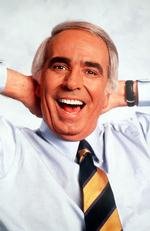
The Tomorrow Show with Tom Snyder-Punk & New Wave

On maybe a handful of occasions growing up, I stayed up late enough to watch Tom Snyder’s “Tomorrow” show on NBC. I knew that the guy smoked like a chimney. That Dan Ackroyd did impersonations of him on “Saturday Night Live.” I also knew that the show was fairly boring. But what did I know? I was young, for Christsakes. I didn’t know that Snyder had a few rock acts/musicians on his show every once in a while. And admittedly, I probably wouldn’t have known or appreciated many of the artists he interviewed at the time.
But years have passed and new music heroes emerged in my life. And wouldn’t you know it: a few of them actually passed through Rockefeller Center and entered into Tom Snyder’s domain.
What his domain actually was a fairly quirky and somewhat unprofessional interview show that broadcast when most people were fast asleep. By “unprofessional,” I’m referring to Tom’s incessant smoking, his continual joking around with the crew, and general lackadaisical attitude towards building ratings.
NBC tried several things to change this: various opening sequences, including an audience (stupid idea) in the studio during later broadcasts, and introducing (then) divisive topics for discussion.
It’s easy to forget that “punk” music (also known as “new wave”) was pretty divisive back in the day. It’s not easy to forget that Tom Snyder was helplessly out of touch with music in general back in the day; I’m sure he could wax poetic about The Beatles or any other socially relevant band from the 60’s, but punk rock? Please.
Nevertheless, you gotta give Snyder credit for inviting some of rock music’s most influential artists on his show, thereby, introducing a country to exciting new music that typical mainstream outlets avoided like the plague.

A new dvd set, “The Tomorrow Show with Tom Snyder: Punk & New Wave,” collects material from the show during its late 70’s/early 80’s run on NBC. Paul Weller and The Jam make a visit, as does a shy Patti Smith, The Ramones, Iggy Pop, Elvis Costello, The Plasmatics, and others, including non-music footage that, in the whole scheme of things, really have no place on this collection.
Patti Smith probably has the most coherent and telling interview in the entire set. She appears very shy yet still very eloquent while she marvels with the rest of us that she’s actually on national television.
Joan Jett makes and appearance with her manager Kim Fowley as they discuss the state of music with a very narrow-minded Bill Graham and an even more narrow-minded L.A. Times music critic Robert Hilburn who sounds like he has a few Eagles’ albums in his own music collection. The panel discussion makes Kim Fowley look like a complete idiot, but this is his own doing; he appears in heavy make-up and tries to get as much screen time as he possibly can with retarded quips about nothing and how he’s working with Helen Reddy on (then) new projects that, if you haven’t figured out, got her absolutely nowhere. Even a young Joan Jett looks embarrassed that he actually represents her, and who wouldn’t?
Iggy Pop is positively on something and he looks worse than I have ever seen. With rotted teeth, he can barely sit still and throughout the interview segment, he gnashes his teeth while trying to explain his past bad behavior of cutting himself was probably nothing compared to the bad behavior that was running through his veins during the time of taping. The footage is positively frightening.
There are two interviews and performances that most people will remember from the broadcasts. The first is Wendy O’ Williams and The Plasmatics, a band that appeared on the “Tomorrow” show twice with the second one being the performance that people remember the most.
In it, Tom seems a little smitten with the flirtatious W.O.W., and she reciprocates this by really divulging nothing about the genre and her place in it. Wendy, of course, was never really an artist with much substance to begin with and her band never really moved beyond shocking an audience rather than becoming musically groundbreaking. They were proficient to a point, but they never managed to forge ahead of lifting musical ideas from others and mixing it with Hollywood-esque stunts.
Case in point: the second appearance shows a performance of “Masterplan” from their release “Beyond The Valley of 1984.” The song itself is nothing special, in fact, it borders more towards metal than punk. To sell it, Wendy brought a car into the “Tomorrow” studio and blew it up. It’s probably the most violent close of a song since The Who blew up Keith Moon’s bass drum on the Smothers Brothers show. But while that seemed like a legitimate prank filled with spontaneity, the Plasmatics stunt seems choreographed to a point where it isn’t shocking at all. Add to this, you can see Richie Stotts, complete with a blue Mohawk, run into the crowd during the first song and land on the lap of a unsuspecting middle aged white guy. Apparently, that footage was so good that they used the exact same thing during the “Masterplan” performance.
The second interview is the one that people remember the most: John Lydon & Keith Levene vs. Tom Snyder. Lydon, in a particularly crabby mood, plays hard to get with Snyder by answering very few questions and coming across like a spoiled baby. He tries his best to show Snyder that he’s yet another representative of the establishment that he has to topple, but what Lydon fails to understand is that Snyder isn’t part of the establishment, that he doesn’t pretend to understand punk at all, and that this isn’t the BBC where he’s impressing a huge audience anyway. This would have been a perfect opportunity to promote the P.I.L. “corporation” that he keeps referring to, but instead, he chooses to promote an on-air feud against someone who doesn’t give at rat’s ass about anything that Lydon has ever done. Throughout it all, Snyder doesn’t get flustered and eventually wins the match by smacking Lydon with the sarcastic line “It’s unfortunate that we’re all out of step except for you.” Lydon’s too stupid to realize he’s been beaten and Levene’s too much of a junkie to speak coherently about anything during the interview.
“The Tomorrow Show with Tom Snyder” is a fascinating document of a different era of television from one of the media’s most unusual interviewers. It’s a very slow paced show to begin with, so the fact that Snyder provided these artists with a venue is pretty surreal in itself. You don’t actually learn anything knew about the artists and the performances aren’t very noteworthy. What you get is a deep voiced guy from Milwaukee interviewing some challenging artists and an opportunity to witness the curious trainwreck in all its digital glory.

Wednesday, April 5, 2006

Death Cab For Cutie-Live Review

Death Cab For Cutie
The Pageant, St. Louis, Missouri
4/4/06

So you’re in St. Louis on a Tuesday night and you don’t want to hang out in the Northwestern suburb hotel all evening. You look up what’s happening downtown and notice that one of your favorite bands at one time is playing live. Decisions, decisions. First of all, there’s a part of you that feels like you’ve outgrown Death Cab For Cutie; you can only take so many albums of sensitive meanderings and, frankly, you didn’t buy their last album “Plans” (their first major label release) because it wasn’t as good as the album before it, “Transatlanticism,” which was most awesome. Secondly, you saw “Drive Well, Sleep Carefully” and determined that not only were Death Cab For Cutie pretty boring fellows, but their live performances were not filled with any elements that would make you say “They were great live.” Thirdly, the venue is, like, 45 minutes from your hotel and why fight traffic to go see a band that isn’t known for memorable live performances. Fourthly, the show is sold out.
Fuck it, you drive in your car through some pretty unsavory neighborhoods with a back-up plan to grab a decent dinner and do some record shopping at a store you had good luck with before (read: a used copy of Alexander Spence’s “Oar”). You walk down to the venue and you’re greeted by a black man who offers you a salutation of “Tickets.” You buy them. And then you’re in line to go see Death Cab For Cutie.
Let me back up and vent a little bit about the current state of ticket pricing, thanks in large part to our friends at Ticketmaster. General admission tickets for this show were $25. Ticketmaster adds another $5 for their “convenience charge.” They add another $1 for a “venue” fee. They charge for postage. In total, if I actually bought these tickets through Ticketmaster, I would be looking at least $38 for them; I paid $30 for my ticket. We live in a time where I can actually buy a ticket to a sold out show from a scalper for less than what I could have gotten them legitimately.
The first thing I noticed about the show was the audience. Death Cab For Cutie is an alternative rock band for chicks. The crowd was made up of about 60% chicks, which made me feel like a pansy considering that I related so much to albums like “We Have The Facts And Are Voting Yes” and “Transatlanticism” and think the world of songs like “Movie Script Ending” and “Photo Booth.” These chicks apparently really liked “Plans” they sang every song from that album and had multiple orgasms when Ben came out during the first song of the encore by himself and sang “I Will Follow You Into The Dark”. They sang the words, called up their girlfriends and held their cell phones up in the air to provide them with a taste of the sensitive boy onstage with an acoustic guitar.
But I didn’t go out of my way to people watch at the DCFC show; I came here for the music. All told, they played plenty of my favorites and less of the ones I didn’t care about. What that means is they featured a lot of material from “Transatlanticism” and “The Photo Album,” and if you’re familiar with those albums, you’ll understand there was a lot of drama that DCFC had to sell on a Tuesday night. Here’s the thing: it dawned on me that those albums are now several years old and, I’d imagine, that some of the emotional connection behind them have been tapped clean. This is assuming that the subject matter of the songs are based on Ben’s own real life events. Can a person deliver first sexual awakenings (“We Looked Like Giants”), deadbeat Fathers (“Styrofoam Plates”) and finding old pictures of lost loves in glove compartments (“Title & Registration”)? That’s questionable. But it didn’t stop me from realizing what a kick-ass song it ultimately was.
The crowd was most responsive to the “Plans” material, in which case, it was strange that they didn’t perform more from it. Like I said before, it’s not my favorite album by them so I’m not complaining. But for the chicks who voice approval during the first drum beats of “Soul Meets Body,” I’m sure they would have liked to continue playing the role of Jenny Lewis a few more times than what the band offered.
Ben played his retarded electronic drum pads and the road crew brought out a little drum kit so that he could play it for, no shit, about a minute and a half at the end of “We Looked Like Giants. A little retarded, especially considering that the band has found real talent in their existing skin-pounder, Jason McGerr
Overall, the music was non-threatening, perfectly suited for non-threatening white chicks. The band was mixed in a very pedestrian fashion; guitar’s rarely got to a level of distortion and Gibbard’s voice was always high in the mix. Interplay was kept to a minimum, with the exception of the aforementioned “drum duo” during “Giants” and the obligatory extended ending of “Transatlanticism.” The rest of the material didn’t deviate too much from the album versions, aside from a couple of changes in vocal inflections here and there. Ben and guitarist Chris Walla demonstrated their “multi-instrumentalist” titles by frequenting the keyboards on most songs. That’s the problem for me: leave the keyboards for the occasional textural treatments and for Postal Service releases. For me, one of the intriguing thing about DCFC was the guitar interplay underneath Gibbard’s knack for writing good melancholy. Now I understand that Postal Service moved 500,000 units and that “guitar interplay” doesn’t always translate into commercial success, but it’s certainly a lot more interesting than replicating synth-filled tales of love lost. “Interesting” is subjective, of course, and judging from those in attendance, they were more interested in tales of love lost than how it was presented.
Setlist:
Marching Bands
New Year
Live Here
Title and Reg.
President
Crooked Teeth
Differen Names
Movie Script
Company Calls
Photobooth
Styrofoam Plates
What Sarah Said
Soul Meets Body
Expo '86
Giants
Settling
Encore:
I Will Follow You Into The Dark
Title Track
Transatlanticism

Thursday, March 30, 2006

Wilco - Live Review

Wilco
The Val Air Ballroom, Des Moines, Iowa
3/22/2006

Touring to support no album can be a great thing for fans; a band has no obligations to anyone except themselves and the people that pay money to see/hear them. Combine this with the last show of a tour and you can expect even better things; a band may throw everything at the crowd because, what the fuck, it’s the last show.
Wilco has their road crew pick out the set list for the final show of every tour, and if there’s any consistency among roadies, hopes were high that they’d come up with a rocking set. They did. The set at the Val-Air Ballroom was littered with loads of stuff from “Being There,” “Yankee Hotel Foxtrot,” “A Ghost Is Born” a new one and a nice surprise (more on that later).
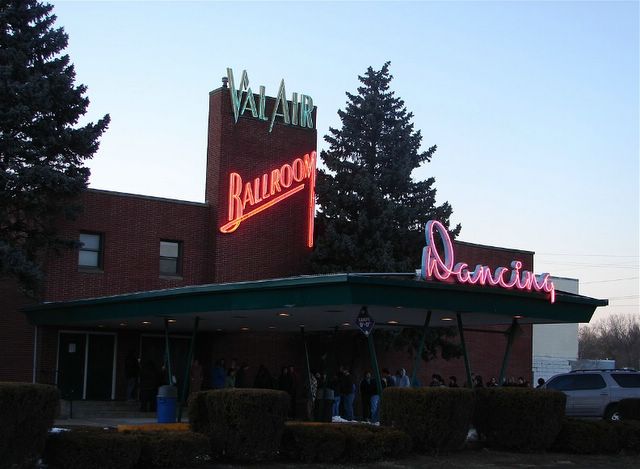
The Val Air Ballroom was a venue that I’d never been to before, but the retro vibe makes me want to check out a few more shows there again. Check out what greeted us as we approached:

How fucking bad ass is that? It’s a ballroom in every sense of the word and I’m sure a few rugs were cut on the hardwood floor during its heyday.
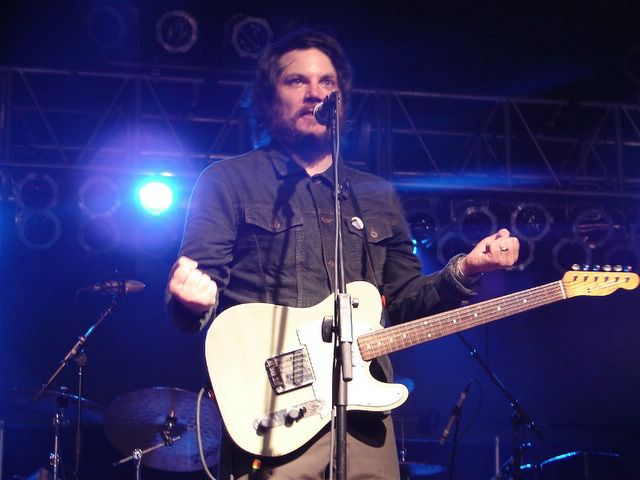
Opening with a stellar “Handshake Drugs,” Tweedy and Co. looked as haggard as ever, sporting the obligatory boycott of the new Gillette razor and a few new faces in the lineup that I didn’t notice when I saw them last (the tour before “Yankee Hotel Foxtrot” was released).
Whereas that show truly seemed like a band effort, this Wilco seemed like Tweedy’s baby; he’s filled the band with very capable musicians who can appropriate his vision without challenging it. So far, it’s working. “A Ghost Is Born” probably wouldn’t have been made with Jay Bennett, and truth be told, I don’t think I’d like a show filled with Bennett’s request for “easy rockers.”

Jay’s exit has led to guitarist Nels Cline’s arrival. This guy can flat out play, whether its tearing up the Jazzmaster ala Robert Quine or settling back with a lap steel, Cline’s only downfall was making a few accidental noises during a soft take on “The Lonely 1,” a song that typically only features Tweedy with an acoustic. The glitch prompted a smile from Jeff and a few lighthearted laughs from the understanding crowd.
Speaking of: the audience was unlike any I had seen before. It was a mixture of general admission drunks, middle-aged hipsters, and even a few grey-haired boomers who didn’t seem too thrilled with some of the evening’s feedback laden landscapes.
The one song that everyone seemed to agree on was the final selection, a note-perfect rendition of Blue Oyster Cult’s “Don’t Fear The Reaper.” Featuring the drum tech on cowbell, the band channeled the facsimile with precision and with the carefree attitude of a group on the last show of a tour and with nothing to really promote.

Setlist:

Handshake Drugs
I Am Trying to Break Your Heart
Forget the Flowers
Hummingbird
At Least That's What You Said
On And On And On (the new one)
Shot in the Arm
Poor Places
The Lonely 1
Spiders (Kidsmoke)
Jesus, Etc.
Theologians
I'm the man who loves you
Walken
I'm a Wheel
Encore #1:
Misunderstood
Far, Far Away
Magazine Called Sunset
Kingpin
The Late Greats
Encore #2:
Red Eyed & Blue
I Got You
Hoodoo Voodoo
Don't Fear The Reaper

Wednesday, March 29, 2006

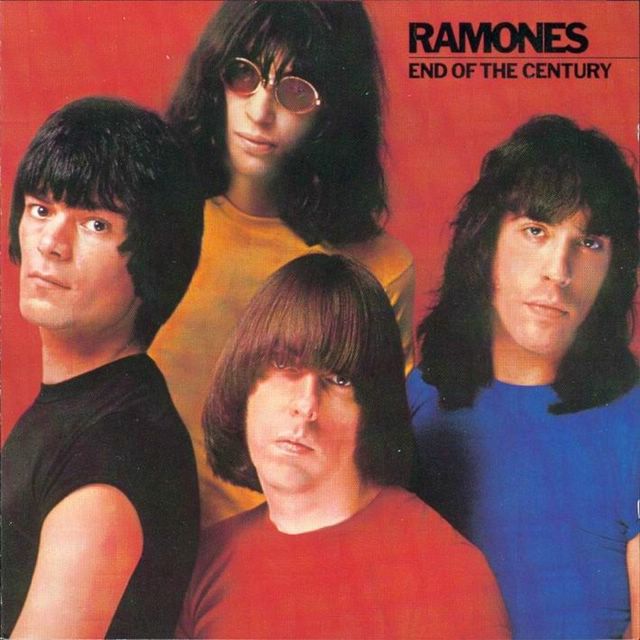
The Ramones-End Of The Century

So a former assistant of Phil Spector files suit against him and I’m reminded to review The Ramones “End Of The Century” album.


By 1979, The Ramones understood that they’d essentially painted themselves into a corner by repeating their “formula” over the course of four albums. It was time for them to either go for broke or forever be linked with the underground minions of rock music. Since the bruthas regularly acknowledged their love for late 50’s/early 60’s AM radio, it was no big stretch of the imagination that they partnered with a legendary icon of this era: producer Phil Spector. At the time, however, the press made the pairing out to be a huge deal; I specifically remember when this album was released that the entire focus was on Spector and The Ramones teaming up. I remember reading that there was some “tension” during the recording of this album, but the whole idea of a Ramones presented in a monophonic wall-of-sound recording is, to this day, a very logical and positive idea.
From the lead-track, “(Do You Remember) Rock ‘N Roll Radio,” the combination works out in a great way. The song perfectly epitomizes the nostalgia of 60’s radio (and early 70’s too, with a sly mention of T-Rex) while eloquently containing the simplistic power of this New York City quartet.


Although not as essential as The Ramones debut, “End Of The Century” remains an important document in their catalog and I’ve found myself repeatedly spinning it lately. The remake of Dee Dee’s “Chinese Rocks” and side one’s closer “Let’s Go” hark back to traditional Ramones territory, but the biggest difference is how Spector puts Joey’s vocals higher in the mix. Curiously, Spector was taken by Joey’s vocal abilities and occasionally confided in him that the rest of the band was simply holding him back. For myself and most fans in general, Joey was always the goofy one up front while the rest of the Ramones managed to forge ahead with some rudimentary chords and energetic tempo. What Spector did is put the spotlight on Joey and force the rest of the band into a recording technique they weren’t accustomed to. Rather than roll tape and record the performance, Phil made the band do take after take of the same song. Since Joey was Spector’s baby, and since this was the first Ramones recording to feature Marky on drums, Dee Dee and Johnny became frustrated with Spector and disenfranchised with the entire project.
Personal dramas aside, the end result is an album that not only marked the first time they attempted to departure from the traditional Ramones sound and “End Of The Century” marked the last truly great Ramones album.

Tuesday, March 28, 2006

Paul Stanley-People, Let Me Get This Off My Chest

For over a month, an unofficial Paul Stanley disc has been frequenting the cd player. Before you think that this is some musical follow-up to Stanley’s 1978 Kiss-era solo effort, remember that some of Paul Stanley’s best material is when he’s introducing his musical material. “People, Let Me Get This Off My Check” is a 70-track compilation of Paul Stanley stage banter recorded throughout the world in various venues during various tours, both Kiss and solo gigs.
If you’ve ever been to a Kiss concert (my review of a 2000 show), you’ll know that half of the concert is essentially Paul Stanley bullshitting the audience and making them believe that the next song is the second coming of Christ. The funny thing is that 1.) Stanley is Jewish 2.) His shtick repeats with alarming frequency and 3.) the whole notion that a band so devoted to giving a spectacle of a show has to remind everyone in attendance that it’s a spectacle of a show is fairly disingenuous. For some of us, that’s what’s fun about seeing a Kiss show; you get the sense that both you and Stanley understand that the entire spectacle is not really about the music, but in the way you sell it.
And sell it he does. Every. Fucking. Song. This fucker cannot shut up. Seriously. The great thing is that material is hilarious, and hats off to the dude who decided to compile all of this shit. There clearly is a market for people who think Paul Stanley is ten times funnier than Dane Cook.

Having only seen Kiss once in my life, it surprised me that many of the same rants included on this disc were verbatim the ones that I witnessed live. It shouldn’t have surprised me as this was a band that calculated almost every single move from the moment somebody in the band said: “You know what we should all do? Put some whiteface on!”
Paul repeatedly reminds the Army that they’re getting their money’s worth (presumably, it’s the audience that he’s referring to), that the next tune is the first time they’ve played it on tour, that he was talking backstage to someone (The promoter? The beer vendor? The caterer?) about what kind of alcohol that people in the area like to drink, that they’re just getting started, and that he’s got an “uzi of ooze” in his pants.
He continually states the name of the city they’re playing in over and over. He yells out some very unheavy phrases like “Yes indeed” and “Oh, my goodness” and does nothing to curtail the rumors that he is a homosexual by asking “Guys, how many of you liked to get licked? You lick me; I lick you.”
In almost every bit of dialogue, Stanley is practically yelling at the audience for no good reason. Its one thing to give an obligatory “I can’t hear you,” but to repeatedly scream “Can you hear me?!” is criminal. Fuck yes we can hear you dude! With your fucking p.a. they can hear you all the way in Greenland.

Tuesday, March 14, 2006

Love Is All-Nine Times The Same Song

Sweden rocks. But I’m partial to that country; at my parent’s house, there is a cedar chest that my relatives brought over from Sweden when they immigrated over in the late 19th century. There’s also a Swedish bible, but I haven’t even bothered reading the English translation. If you haven’t guessed, I sold my soul to rock and roll.
So go ahead and throw Ace of Base, Roxette, and even Yngwie Malmsteen at me. I’ll raise you a ton of great bands that demonstrate a consistent stream of innovative rock music.
One of those bands is Love Is All, who released “Nine Times That Same Song” belatedly this year (it was originally scheduled for a 4Q ’05 release) and it’s another example of how Sweden rocks.


You’ll initially notice that Josephine Olausson sounds a lot like Karen O of the Yeah Yeah Yeahs. But Karen O sounds a little like Marion Coutts from Dog Faced Hermans and (sometimes) like Chrissie Hynde from The Pretenders. Spin “Nine Times That Same Song” a few more times and you’ll start to notice other things, like how the band fucking rocks. By “rocks” I mean in that late 70’s/early 80’s post-punk kind of way when bringing a trumpet into the mix and throwing in a reggae dub arrangement was considered “punk” enough to even be considered.
That’s a good things, sometimes, particularly when your vision exceeds your actual recording budget. A lot of “Nine Times That Same Song”’s charm actually comes from the low-fi recording technique. You have to struggle to find some of the musicianship that’s deep in the tape hiss, but when you do, you’ll end up like me and spin the thing more times than you wanted to during your initial Yeah Yeah Yeah’s comparison.
The album, perfectly timed under 40 minutes, focuses on one subject matter: love. Specifically, the roller coaster of it all. One moment, Josephine sounds giddy and hard to contain. On others, she’s dark and frustrated. Been there before? Me too. We all sing the same song of love, but most of us have never made an album as clever and captivating as this one. Like Roxette told us: listen to your heart.

Sunday, March 5, 2006

The Arctic Monkeys-Whatever People Say I Am, That's What I'm Not

Remember when I said how The Strokes were an influential band, particularly across the pond? By “pond” I meant Atlantic ocean and by that I meant England. By “influential” I meant that dozens of British bands took a look at the Strokes blueprint and started dishing out a shitload of smug young rock bands. What’s cool is how many of these bands managed to actually outdo what the Stokes started. So while we’re reeling in the disappointment of the Strokes third release, we’re suddenly enraptured at England’s Arctic Monkeys debut album “Whatever People Say I Am, That’s What I’m Not.” How much are we reeling? The album became the fasted selling debut indie album in England’s history and, holy shit, the album sold enough copies here in Amerikkka to debut in the top forty. The Strokes are probably laughing their asses off at how the Monkeys are going to work efficiently while the English music press prepares to dismantle them around the time they begin working on their second album.
You see, every other week, N.M.E. et all seem to “discover” a new flavor and force feed it down our/their throats until we can’t even look at eating it again. It’s the same reason why the SLF can’t eat plain M&Ms. It’s the same reason why another friend can no longer eat Pringles. It’s why I can’t get near cocaine, but that’s another story. What you’ve got to consider in these cases is the source (English music press) and take it with a grain of salt and a few free downloads before you formulate your own opinion. But here’s a case where I would strongly encourage you to avoid listening to the editors of the N.M.E. and, instead, listen to this awesome debut from a very capable rock band from Sheffield, England.


You’ll immediately notice that there’s nothing really new here. You won’t care, either. “Whatever People Say I Am, That’s What I’m Not” will hopefully be a mantra that the Arctic Monkeys believe in, because whatever me, you, or the N.M.E. says about them, these guys (for the time being) seem to be having a good time at what they’re doing and they do it quite well. Think back to how good The Stone Roses debut is and then how let down you felt when “Second Coming” came around. You waited for that fucker forever and, because of its limitations, you felt a little silly about getting all hot and bothered over their debut, didn’t you? But before that second record, you couldn’t tell enough people about the Stone Roses. You did the same thing with Oasis. You might have even done it for Blur, didn’t you, you silly little Anglophile? All I’m saying is that the new Arctic Monkeys record will make you feel the same way, and apparently over a 100,000 English kids feel it along with 30,000 “hip” Americans, according to the last SoundScan figures. So you can try and deflate this, if you’d like, but the rest of us will be digging on the record’s solid delivery of 13 well-crafted-and-even-better-execution-of rock songs. It’s the album The Strokes wish they would have made, but they didn’t and now we have to deal with the fact that some British kids did and did it better.
The biggest difference is that that Alex Turner writes way better than Julian Casablancas does and better than most rock lyricists around today, English or otherwise. He’s got a keen eye for observation and a savvy way of putting them down into clever couplets. Check out this line from their “Fake Tales Of San Francisco”:

“And as the microphone squeaks
A young girl's telephone beeps
Yeah she's dashing for the exit
she's running to the streets outside
"Oh you've saved me,"
she screams down the line
"The band were fuckin’ wankin’
And I'm not having a nice time”

An incident like this has happened in any club in America while a local band struggles to find their sound on stage in front of a couldn’t-be-bothered audience. But it took a bloke like Turner to turn it back on us. With a line like that, it’s impressive. What makes it better? The next line. In it, Turner notices the girlfriend of one of the band member. She obediently watches her man on stage, enjoying the sounds of her struggling partner while others talk on their cell phones. “..proof that love’s not only blind, but deaf.”
Something like this may have actually happened during the band’s brief existence and, I’d like to think, prompted them to really focus on their chops and become the shithot outfit that we hear on this record. I’d love to see this band live, but it looks like I’m not the only one: the brief American club tour they’re about to embark on is already sold out and, guaranteed, not one person will be running away from the stage to talk on the phone.


Most of the negative reviews that I’ve read about this album point to the entire “derivative” nature of it. It is derivative. Ain’t that the point of a band that essentially takes the ball from a couple of admittedly derivative bands (Libertines and Strokes) and rocks the shit out of an impressive lyricist’s material? And while the Libertines focused their eye on junkiedom and while the Strokes professed to be bored in a city that never sleeps, Arctic Monkeys seem content and credible to focus on regular blokes. Since when is it a bad thing that a few regular blokes actually demonstrate enough ambition to become proficient at their instruments? The album rocks and those that have it probably know this by now. Those critics that actually are dumb enough to expect an epiphany moment because N.M.E. hipster says so doesn’t deserve the free album copy they were provided.

Saturday, March 4, 2006

FM3-The Buddah Machine

The Buddha Machine” came via USPS yesterday. I’ve messed with it. Had sex with it on. Took a shit with it. And I’m still as confused as you are reading this. From what I understand, an Ambient duo Christiaan Virant and Zhang Jian that go by the name of FM3, came up with a very pretentious idea of releasing their work via a hardware device in an age where people typically use software (cds) or programs (mp3s) to listen to music on.

I know nothing about the artists, the above names were gleaned off of the machine itself, and I can tell you nothing about the songs. The majority of the lettering, including the colorful box it came in, is in Chinese. What “it” is requires you to do is to consider a small plastic box, about the size of a small Walkman. The device has a cheap speaker (monophonic), an earpiece jack, a 4.5V jack, a red light, an on/off/volume control, and a switch that moves left or right. That’s it.
With no instructions and no familiarity with the Chinese language, I was forced to put in two double-A batteries (included) and start playing with it. Once on, the shitty speaker produced an ambient loop that continued….indefinitely. Once I switched the side button, a new loop started. This repeated nine times, until I identified the loops that I liked. From there, you just leave it alone. Seriously.
These aren’t “songs” in the traditional sense and you won’t find yourself singing/humming/whistling along to any of them. As a point of reference, one of the loops sounds like the music in “Close Encounters of the Third Kind,” but less irritating. The last song, which has a loop that’s only about a second and a half, is irritating. I don’t listen to that one much; it sounds like a record skipping.
I suppose I could plug in some headphones and listen to it, but why? The cheap speaker provides additional nuances. I can play it softer for calming backgrounds. I can turn it up (it doesn’t get very loud) higher and make the speaker crackle with the loops. The idea is brilliant: music that has no end and will only stop when the power source runs out. The idea isn’t for everyone. The SLF had no other reaction to the Buddha machine other than the obvious questions:
  • What does it do?
  • Why did they do it?

I suppose I could have gotten heavy with a discussion of Buddhist spirituality, minimalist art and the theories of Brian Eno, but that would only add to the pretentiousness of it. Instead, I suggested that we allow it into the room we get frisky in. An acceptable level was agreed upon and it was set aside. We really didn't notice it during the activity, which was and is the point of "The Buddha Machine." I was instructed to turn it off when we retired, but if I had my way, I would have let the thing play all night.

Friday, March 3, 2006

The Strokes-First Impressions Of Earth


I’ve received 318 e-mails asking me for my thoughts on the new Strokes album, “First Impressions of Earth.” Think of this as my first impression of “First Impressions of Earth,” which actually would mean several impressions as I played the thing a few dozen times in the car, which may lead you to believe that I really like the new Strokes album, which wouldn’t be true at all.
It’s not as bad as you might think, and you need to consider the following before continuing:
1.) I bought The Strokes’ debut single when N.M.E. was shitting all over themselves at these spoiled, prep school rock boys.
2.) I spent additional cash to get the naughty cover copy of “Is This It,” an album which, regardless of your own opinion of this band, will continue to be highly regarded and highly influential, particularly across the pond.
3.) I think “Room On Fire” is a great follow-up, one that only suffers from being released immediately after the Strokes backlash began and from sounding too much like, go figure, a sophomoric album.
So what’s a touted rock band to do when poised to release their third album? You expand it. Fill it out. Polish it up.
It starts out great; “You Only Live Once” contains everything great about the band and builds a blueprint of what they needed to do to remain relevant after more print was spent on what The Strokes wear than what they sound like. For sure: when you start reading more about the parties the band attended than a show, a song, a session, it’s not hard to jump on the nuke the Knack bandwagon.
The second song, “Juicebox,” the album’s divisive first single with a Peter Gunn guitar riff underneath a snotty Julian Casablancas delivery, raised a few eyebrows when, by the time of the chorus, he actually sings. And if you recall, boys and girls, Lou Reed never really sang and we tolerated Tom Verlaine’s voice knowing that he was just setting up for an unbelievable guitar solo.


Saint Julian doesn’t play guitar. But guitarist Albert Hammond and Nic Valensi do, and “First Impressions of Earth” is the first Strokes album in which we see how good they’ve become over the past five years. Example: on side one’s closer “Vision of Division” the guitar solo absolutely shreds, and when the racket finally ends, Casablancas mutters “I’m such a success.” Perfect.
When you reach the end of side one, you start to consider that “First Impressions of Earth” is, in fact, a very good album. The problems start creeping up immediately at the beginning of side two. One of the things that was cool about The Strokes was a common complaint lodged by their detractors: they’re boring. Exactly. That’s the point. Boys in their early twenties in New York City that seem positively bored with their surroundings. Huh? Try spending a weeknight in smalltown Iowa, fellas. Now, particularly with “Ask Me Anything,” they seem not only bored with their surroundings, but bored with the notion that they’re supposed to actually deliver a stellar third album. More than ever: this was supposed to be their comeback album, and side two sounds like they’d rather be at a fucking cocktail party instead of being in the studio. Proof? I swear that Julian said something like “Took a shit/It was fine” in the song “15 minutes.” I’m not sure about this. It sure sounds like he said this. The point is, when you start mumbling about bowel movements, maybe it’s time to consider a career change.
Why haven’t they? Julian seems to answer that on the last song “Red Light” with the line “Do it for the people that’d die for your sake/An entire generation that has nothing to say” which may point to why they finally gave up. Why bother striving to release an intentionally excellent album to a fickle Generation Y who’ve already moved on to another next big thing and who will just download your shit for free anyway? The point is, gentlemen, because you’ve got to give us a reason to buy your shit. It seems that everyone but Julian on this album understands that rock music is their fucking job, and while his cynicism is kind of precocious in small doses, over the course of an entire album side, he turns into the guy at work that nobody likes to socialize with because he’s always got a chip on his shoulder. Lighten up, buddy. There’s a lot of us who still dream about fucking models while RCA picks up the bar tab for the entire evening. The frustrating thing is how, if he would have invested just a little more focus on “First Impressions of Earth” the band would have delivered what was expected of them on their third offering.

Monday, February 13, 2006

Low-Live Review

Chan Marshall cancelled her latest tour because she went crazy again, so what’s a guy to do but go see a show fronted by another looney bin. Alan Sparhawk, vocalist/guitarist/writist of the Duluth, Minnesota band Low, released the band’s most accessible album last year and then went crazy immediately before they embarked on an American tour. Now, not only does this mean that your label (and your band) are set to lose thousands of dollars in sales resulting from your craziness, but it also means that people are going to look at you in that “Will he flip out?” stare. So a tidy number of us set out to see a real live trainwreck in a funny little bar/restaurant that served a mediocre grilled cheese sandwich.


Late last month, Sparhawk did a nutty little interview with Pitchfork, which eloquently repeated his “Here’s how crazy I got:” story, along with a bizarre Mormon + Pot = bass player leaving story. Like a hockey crowd looking for a fight on the ice, there were lots of us there that understood a minor meltdown may be afoot if the crazy stars aligned themselves just right.

Sidenote
I’m so fucking angry at myself that I spelled “there” in the last sentence as “their” and spellcheck caught it before me. Stupid Stupid Stupid. I feel like such a retard right now.
End Sidenote


Having seen Low before several years ago, I knew that drinking a lot of High Life may create a sleep coma when mixed with Low’s “slowcore” tempos. But Sparhawk has wisely implemented some expansion efforts in his material as their music developed a bigger arrangement on the past three albums. Fine, then. I’ll stop at three High Lifes.
The polite audience sat down, hippie style, in front of the stage. Luckily, our seats were positioned directly off stage left, with new bassist Matt Livingston’s scrawny ass just four feet away from my face. A few things about Matt Livingston:
1.) He’s got a very scrawny little ass
2.) He needs to pull up his pants
3.) The elastic band on his boxers is showing
It was a very informal performance, with stripped down renditions of their last three albums taking up the majority of the set list. One song was aborted momentarily, after Sparhawk realized mid-verse that they’d begun in a higher key than he could sing in. Livingston and Mimi Parker kept going while Alan lowered the strings after asking permission from his invisible friend, Dr. Minnetonka. He then pulled out an apricot and yelled “Stop looking at me!” at the audience.
Alan then tried to kill himself by adjusting the stage lights in front of him despite being electrocuted doing the same thing once before.
His wife, Mimi Parker, occasionally ribbed him by telling him that he had “too many gadgets” for his guitar and other hurtful comments. Alan started weeping uncontrollably until a roadie came up and offered a huge joint that would take him directly to his “happy place.”
Mimi’s kit remains as primitive as ever, and Alan spent the majority of the night behind an acoustic guitar (with a bunch of guitar-effect pedals) carefully channeling an almost morbid muse. The other thing that remains with her presence is the unbelievable harmonies she adds. This is critical. With Low, things move at a snails pace, requiring listeners to be attentive to every detail. Mimi’s voice adds a very ethereal element to a very dirge-like rhythm. It’s clear that Low wouldn’t have been able to sustain an over decade long history without her contribution.

A girl that looked an awful lot like Harry Potter yelled out “Sunflower” when they came back for an encore. They started playing it (most awesomely, I might add) and then the Harry Potter girl scream “Yes!”, clapped her hands together and then pissed her pants
The “hit” “When I Go Deaf” ended the three song encore in a swell of feedbacks until Alan finally declared “I think we’re done now.”
Three other interesting things about new bass player Matt Livingston:
1.) His second touring bass is one of those Steinberger ones
2.) He wears glasses
3.) He’s a pretty nice guy
“When they finally found your body/Giant x’s on your eyes” starts the uplifting “Sunflower.” I suppose I’m a little grateful that they didn’t find Alan at the end of a noose. I’m glad he’s apparently gotten his shit just a little bit together. And, considering how his child with Mimi is probably ready for kindergarten and how touring may not be a viable option soon, I’m glad I took a night off see Low on their “Crazy From The Weed” tour.
Setlist:
Dragonfly
Monkey
Sandanista
In The Drugs
California
Amazing Grace
Condescend
Pissing
Violent Past
Lazy
Murder
Encore
Over The Ocean
Sunflower
When I Go Deaf

Thursday, February 2, 2006

Bruce Springsteen-Born To Run The 30th Anniversary Edition

An admirable man, Henry Rollins, once said “You got ‘my-bossman’s-a-motherfucker-and-I-want-to-cut-his-balls-off-and-shove-them-right-down-his-throat’ blues!” and he was right. The boss is a micromanaging fucktard and he has been the subject of my ire for the past few weeks. The motherfucker is nickel-and-diming me with my bonus payout and when you fuck with the cashflow….Well it’s whatever the guitarist from the Dwarves said to the verbally abusing audience member back in ’96 after the lead singer smacked the aforementioned verbal abuser in the face with his microphone, Rodger Daltry style.
But this story ain’t about my boss. It’s about our boss. The one from Jersey. That dude who you’d, for whatever reason, like to be able to “pfft” but can’t because, well, he writes such fucking good songs.
For me, that “pfft” would come around the time that “Lucky Town,” or whatever the fuck it was called, came out. Then again, I actually went to a Springsteen show during the “Lucky Town” tour and the thing fucking rocked. This guy managed to completely destroy, for the better part of three hours no less, and he did it without the help of The E Street Band. Bruce Springsteen, if you haven’t heard, puts on some righteous live concerts, and no true rock fan should die without attending one. Period.
I couldn’t tell you one member of his band from that tour/album. The only thing I can tell you is that when you go to work for The Boss, he expects you to be proficient at your instrument and be willing to work overtime.
Apparently, his live abilities aren’t an isolated event; Springsteen has consistently owned live shows for his entire career. The first concert I saw with him included the E Street Band and it too ranks high as one of the best shows I’ve ever been to. And that second show without the E Streeters would destroy over 75% of the rest of the shows I’ve seen.


Springsteen released the 30th Anniversary edition of the album that propelled him into superduperstar status: “Born To Run.” I’ve got to confess to not owning a single Springsteen disc (I only have vinyl copies) so I didn’t have the feeling that I was getting fucked in the ass when Columbia re-issued it with a cleaned up sound quality and bonus material. The bonus material is actually two DVDs: one of the making/back-story of the “Born To Run” album and a live DVD from Bruce’s first U.K. appearance that coincided with the release of the album. No bonus tracks are included with the package, which is actually a nice twist-Springsteen and the packagers force you to consider the album in the same context as its initial release. The difference being the bonus material that is included allows the fan to act as a fly on the wall for this album, from start to finish. The only thing that isn’t included is the impact it had on Springsteen himself. From this point on, he became a high profile artist for Columbia and for rock itself. In my opinion, when you consider the body of work that Bruce has taken since this release, he’s handled himself remarkably well and remarkably consistent. I’m hard pressed to find a period of his work that would be considered “a low point.” Bruce’s early 90’s work was mediocre, but I wouldn’t consider it embarrassing. If anything, it prompted a special edition version of “Born To Run” because you tend to forget the reasons why an artist becomes universally revered. And this special edition reminds us that the reason why we revered him.
The first reason is because “Born To Run” is an essential album. Masterfully written and impeccably executed, the music transcends time and the quality of it remains as relevant today as it was in 1975. Which got me thinking about how it was actually received in 1975. My guess is that, because it is musically flawless, it may have been looked as a polished effort, sonically enhanced by producers intending to make a big sounding record. The thing is, “Born To Run” the song is a big song to begin with; it may be the reason why there are no demo versions, alternate takes, or early mixes of the song. They show the progression of the song, how it achieves that Spectoresque-sound, but this is part of the video extras.
The other thing I noticed from the presentation of the album is how expertly it was sequenced. I’ve long felt that album sequencing has become a lost art during the CD era; here is a perfect example of how sequencing can influence the impact of an album. Firstly, the album has a bare-bones number of songs: 8 tracks. But every one of those tracks is critical to the story “Born To Run” provides us. Today, and ironically Springsteen is guilty of this too, albums are filled with tracks that merely add to the total time. Case in point: Springsteen could have made a really good record in 1992 if someone with some balls had combined the entire “Lucky Town” and “Human Touch” albums and brought it down to only ten cuts.
“Born To Run” knows that if you’re going to make an epic album, every cut counts. Every cut does: from the Broadway-via-Jersey opener “Thunder Road” all the way to the closer “Jungleland.” Springsteen was forced into a make-it-or-break-it scenario and he throws it down. “Show a little faith/there’s music in the night” he barks in “Thunder Road,” and with an image like that he masterfully throws down an everyman line “You ain’t a beauty/but hey, you’re alright.” And that’s a perfect example of why he’s on the same playing field as a Dylan, Davies, or Townshend; the notion that a smart blue-collar bloke can get out of their cul-de-sac using words can inspire even the not too literal.


The live DVD shows Bruce and his updated E-Street Band finally arriving over the pond to bring this very American sound to the country’s forefathers. The performance is just as theatric as the album, with the E-Street Band perfectly executing the current crop of titles with those that made a name for them in New England. The audience remains intently focused on him, perhaps asking how such a bloke could evoke the same amount of sheer drama as a Ziggy who needed platforms to demonstrate his own larger than life sound.
“She’s The One” begins as a harp train traveling through Bo Diddly territory before arriving at the familiar album rave up. Springsteen crawls in, around, and over the stage, playing the spotlight like a master. But the real masters are the band themselves, who with every song, throw down a good shift and let the boss take credit for how good the performance is. Seriously, the fact that cameras were able to catch this performance is a blessing. Just as he knew he had to make “the” album with “Born To Run,” Springsteen understood that he would have to provide this English audience with “the” performance to justify the hype that arrived on their shores before they even played a note.
They deliver. It’s a spectacular performance and one, I’m sure, few in the audience forgot about. And a performance that we now can witness to have a solid frame of reference of why the boss deserves our respect.

Saturday, January 28, 2006

File Under: Popular Music

My record collection is waiting for your admiration. Admittedly, there’s a part in every music collector’s ego that secretly wants a fellow fanatic to come over and admire the fruits of their labor. That labor, incidentally, is nothing more than shelling out moneys for an overpriced piece of plastic that somehow represents a memory trigger of an incident, feeling, event, or individual that has now been reduced to a fading image. That aural reminder vaguely colors in that image, and for a select few of us, we’re willing to invest a large portion of money for this. And we’re willing to look silly in the minds of others who just don’t get it.
There are definitely others that we’ve observed over the years that have done the same. We remember these individuals too, and sometimes, we get a little envious over the quantity and quality of their collections.
The first one that comes to my mind was a friend of my parent’s named Eric. His wife worked with my Mother and the two became close friends, which in turn, meant that my Father had to socialize with the couple too. Not that he minded; Eric and my Father would become drinking buddies and I can remember being dragged along to become the proverbial third wheel in their social activities. These activities usually involved card games, board games, softball leagues, and Sunday barbeques.
Typically, we would go over to their house and some times they would visit our house. I had my own creative ways of entertaining myself when they came over, but I really enjoyed those times that I was brought over to their house. Eric had the largest record collection I had ever seen at that point. It spanned the bottom half of a wall and it contained pretty much every popular album from 1965-1978. He was a huge Beatles freak, which was a plus, and I specifically remember him showing me a “White Album” re-issue that he purchased with limited edition white vinyl. “It will be worth a lot more someday than what I paid for it.” He explained. Never mind the fact that he already had an original pressing that is probably worth more, but I didn’t know that at the time. I was just impressed with his enthusiasm.
Eric worked for the coast guard, and I remember him getting drawn to Gordon Lightfoot’s “Summertime Dream” album because it contained the hit “Wreck of the Edmund Fitzgerald.”
He also was the first person to expose me to Frank Zappa. Eric bought “Sheik Yerbouti” when it first came out and I overheard him talking about how raunchy the latest Zappa album was. While the couples played cards in the kitchen, I was given full access to Eric’s collection and stereo, provided I listened to everything on headphones. I immediately located “Sheik Yerbouti” and put on side one of the offensive effort. After side one alone, I learned that sex was stinky, that tampons can ruin plumbing, that “poop chute” was another name for an asshole which was another name for your butthole, and that ugly people should die. It was quite a mind-blowing experience for someone who was only 12. When I went to put on side two, Eric walked past the stereo on route to the bathroom. He saw me playing that Frank Zappa album and said “Man, you really shouldn’t be listening to that.” He didn’t stop me though, and he did the responsible thing of telling my parents that I was in the other room listening to the Zappa album he was talking about earlier. Neither parent got up to request that I listen to something else, so I learned about a homosexual sex spastic named Bobby Brown.
Eric chastised me for listening to Cheap Trick’s “At Budokan” too much. He also didn’t think it was cool that April Wine used the same guitar line as “Day Tripper” at the close of their “I Like To Rock” track.


He did teach me some critic things in my music obsession.

  1. Number one: When making a mix tape, try to put like era/like artist cuts together. It was a strategy that I used until 1989.
  2. Don’t use that shitass Memorex normal-bias shit. Throw down the extra cash and get that Maxell XL-II shit. High bias. Chrome. Aw yeah!
  3. Wipe that shit down before you play it. Grab that Discwasher fluid, trickle it on that big ol’ brush and get that lint off the vinyl, bitch.

So then I started collecting stuff, alphabetizing it, and spending money on plastic record sleeves. Once, I was talking to a friend who really didn’t have much of a collection himself and he mentioned that he knew this guy that used to be an Assistant Manager of the local Disc Jockey record store, or some shit. We made our way over to this dude’s house one night and we rolled a j with him. His entire wall was vinyl, and I remember specially ordering Syd Barrett’s “The Madcap Laughs” from him at the store. He said I was the third person in the past week that had been asking about Barrett, which made me happy, because I remember talking about the original lead singer of Pink Floyd with them at school that week. It was nice to know I had aligned myself with fellow music explorers.
I immediately asked him if he remembered the Barrett incident and he did. He showed me some bootleg Barrett vinyl that he had and I asked if I could borrow it. “I don’t lend out albums.” He explained. That’s the best lesson a fellow fanatic has ever told me: if you really love this shit, then you won’t treat it fleetingly. From then on, I never loaned out any of my records to anyone.
He did let me return some other time and record the album on his own stereo. That was pretty cool, as was his acoustic rendition of Floyd’s “Wish You Were Here.”
He was the man in Keokuk, Iowa, but he was nothing like the freak in Waterloo I met years later. Tom, a man who had a record store once, got cancer, quit the business and became this hermit-type of guy who lived with his Mother. Almost the entire basement of his house was filled with alphabetized cassettes, reel tapes, vinyl l.p.’s, singles, every fucking format known to man.
He had everything no matter how obscure. He was proud of his collection and he would litter each conversation about the magnitude of his old store and how majestic his new store would be, if he could just get it off the ground.
Tom provided me copies of rare albums that he insisted that he use his own equipment for. It would take him a week to fire up all the components on it and he had some theory about taking noise reduction techniques out of records during the transfer of audio to a cassette tape. It was crazy, and most of the copies he made for me ended up sounding dull and flat with no high end and a very barky low end. Tom had the original copy of Television’s “Little Johnny Jewel” single and an original copy of The Replacements “The Shit Hits The Fans” live album released on cassette only.
Tom later moved out of his Mother’s house and got an apartment in the downtown area. Right below his apartment was his new record store, filled with inventory of albums that he didn’t want anymore. It was pretty underwhelming, as Tom really didn’t want to part with many of his albums. The store closed about a year later.
Finally, I vaguely remember the record collection of a female roommate who lived with some friends of mine. She seemed fairly reserved. An East-coast bohemian type who eventually fucked one of my friends (also a roomie) and who’s name I cannot recall. Strangely, I do remember her record collection. She left one holiday to return home out of state and I snuck a look at her goods. Amazingly, it was primarily reggae music, deep catalog stuff, with a few new wave albums leftover from high school thrown in to add a sense of history. Peter Tosh, Bunny Wailer, she even had a huge stash of Black Uhuru albums. What devotion! I found it admirable that she had found a specific genre and completely embraced it to the fullest. Her stringent collection impressed me more than her Christian name, and the drama of fucking a roommate led her to eventually split very abruptly from the house and take Natty Dread with her.


Her collection told me not to go beyond my own musical capacity: Her comfort zone was reggae. To this day I have not delved headlong into jazz because, honestly, I have a lot of uncomfortable feelings about improvisational musicianship that goes beyond my own musical understanding. I understand “Jailhouse Rock.” I understand also that “A Love Supreme” is more spiritual than I can comprehend.
There are some other collections that have stayed with me over the years too. It’s reassuring to know that there are others with the same ailment as me, and it’s interesting to see where and in what areas their collections have grown. Some are completists. Some have narrowed their vision to a particular time or genre. But everyone of them can tell you a story if you’re fortunate enough to admire them.

Sunday, January 15, 2006

Life Changing Baker's Dozen

I think this topic has been addressed on this blog before, but I recently examined my musical past and determined the top ten albums that utterly defined my music tastes and changed my way of “listening” to things for evermore. At first, I wanted to make the list as highbrow as all get out. But then I realized that would be a disservice and, for lack of a better word, a lie. I mean, if a guy has a life-altering experience after hearing Rainbow’s “Difficult To Cure” album (read: one of the worst albums ever made) then so be it. If Queensryche’s “Operation: Mindcrime” album open the door to another planet for you, that’s your link. A real man would point to that album and stand by it, no matter how uncool or passé that album was/is. Unless that album happens to be Rainbow’s “Difficult To Cure.”
The key would be to have some passion in your explanation of what makes that album a watershed mark. If you really dug Rush’s “2112” and that’s what got you to listen to lyrics, then that’s an influential album.
Also, it’s got to be a “big picture” album. For example, I’ve got a ton of stuff that I could point to specific areas of preference. David Bowie is a hugely important artist to me, but it was Alice Cooper that led me to David Bowie in the first place, so “Love It To Death” would be on the list instead of “Hunky Dory.” But what led me to Alice Cooper? That’s where it gets tricky. I’m going to try and give it a stab, so let’s take a look at the records that made me into an elitist music snob.

1.) THE BEATLES-“Sgt. Pepper’s Lonely Hearts Club Band”
I swear to God, I probably knew the words to “Lucy In The Sky With Diamonds” before any children’s song. “Sgt. Pepper” with the rainbow ring of Capitol Records’ old label spinning in my bedroom, I listened to this album incessantly. Why my parents let me take this album is beyond me, but I had access to all of their respective singles and relatively few long players. They made the switch to the 8-track format and placed the collection too high for me to reach. I completely destroyed to actual cover after permanently engraving the artwork in my head. The songs allowed me to consider unique sounds while reveling in The Beatles’ masterful sense of melody. The other long players at my disposal were The Beatles’ “’65” album and “Meet The Beatles” and the number 2 selection on this list.
2.) THE ROLLING STONES-“Beggar’s Banquet”
The first album that was purchased exclusively for me. I asked my parents at the Woolworth’s store in Shenandoah, Iowa for this album and they bought it. I immediately wrote my name all over the American cover art and thought that “Sympathy For The Devil” was a fairly naughty song because it talked about that guy with the pitchfork and killing the Kennedys. The underbelly and ‘poor boy do?’ of the blues Started with this record.
3.) THE JIMI HENDRIX EXPERIENCE-“Are You Experienced?”
From my first exposure to Hendrix came the explanation from Dad that the guy was a hot shit guitarist. Not that I had any prior exposure to hot shit guitarist up until that point or anything and not that I would later become a hot shit guitarist myself. I simply knew the guy could play the guitar behind his bath and with his teeth. I also knew that Hendrix died too soon and that others worshipped him; my Father had an original print of Hendrix made by a student of his. This framed tribute didn’t move my Dad in the same way it moved me. He gave it to me and it found its way to the wall of my room and I associated “cool dead guy” with Jimi Hendrix. Further proof was when I brought “Are You Experienced?” to show and tell in Kindergarten while others were bringing Kermit the Frog’s “It’s Not Easy Being Green.” The stereo separation was lost on the school’s monophonic turntable and I understood that something was lost in the translation. I also understood that I needed to pay more attention to rock guitarists when listening to rock albums. Hendrix’s playing also prompted me to pick up the guitar backwards and try to play left-handed, a trait that remains with me to this day despite the fact that I write with my right hand.
4.) BOB DYLAN-“Highway 61 Revisited”
As mentioned before, the parents offered me a few albums to entertain myself when they probably shouldn’t have. There were three albums that my Dad kept hidden away that were off limits. Peter Paul and Mary’s first album was one, Pete Seeger’s “On Campus” was another, and this album was the third. The first two did nothing for me, but “Highway 61 Revisited” struck a nerve. I’d play it without my Father’s permission, and I eventually taped it directly from a speaker onto a portable cassette recorder. I also found a bunch of transcripts of Dylan lyrics that he used for English class. It signified that even Rock performers (there was no prior knowledge of Dylan’s folk roots) could be considered writers and I began to take note of the actual words within songs. This album was the holy grail of all albums.
5.) THE DOORS-“The Doors”
No other album brought me to the dark side like The Doors’ debut album. Throughout middle school (6th to 9th grade), this album was perpetually on my turntable, reflecting my disdain for parental units (“The End”), my new love of weed (“Break On Through”), and my new appreciation of girls (“Soul Kitchen”). The book “No One Here Gets Out Alive” was also read repeatedly and I started to subscribe to the live fast die young ethos. I later regarded Morrison as a drunken dipshit, but there’s no denying that the Lizard King pointed me towards a more literary direction and an appreciation to rock music’s dark corners.
6.) ALICE COOPER-“Love It To Death”
I wasn’t joking about Alice. My Father and I went to a local record store that was going out of business. They were auctioning off their remaining stock alphabetically and he placed a bid on the “B” and “C” section hoping to nab some Beatles and Cream albums. What he got instead were things like The Beach Boys, Joe Cocker, Bloodrock, Badfinger, and this album by Alice Cooper. “The Ballad Of Dwight Fry” freaked my shit, “Black Juju” was menacing, and the rest of the album was the heaviest thing I had ever heard in my life up until that point (age: 8). When I started to look into some of rock’s heavier acts, this was the album that I used as a reference point. Bands like Black Sabbath rated high on the scale. Bands like Kiss didn’t. He was also the first artist that genuinely dismayed my Grandparents when they caught me watching something like Don Kirshner’s rock concert with him on it. And anything that makes the older generation squirm is typically a good thing.
7.) THE CLASH-“London Calling”
I firmly believed everything I read about punk rock in mainstream music magazines. They were portrayed as dumb, talentless freaks….Except for The Clash. It seemed that these guys were credible, and for a thirteen year old that was enough. I swear to God that the selling point of this album to fellow classmates was the parental warning sticker that declared some of the content would be consider offensive to some listeners. I totally missed the line “he who fucks nuns must later join the church” and totally learned that punk rock sounded an awful lot like regular rock to me. Out of the big three (The Ramones, The Sex Pistols, and The Clash), these guys were first for me.
8.) BLACK FLAG-“Damaged”
When I finally got around to accepting punk as a credible rock genre, I began looking for more recent examples of it. Around the same time, a friend came back from a boarding school out East and with him, a collection of l.p.’s, singles, and mix-tapes of various punk bands. Minor Threat, Christian Death, The Avengers, Dead Kennedy’s and others all spawned from this discovery, but it was Black Flag’s “Damaged” that jumped out. There was enough novelty to appeal to the drinking buddies and enough chaos to accommodate those who continually spun Judas Priest or whatever.
9.) THE CARS-“The Cars”
New Wave fever took over America in the late 70’s, because most of us were told that Punk was a bunch of retards who couldn’t play anything, spit on their audience, and had funny looking clothing. I think the Cars were better dressed and they sang catchy fucking radio hits, of which this album is chock full of. The brilliant thing was that they were hugely influenced by a number of more less-commercial bands, and I felt obligated to investigate them right after I stopped “Moving In Stereo.” I gave up on them after “Panorama” because by the time of “Shake It Up” I was already spinning the bands that influenced The Cars rather than The Cars themselves.
10.) SONIC YOUTH-“Bad Moon Rising”
Unlike anything I had ever heard before. The scales fell from my eyes when I heard this album in college, some two or three years after it was originally released. I hated it at first, but a friend continued to praise and play it. This album enabled me to look at guitar bands in a completely different manner and look for creativity in feedback.
11.) THE SMITHS-“Meat Is Murder”
The opposite sex brought me to a band fronted by a celibate lead singer. Go figure. But liking the Smiths sometimes brought a connection to unique members of the female gender. Their misery was a perfect soundtrack to High School, and it spawned a network of mopey drama kids too sensitive to understand why they were so depressed in the first place. The American cassette version featured the new single “How Soon Is Now” as the kickoff track to side two, which made the auto reverse function fairly popular with this release. Probably their worst album overall, but hugely important to yours truly.
12.) JOY DIVISION-“Closer”
None blacker. A collegiate entry that hit in every category: depressive lead singer who commits suicide immediately before displaying his literary talents to American ears. They released two certifiable classic albums before the tragedy and I favored this, their second album, as the backing music for my entire time at college. I briefly gave up metal because of this album, because this was the “heaviest” shit I had ever heard.
13.) THE RESIDENTS-“Commercial Album”
In the back of Rolling Stone magazine was the album charts. I used to love looking at it and tracking the progress of my favorite releases. Right before the charts, a small record company out of San Francisco called Ralph Records regularly ran advertisements stating “Buy Or Die.” You could get sampler records cheap from Ralph and it featured some of the most unusual music known to Earth. One of the bands making some of the most unusual music known on Earth was made by The Residents. “The Commercial Album” was one of those records that only a few of us actually listened to and even fewer tried to describe. Not rock, not punk, not new wave, The Residents made the kind of music you’d expect if it was made by four eyeballs. They also forced me to look beneath the radar, past the album charts, for groundbreaking music.

Monday, January 2, 2006

2006: Still Tippin'

Resolution 1: Watch more boxing

I suppose I can fill you in on the personal shit now. Things are good and I’m glad 2005 is over. Moving. Starting a new job. Leaving it. Starting a new job. Putting the house up for sale. Hurricanes. War. Retards running this country. Death. New car. Lots of shit went down last year. At the end of the day, I’m fairly content. Work sucks a little ass, but I won’t hang around forever if I don’t feel like it.
Jesus is the reason for the season, and for the first time ever, I went to church on Christmas Day. A pastor whose own congregation had left him during the holidays, found his way into another church where he was invited to give the Christmas sermon. Rotund and wearing an out-of-style sweater, the pastor wanted to delve into the “heart of Mary,” but ended up confusing the majority of those in attendance with speculation on items totally irrelevant to the holiday. “But what about the myrrh?” He asked. “What about the myrrh?” He briefly explained that myrrh was used to mask the stench of human decay, which made it such an unusual gift for the baby Jesus. They also had a little slideshow and put up the bible passage “The Lord loves a cheerful giver” as the collection plate was passed.
I spent the holiday on a fucking air mattress and showered in a cold basement with a flimsy stall. The baby Jesus, on the other hand, slept on some hay while the myrrh covered up the smell of the rotting afterbirth. At least that’s what I’m guessing.
This would be the first Christmas I felt a little disconnected. I spent most of the time trying to figure out who had the motherfucking Christmas plan after it had become so routine that most in attendance, aside from me, already knew the motherfucking Christmas plan by heart. This just in: there’s a guest here with an air mattress backache that doesn’t have a fucking clue what’s going on. Throw the dude a bone and give him an idea of what the drill is. That’s a critical part in being cool.

Resolution 2: Stop smoking this year


On New Year’s Eve, I spent a shitload of money on a mediocre four-course meal that featured a bitchy old lady next to the table I was at. There’s nothing better than a retired woman bitching about how rare the prime rib is. The next day I got baked and went to “Syrianna” with the SLF. I have no idea what the movie was about. I think it had something to do with oil. Matt Damon had a kid in it who died. Tim Blake Nelson gave a little soliloquy on corruption. George Clooney has a beard. That’s pretty much all I remember about it.
You know what really grinds my gears?
“Syriana”-A plot so complex that you’re forced to give up on trying to follow the plot. Brilliant. At least give me a little eye candy to prevent me from yelling “What the fuck is going on?!” at the screen.
Wal-Mart-Every other word out of my mouth was “fuck” when I had to go there for some job-related need just prior to the holidays.
The entire staff of the C.R. Home Depot -Just make the fucking thing self-serve, cuz these motherfuckers you’ve got in there now really don’t want to be there. They hate us, and it shows.
Extended holiday hours -Fuck the "need" to get that $19.95 dvd player at 5:30 am in the motherfucking morning!! Go to bed. Stay at home.
American Bistro That wasn’t a $45/plate meal, fucktards. I’ve had better dinners at my Mom’s house.
Anyone under the age of 23-Seriously, you guys need to chill the fuck out. You don’t get it for free and the world ain’t gonna end if you don’t buy it. Learn some manners. Tuck in your shirt. Get a dictionary.
That Craig Ferguson guy -Who are you? When did this motherfucker get a show after Letterman? Isn't he that guy from "The Usual Suspects?"

Resolution 3: Purchase 6 Bob Dylan albums in 2006.