Saturday, September 23, 2006

20 Questions with Mark Prindle

"Mark Prindle, he's a buddy of mine!" I say, with the fervor and coked-up enthusiasm of Alfred Molina's character in "Boogie Nights" when he describes his relationship with Rick Springfield. There is no Chinese boy throwing firecrackers in the background as I say this, just as there is no real "relationship" between myself and Mark Prindle.
What it amounts to is that one day back in the 90's, I was looking for some information about Polvo, a band that I was totally obsessing on at the time. While scouring the internets, I discovered a guy who had posted some online reviews of Polvo albums and he let readers "Add Your Thoughts" about the topic. I did and then I promply forgot about it, much in the same way that most people completely forgot about Polvo.
A year or two later, I ran into Prindle's website and discovered that this was the same dude that reviewed the Polvo albums. He expanded his scope. Big time. To the point where dozens of other bands were reviewed, and with no hint of linear thought.
Buckner & Garcia, Sun City Girls, Sonic Youth, and many more were provided with reviews and, this is telling, their entire catalog was represented.
Prindle was/is unlike any reviewer that I've ever come across. Mixing a dollop of Lester Bangs with a heaping tablespoon of junior high humor, his reviews provide more laughs than actual information on whether or not you'd actually like the music. Like most music fanatics, he's obsessive about his hobby and his stream-of-consciousness commentary is not only an end result of his passion, it's fucking refreshing. Particularly after you've read a Pitchfork review.
Like Bangs, Mark has also ventured into the music world via such albums as "Keep On Zaccin'! Songs From And Inspired By Mystical Excursions On The Experimental Hallucinogen 'Prozac' (Fluxetine)" and "Stop, Drop and Roll: A Musical Celebration Of Death By Smoke Inhalation." His music, like his reviews, are littered with inside jokes, potty humor, and enough busywork to make a kid on Ritalin remain on task. And that's not saying that his music, like his reviews, are bad by any means. Christ, I heard more talent in his "Only The Good Die Young" album than I have in any fucking Jandek album, and that fucker has a documentary on him. Prindle, on the otherhand, does have a Wikipedia page devoted to him, so give him time and we may be seeing a biography about him in Netflix.
I started reviewing music and posting online ramblings for two reasons: 1.) My therapist at the time suggested that I needed a creative outlet to compliment my own passion and 2.) Mark Prindle. Actually, the therapist suggested that I start and maintain a journal and write about anything, but that idea came to an end when my ex-wife started rummaging through it and ripping out pages. She also ripped out several pages of my copy of Jim Carroll's "Forced Entries," for what reason, I don't know. So I started blogging shit, and I used Prindle's unrelenting enthusiasm as a role model. This isn't his career, which helps, and it adds to the validity of everything he writes about.
So as a way to public thank Mark Prindle and to perhaps let anyone who runs across this little slice of heaven know about him, I posed 20 questions to the man and he responded. Some of the questions use obvious Prindlesque juvenilia and I've added comments after the fact using that nifty italicized "-ed" thing that Jack Rabid does.


TWENTY QUESTIONS


Why did you start markprindle.com?
"I wrote silly record reviews for my college newspaper (the Daily Tar Heel) and upon moving to NYC with my brother in early ’96, remarked to him that I would greatly enjoy writing a book in which I told my thoughts about every single album I own. He said, “You could do that on a web site” and offered to set up the HTML for me. The rest is (etc)."

How much time do you typically devote to maintaining the site and/or writing reviews?
"Too much. Probably an hour and a half a day, at very least."

Do you still write for any zines or other publications?
"Not that I know of. Sometimes I’ll send something to New York Waste. I was in a good position to begin writing for Maxim UK (and wrote one very brief little joke article for them), but then the editor-in-chief who liked me got fired."

How did you get noticed by some of these publications? Did you solicit them or did they approach you?
"Both. Citizine and California Pop approached me. I approached most of the others."

I know that little is left for the imagination on the site reviews, but have you ever had to “modify” a review for a publication based on the feedback it received?
"I believe so, yes. If a joke didn’t come across the way I meant it to. Like Aerosmith’s “Hooked On Bobo” or whatever that one’s called."

The website has been up for ten years, what keeps you going?
"My urge to do something ‘creative’ (which is why I don’t write straightforward record reviews at all anymore – too fucking boring!), and the positive feedback I get from people. It’s nice to know I can make people laugh their folly and cares away."
Mission accomplished, sir!-ed.

Tell me about the worst album that you’ve heard so far this year?
"That new Pink album. It’s just terrible. She’s terrible. No vocal melodies, no musical melodies – why does she exist?"
Pink is regularly panned by Prindle and is a fairly easy target, I suppose. At the same time, I've heard one of her newer songs and it didn't produce the violent reaction that she seems to cause Mark. Who knew?-ed.

So far, what’s the best album that’s been released this year?
"Who knows. I’ve only heard about 1% of this year’s releases."
OK, he's got me there. What I was trying to get out of him was "What is your favorite release so far this year and he gets all pissy about the semantics. Christ.-ed.

You got a lot of feedback regarding your comments about Katrina, what other topics or comments have you made in the past ten years that struck a nerve with your readers?
"Did I? I got many more comments about my dumb attack on the 9/11 firefighters. I ended up deleting that whole bit after enough letters came through pointing out how asinine that whole bit was. So there’s another answer for #5."

Occasionally, I’ll try and solicit feedback from people at work by saying “Add your thoughts.” It makes me chuckle because I think about you. Does that make me gay?
"Couldn’t think of a full 20 questions, I take it?"
Actually, I originally had about 26, but narrowed it down to 20 and kept this one on the list because I thought it was funny. I was wrong.-ed.

Seriously. What’s your fucking deal about the band Bloodrock?
"My fucking deal is that they fucking ruled. Have you ever heard any of their albums?"
You're Goddamn right I have...When I was six, I listened to "Bloodrock 2" countless times and always got freaked out by the song "D.O.A." Then I got some taste and started listening to Styx albums. This is a great example of Mark's passion. Here's a band that was, he'll take offense to this categorization, a farm league Grand Funk. Both were managed/produced by Terry Knight and both sucked sweaty balls. For the record: Bloodrock is much better than Styx.-ed.

Have your parents ever visited your site? Do you talk that way to your Mother?
"My mother used to read my site, but stopped when she realized how “blue” my writing style is."

Was it hard to understand Mark E. Smith on the telephone?
"Very."

What bands would you consider yourself to be a piss drinking little fan faggot for?
"None. I’m too old for that silliness. "
OK, a little explanation here. Mark loves The Fall and so do I. Except he had a chance to speak with Mark E. Smith and, when he transcribed the interview several years after the fact, he publically declared himself to be a "piss drinking little fan faggot" after he chuckled at one of M.E.S.'s comments for no apparent reason. It's a great example of Prindle's self deprecating humor and one of the reasons why I enjoy reading him.-ed.

Stephen Thomas Erlewine. Add your thoughts.
"He just seems to really love a lot of records that are goddamned near OBJECTIVELY horrible. Maybe he just likes everything ever recorded?"
I don't mind S.T.E. that much. But many people do.-ed.

You’re on Wikipedia now. How gay is that?
"I’ve been on Wikipedia for about four years. Way to keep up on current “Mark Prindle” goings-on."
Again with the semantics. I should have deleted the "now" and left it at that. But really, had I known that Prindle has been on Wikipedia for the past four years, wouldn't that qualify me as being a piss drinking little fan faggot? Does the fact that I'm doing 20 questions with Mark make me one anyway?-ed.

Was it hard sucking Jess Margera’s dick and interviewing him at the same time?
"You could ask the same thing about any of my interviews. I actually don’t recall being all that fawning about Jess Margera, but I haven’t read that review since I posted it so you may be right. I don’t set out to do confrontational interviews though; that’s never been part of it. I set out to let my favorite artists (or.. you know, people whose bands I like) know how much their music means to me, so that they trust me and will be more willing to open up about things that they normally don’t discuss in interviews."
A little explanation here. It totally blew my mind that Prindle liked C.K.Y. and went so far as to interview Jess Margera for his site. That, to me, qualifies as being a real fan/supporter of their work. I consider C.K.Y.'s work to be of minimal importance; sure it's nice background music for my C.K.Y. videos (which I own), but I never really considered them to be anything more than a by-product of Bam Margera's MTV-funded empire. But whatever, it's his site and this is just some gentle ribbing, in much the same way I kid those who are huge Elvis Costello fans about his album "Spike." Christ, I've admitted to liking April Fucking Wine, so there's a huge target for anyone who wants to take aim at me.-ed.

How’s your dog?
"Great! He’s very happy at the moment because my wife and I have been out of town for 8 days and now we’re home."
Mark has a very cute dog. And his wife is very attractive too. Like Rod Stewart said, "some guys have all the luck. Then Phil Collins said something too, but I was into Peter Gabriel at the time.-ed.

How many beers would it take before you seriously would consider fucking Pink?
"So many that I would be passed out and incapable of performing."

What prescriptions are you taking right now?
"Effexor, Gabitril and Lipitor"
"Effexor" is an anti-depressant medication that is known as a serotonin-norepinephrine reuptake inhibitor.
"Gabitril" is typically used as a medication to help with epileptic seizures.
"Lipitor" is a cholesterol-lowering medication.
All of these medications produce no side effects which prevent or hinder an individual's ability to maintain a review website.-ed.

So there you have it: Glam Racket's first interview! Mark was a great sport for participating and I, again, encourage every one of you to click on the link that's always been to the right of this page and pay a visit to Mark's record reviews site. Take a look at his opinions on the many albums he's heard and check out his own, ever-growing list of interviews.
And while you're there, add your thoughts.
I did.
Look where it got me.

Monday, September 18, 2006

White Whale-WWI

Someone tell me how a bunch of land-locked indie veterans have the balls to name themselves after a large sea mammal and throw together some nautical titles and name it after World War 1? There’s the idea that White Whale is somehow a “supergroup” even though the most popular band that one of the members is from, the bassist, is The Get Up kids. Add to this that the band is from Lawrence, Kansas, a Midwestern town that’s so far removed from the sea and the assassination of an Austrian Archduke, that you could pretty much dismiss these guys without playing one note of their debut album.
But hold the phone, Franz Ferdinand, these guys have got something good going on.
Singer Matt Suggs sounds like Ray Davies, which is a strange vibe particularly when the first words out of his mouth on the album are “Won’t you lay your nine good fingers on me/Would you please keep that lone one wrapped in gauze?” So immediately we’re let on the notion that the band is not out to give us a history lesson about the Black Hand or an albums worth of sea shanties.
It is an epic endeavor, with elements of British progressive rock and obligatory indie chamber pop making their way into the sonic landscape. It’s a blast to listen to with headphones; cheap synths, feedback, and drum machines pop in an out of the mix with precision. They’ve spent a lot of time on this album and it’s an admirable effort.
The album’s lengthiest tracks, “O’William, O’Sara” and “Fidget and Fudge,” utilize this approach the most and, as a result, are the best tracks on the album. They more than make up for the album’s worst entry “I Love Lovely Chinese Gal.” I’ve hit forward every time that song has come on.
So one dud among a pretty impressive album of eleven; not a bad way to start off and a heckuva better than Suggs’ other Merge output via his last band, Butterglory. While they provided by-the-book Pavement low-fi ethos, White Whale actually embraces the recording studio as another member.
I’ve got to give Merge records credit for finding a worthy follow-up to the surprise that was the Arcade Fire. Comparisons are inevitable, but White Whale are distinctly unique in their approach. In fact, the only comparison to the Arcade Fire should be: how will these bands be able to improve on debut albums this good.

Friday, September 15, 2006

Tight & Shiny: Remembering The Jesus Lizard

One of the biggest disappointments I have this year is not finding enough initiative to prioritize Touch & Go Records’ 25th Anniversary shows in Chicago as a destination. It should have been and I didn’t react selfishly enough when I heard about the line ups (Scratch Acid reunited! Big Black reunited!) and immediately book a hotel room for the event. Damn me and this domestication!
This prompted me to grab a Jesus Lizard cd the other day and remember those times when I had a chance to see them perform live when they were still a working unit. These shows are permanently embedded in my mind and they remain some of the most intense performances I’ve ever had the opportunity to witness.

I’d been a big fan of Scratch Acid, vocalist David Yow and bassist Davis Sims former band, and even had a chance to see them live. It goes without saying that it was a great performance. It also goes without saying that it was a drag to read about their breakup before anyone had a chance to hear and fully appreciate them.
But fate is a curious thing, and when the news that Sims and Yow had relocated to Chicago and formed another band called The Jesus Lizard, well, you tend to forget about what could have been and focus on what will become.
What they initially became was a real disappointment; part of the appeal of Scratch Acid was the rhythm section as Sims had a great drummer, Rey Washam, to play off of. The Jesus Lizard, on the other hand, started without a drummer and it undercuts the power of their first e.p. “Pure.” I mean, Big Black tried this approach first and they perfected it, so why bother replicating it?
Thankfully, they added a real drummer, Mac McNeilly, and then the real fireworks began. Their Touch & Go albums were perfectly recorded by Steve Albini and they do a great job of capturing the Jesus Lizard’s fury.
At the same time, the best way to appreciate this fury was to see them live. I don’t know what prompted me to travel on a weeknight to see them live with the knowledge that the show would end well past Midnight and the 90 minute drive home wouldn’t help my job performance at work the following day.
But I did. And I’m better for it.
I noticed David, a small man, standing by the soundboard before the show drinking a beer and failed to strike up a conversation. He looked approachable, but when their set began, he transformed into a lunatic.
Within thirty seconds, Yow was leaning into the front row of the tightly packed crowd of this infamous Iowa venue. Within 1 minute, Yow was on top of the crowd, the microphone chord his only connection with the stage. For well over an hour, David spent most of the performance either being passed over the heads of the audience, in the obligatory push ‘n pull of the crowd, or somewhere underneath a sea of sweaty concert-goers. Because I didn’t know any better, I found myself in the middle of all this. Yow’s boots kicked my head on a few occasions, his sweat dripped on my body, and he screamed unintelligible words every time I passed him overhead. It was glorious.


It’s easy to write about his drunken shenanigans, but it’s harder to express at how good the, essentially, power trio on stage was throughout this intense ordeal. They were more dangerous than Yow. Literally. Sims maintained his section of the stage by chugging out incessant rhythms on his bass while occasionally welding the headstock of his Fender like a baseball bat. I do remember the pegs of his instrument connecting with the head of an audience member who thought he would use Sims’ area as his own stage diving platform. The connection served as notice; nobody used that section of the stage to dive off of again.
On stage right, Duane Denison turned out creepy chord structures with his Travis Bean(!) guitar that belied their complexity. Seriously. Try to learn a few J.L. chord progressions and you’ll see that what he’s doing ain’t normal for your stereotypical band fronted by a small drunk dude.
And then there’s Mac McNeilly, who’s most lengthy appendage is more certainly his arms, bashing out the entire drive-by-shooting with stellar precision.
It was a twisted, beautiful racket that I simply cannot efficiently describe.
The Lizard was my savior. I vowed to attend church again.
That time came a few months later. Same venue, more people.
About thirty miles into trip, and unbelievable racket sounded from the engine of my Ford Ranger pickup. Like the aluminum headstock of a Travis Bean guitar, the sound was the undeniable noise of metal upon metal. And you don’t need to be a service technician at the filling station to understand that, when you hear the sound of metal on metal in a vehicle, it is not a good thing. Understanding that I was most certainly faced with completely ruining the engine if I continued onward, I had to make a decision: proceed to the show or pull over and call a tow truck. The truck was moving forward, so I steered it towards the show, which was well over an hour away, with my fingers crossed that I would make it.
Same venue. More people. The place was packed, hot and sweaty, but I was happy that the Ford brought me to the service. For some reason, I brought a gift for David Yow: an airline bottle of Absolut vodka. I pushed my way to the front and got situated between two tame looking indie rockers who had no idea what they were in for that close to the stage.
Most of the fear that the Jesus Lizard produces comes from the unsettling music along with the drunken unpredictability of Yow; you never know what to expect with a man who’s had too much to drink and with relatively little to lose.
Again, before the minute mark of the first song of their set, David was leaning into the audience, sweating, barking, and clearly loving his ability to shock the first timers like the ones next to me. He sprayed his beer into the crowd, and I thought that would be a good time to give him the little bottle of Absolut. He examined my gift as I handed it to him. He continued to scream into the microphone while he opened the bottle and, without a taste, he immediately sprayed the crowd with the liquor. I was a little put off that he didn’t drink it, but any good drunk will tell you not to mix your poisons.
Some of the more vocal members of the crowd continually berated David with profanity, a strange form of flattery that also served as a way to pry a primitive response from him. Being a veteran of the punk rock circuit and being used to probably more eloquent forms of verbal harassment, Yow ignored most of the verbal volleys. One did manage to catch his ear, and hey yelled back “Hey shitmouth!” to appease the baiter’s request for attention.
Another show, another life-affirming experience. That’s batting a thousand for you baseball fans and it placed the Jesus Lizard into the category of “must see” shows for me. The rapture overtook my reality and, for 90 minutes, I completely forgot about the late-model pickup with the barely working engine that sat in the parking lot of a friend’s apartment building.
The Ford dealership questioned why I didn’t bring the truck to them sooner, explaining that not enough oil was reaching all of the cylinders, thereby creating the unbelievable racket from the engine compartment. I didn’t hear a lot of the scolding, my ears were still ringing from the show, but I did hear that the costs of the repairs were all covered under the factory warranty.

Third show. Bigger venue. The legendary First Avenue in Minneapolis was full of the Lizard brethren and it was nice to see them in a larger setting, although it was offsetting to lose some of the intimacy. It’s hard to smell Yow from a distance and you miss the impact of assisting him scale the club as he passes above you.
Nonetheless, the band started the set with my favorite J.L. song of all time, “Glamorous.”
Denison crunched out the familiar chords while “Mac” counted off with his hi-hat. Yow stalked around the drum riser, mush-mouthing the first few verses before parking himself directly next to the bass cabinet.
“Smoke it down to the filter! And put it out on your hand!”
With the microphone still in his hand, he ran, full speed, towards the audience and completely cleared the first five rows before landing on the top of outstretched hands of the (literally) supportive audience.
First Avenue can hold a few people. So appreciate the distance that Yow covered while out in the crowd; the apparent goal was to try and take him back towards the doors to the bar area, and by-God, he nearly made it on a few tries.
“Shitmouth, I love you.” David muttered at one point while back on stage. Apparently Yow had seemingly come to terms with the loud audience member who kept yelling a request for “Seasick.”
A chance to see the Lizard for a fourth time in Peoria came and went thanks to some unsuccessful detective work on the part of my cousin who could find no mention of a Jesus Lizard show in his hometown and found it hard to believe that a band would even be playing at the local V.F.W. hall there. But it was true: a concert review in the next issue of Rolling Stone documented the performance and it mentioned that Yow had unveiled his “tight and shiny” routine for the crowd their. This trick consisted of David pulling out his sweaty testicles and displaying them under the bright stage lights for the attendees. It goes without saying that I was very disappointed with my cousin’s lack of drive in trying to find tickets.
Their next album, “Down,” was their final on Touch & Go and the band’s final work with Steve Albini. It was a bit of a “downer” for me as the band, understanding that they had pretty much run the course of abrasive noise guitar rock, attempted to shore up the chaos in favor for a more scaled down approach. Think of the albums “Goat” and “Liar” as reflections of getting violently drunk; think of “Down” as merely an even-paced way at getting inebriated. There’s a difference, and the Jesus Lizard started to sound like the beer was almost empty.
Curiously, they jumped to the majors. Why the decision to record for Capitol seemed like a good idea was beyond me; the band had limited commercial appeal and I didn’t think that the label’s better distribution could expand their audience much.
Albini didn’t like it either. He wasn’t present for the last two records and much of their fan base wasn’t present either. This included me.
It had nothing to do with “selling out,” again, there was no way the band could have been accused of that. It had everything to do with changing out of those sweat and beer-soaked jeans into a new pair of Levi’s off the rack. There was nothing wrong with that old pair. They may have been a little stained and smelly, but hey shitmouth, they fit just fine.
So the mention of “Touch & Go” records’ 25th anniversary show has got me reminiscing a little, and it’s made me realize that a band like the Jesus Lizard was fairly uncommon back in the day and even more so today. There was no video budget, no myspace street team, no video game tie-in that demonstrated their supposed street-cred. There was just a little man with total disregard for his own health and safety and a hammering trio that drove him to the edge of the stage night after night.
And there was us, a few thousand rock ‘n roll revival converts that were sure that was the face of God on stages some nights. On others, it was just the reflection of a middle-aged man’s testicles.

Monday, September 11, 2006

Tapes 'n Tapes-The Loon

The trouble with the Midwest is that we tend to ape what each coast squeezes towards us. I’m sure acid wash jeans hit the land-locked midsection several years after the fact and that the hip coastal kids laughed at our delinquencies. But I’m also sure there were a couple of Midwesterners that looked good in those acid wash jeans too.
Tapes ‘N Tapes are those good looking kids, even though the clothes they’re sporting are a little dated and more than a little contrived. It still fits.
Put a blindfold on it and you’d swear that the Pixies reunited, toured, and presented “The Loon” as their comeback album. Hell, by track three (“Insister”), they’re quoting “Harvard Square” like they’re from the Pixies’ stomping grounds and they’re galloping along just as good as Black Frances did in “Vamos.” But singer Josh Grier doesn’t seem to have the sense of humor that Frances does in his songwriting, so all we’re left with really is a lot of head-scratching lyrics (“in Houston/in Oslo/the contracts/they can’t slow/and no sex/and no sleep/it’s hard toe/it’s hard speak”) and a good idea what he and the other fellas did during harsh Minnesotan winters: listen to a lot of records from the Pixies, Pavement, The Shins and maybe even a few Modest Mouse albums.


So honestly, I should be really harsh on ‘em. But I can’t. Not only are the songs on “The Loon” so completely familiar, they’re also earnestly executed. Honestly, a track like “Omaha” is just as good as anything on “Chutes Too Narrow” and if more songs were like the ones on “Chutes Too Narrow” you wouldn’t hear me complaining.
So I know all about the hype machine of this band (and the upcoming backlash, I suppose) and I know how it’s not going to change the world or inspire others, since it essentially mirrors its own inspiration. I also know that I’ve been playing it all summer and have yet to be disappointed with the results. But now the pressure should be surely felt by the members of Tapes ‘n Tapes for their follow-up. Margaret Fairless Barber once said “To look backward for a while is to refresh the eye, to restore it, and to render it the more fit for its prime function of looking forward.” Now is the time for them to figure out who they really want to be, to start building upon their obvious influences and to start looking forward.

Wednesday, September 6, 2006

Bob Dylan-Modern Times

Let’s call bullshit on this idea that “Modern Times” is a modern masterpiece that neatly completes a master-stroke trilogy of classic Dylan albums. Two words: it ain’t. So now that we’ve disposed of all of the hype (you think Bobby himself had a say in it, anyway?) it’s time to reveal what “Modern Times” really is: an album that more than anything else mirrors some of Dylan’s AM radio drift as a young boy in Minnesota. That’s concerning to me; I always viewed him as a forward looking artist that’s not interested in revisiting his past. “Modern Times” seems hellbent on nostalgia, both lyrically and musically, as this is surely an album that would please even his own Grandparents.
Let’s call bullshit on the idea that “Modern Times” is supposed to compete with legitimate masterpieces, i.e.: the real classic trilogies, and the entire notion we can even critique recent efforts with the same pen as Bob circa ‘65, ‘75, ‘85, or even ’95. And fans have to get used to the idea that the reason “Modern Times” isn’t a modern masterpiece isn’t because it’s no “Blonde On Blonde,” it’s because it’s not even the same caliber as “Time Out Of Mind” or “Love And Theft.” The truth is, those albums are better, and I would put them closer to essential Dylan than his latest.
This is critical. If you’re looking for a looking-glass into those eras, may I point you in the direction home of something called The Bootleg Series? After all, if you’re going to compare apples to apples, here, then at least keep it in the same orchard. The fruit of “Modern Times” is clearly from an older tree, and that’s why it’s important to judge it with the trees that have a similar number of rings.

Much has been made of Bob’s recent cranking about how most modern-day studio techniques sound like “static” and, to that point, his latest album sounds impeccably under-produced. The music has depth and focus; it’s about as retro sounding that a modern studio could contrive. So the issue isn’t really that Dylan hasn’t attempted to make another “modern” sounding album or that there’s not enough Lanois mystery to hold it together sonically. The problem is that it sounds so utterly pedestrian at times, and I’m not used to seeing Dylan walking down the sidewalk, waxing poetic about Alicia Keys.
“Thunder On The Mountain,” the lead-off track that features the curious Keys reference is one of the better tracks. Actually, it’s one of Dylan’s better tracks, period. We get a glimpse of angry Bob (“Gonna raise me an army, some tough sons-a-bitches”), funny Bob (“I’ve sucked the milk out of a thousand cows”), horny Bob (“I got the pork chop, she got the pie”) and the Bob that wants you to believe he’s nothin’ special anymore (“I’ve already confessed, I don’t need to confess again”), all in the span of six minutes. Of course, by the end of those six minutes, you’re looking for more signs of that lyrical prowess in the rest of the album. You’ll get it, of course, in a nice tepid package that manage to evoke the music bed of an Ipod commercial while being clearly uncommercial at the same time. Only Dylan himself could create such a dichotomy.
So while we’re discussing the 31st album of his career, no doubt that Bob is having a blast working with his band, making music that’s entirely un-modern and surprisingly complacent at the same time.


Monday, August 28, 2006

The Angry Samoans-Back From Samoa

Clocking in at less than 18 minutes total, The Angry Samoans “Back From Samoa” is hardly an “album,” let alone an essential one. It’s an album that doesn’t pretend to be an actual album, just like the band doesn’t pretend to be more than they actually are. And what they are is a highly credible, offensive punk rock band from Los Angeles.
Completely misguided and completely lacking that part of the brain that tells you “You shouldn’t say that,” The Angry Samoans remain a band that few have heard, but once you have, you want everyone to hear it with you, if anything, just to see the reaction on their face.
I’m not talking offensiveness in the sense of The Mentors or G.G. Allin, I’m talking about a bunch of guys that can write a riff and then, just because, decide to throw in some lyrics about Hitler’s cock. It works, for at least 18 minutes, and the world is a better place for it.
“Back From Samoa” remains the only real Angry Samoan “album” that you need, and, trust me, there are days in which you need this “album.” Take the song “You Stupid Jerk,” clocking in at a mere twenty three seconds and featuring the following lyrics:
“You stupid jerk
I can’t take it no more
Your face makes me wants to puke
And your Mother’s a whore
Oh!
You stupid jerk”
Screw taking a deep breath and counting to ten; play this song whenever someone has pissed you off and I guarantee better results.
Or take my personal favorite “The Ballad of Jerry Curlan.” Mr. Curlan, apparently is “nice,” “sensitive” and “goes to Sacramento.” But what happens next is inexplicable. The song literally goes from an off-key ballad into a verbal diatribe that can only be described as full-on hatred towards the subject matter. Jerry, through the aid of increased distortion and faster tempo, is then chastised as a man who “buttfucks his dog,” and who “licks his sister’s pussy” among other even more disturbing tirades. It’s a believable tirade; there’s no doubt in my mind that The Angry Samoans hate Jerry Curlan with a passion. Who Jerry Curlan is remains a mystery. And its better that it remains that way.

So how did a teenager from Iowa discover such a landmark album? Three words: New Wave Theatre. This show, which aired as a segment during USA network’s “Night Flight” program, provided me and (assuming) countless other tolerant youths across the country with a world of strange and exciting music. With the show’s “Ghost Host” the late Peter Ivers, I had my first exposure to the Samoans, Fear, and tons of other second wave L.A. punk.
The Samoans appears (the actual footage appears above) and it features a live performance from them. Afterwards, the band discusses the reason why they seldom performed live (financial reasons) even within the SoCal area. The interview is then cut short with lead vocalist Metal Mike Saunders’ declaration of “Billy Squire!” Thankfully, I recorded “New Wave Theatre” religiously, and the Samoans’ bit became a favorite until I found the album one weekend in a record store. If I recall, most of my friends were pretty enthusiastic about this record.
So can this record be recommended? If you’re a white, straight American male with a firm sense of irony, then perhaps. For anyone else, there’s a good chance that you wouldn’t get the joke and an even better chance that you’d be offended.
By “irony,” it’s important to understand that a few of the band members were, in fact, rock critics and that one member, in fact, later received a doctor’s degree. It’s also important to note that some of their most notorious swipes came towards members of the L.A. music community. By demanding that legendary d.j. Rodney Bingenheimer “get of the air” and calling a recently deceased Darby Crash a “homosexual,” the band managed to burn every bridge imaginable. If not for a few thousand people (Lester Bangs was among them) who got the “joke” and admired the band’s apparent lack of self-restraint, the Samoans may have ended up as a forgotten shock outfit. Amazingly enough, they continue to (occasionally) perform live as a working unit and “Back From Samoa” remains in print to this day. Which is fortunate, because there are not very many bands around that can be as intentially offensive as The Angry Samoans and, in this day and age, we could really use some more intentially offensive bands around.
You stupid jerk.

Sunday, August 27, 2006

The 53rd Annual World Series Of Drag Racing

Say what you will about NASCAR; there’s a world of difference between the Talladega set and the folk that frequent the local drag races. Sure, the mullet quotient is up there in both, but the drag racing crowd seems closer to the idea that there are dreams to behold in the ’78 Trans Am sitting on blocks, rusting away in their back yard and that disputes can be settled by seeing who can travel a quarter-mile the fastest. It’s a simpler crowd, for sure, but they have a better understanding than some of the elite as to what constitutes “fun.”
Fun is, watching a Peterbilt semi truck powered by three airplane jets.
Fun is, watching a crane, disguised as a dragon, destroying a 1990 Pontiac Grand Am.
Fun is, watching a Chevy Van barrel down a stretch of concrete on nothing but the rear wheels…at speeds of over 120 miles an hour.
Let there be no misunderstanding that these things are indeed very fun. And I feel sorry for you if you feel that you are somehow above it.


There are no curves on a drag strip. It’s a straight line with two lanes. Two cars start at the same point at the same time. Only one of those vehicles makes it past the finish line first.
Vehicles are paired accordingly; you won’t see a jet car going against, say, a funny car. It’s an ultimate test of horsepower and driving ability. By driving ability, I mean that it takes a lot of effort to keep a vehicle with that amount of power on the road, headed in a straight line.
And it’s a profession not for the faint of heart. These are some of the fastest accelerating vehicles on Earth, even faster than a Space Shuttle launch or a catapult-assisted jet fighter. They’re also deadlier; there are numerous examples of vehicles exploding and/or catching on fire when taking off from the starting line.
The biggest score settled last Saturday night during the 53rd Annual World Series of Drag Racing? A challenge to all drivers to be the first-ever to hit a 300 mph run. The record (290 mph) was broken by Tony Pedregon who piloted his Nitro Funny Car down the strip in only 4.935 seconds and a top speed of 300.53 miles per hour.
With over 10,000 fans packing an Illinois village too small to be called a town, racing began shortly after 5:00pm on Saturday night. By midnight, they were just starting the second half, thanks to a couple of first heat crashes at the end of the strip.
There is an unbelievable roar every time a car takes off. I’m talking a painful noise that easily destroys eardrums without adequate protection. It’s to a point where you can actually feel the power of the vehicle within the grandstands lining the first half of the quarter-mile track. This is a profession that ignores catalytic converters and any other type of gas saving/ecological compliance. The fuel used to propel some of these vehicles runs about $30 a gallon and it’s indeed used at a fantastic rate. While I’m a firm supporter of low-emission/high mileage consumer vehicles, it’s refreshing to see performance vehicles that have an ultimate goal of loud/fast rules, irregardless of the impact.
One of the most enjoyable aspects of drag races of this magnitude is the public address announcer. This is the same guy that does the obligatory “Sunday! Sunday! Sunday!” radio ads you’ve heard on the radio or television. While these ads are comedic and fun to imitate, they belie the sheer work that the announcers do. Not only do they posses an encyclopedic knowledge of the machines, drivers, and history of the sport, they are continually “on,” and to maintain that energy level for upwards of 8, 9, 10 hours, is simply admirable.
What I like about this all is the sport’s total lack of pandering to novices. You either get it or you do; there’s no apparent goal to grow the fan-base through means of “dumbing down” the sport. NASCAR, on the other hand, has done a tremendous job in doing just that and, in the process, making it one of the most popular and lucrative sports in America. It’s more marketable, for sure, because of the personalities involved and the corporate sponsorships. But in drag racing? You’ll get the obligatory automotive sponsors but few mainstream ones. Madison Avenue may view the sport as too segmented to actually promote mainstream companies. But the “rednecks” that frequent drag races know a little something that Madison Avenue probably neglected in their research: the cars move too fast to even see a fucking logo.

Thursday, August 24, 2006

Just Between You & Me: April Wine's a guilty pleasure

I’m old enough now to admit to my guilty pleasures, probably because I can justify them out the ass and have more examples of credibility to weasel out of them. Take April Wine, for example.
I like April Wine. Admittedly, they only released about three good albums (notice how I didn’t say “great”) and none of those managed to change a thing on the rock and roll landscape. And I don’t expect anyone to rush out and actually buy an April Wine record because I suggest it, nor would I expect you to change your opinion about them (provided you even have one) just by simply reading this.
You don’t need an April Wine record.
It’s understandable that you’ve never heard of them.
If you have, it’s ok not to like them.
This is my guilty pleasure, not yours.
It started on shaky ground anyway. In the late 70’s/early 80’s, my musical knowledge was limited. It was formidable. It was impressionable. It was in the learning stages. To give you an idea of where I was, this would have been the time of middle school. I remember being a huge fan of The Cars, The Knack, Cheap Trick, Rush and Van Halen. I had a deep affection for “classic rock,” because it was new to me then and there was a shorter amount of distance between a Led Zeppelin cut then than the distance between a Nirvana cut today, if that makes any sense. Yes, The Beatles and The Stones were up there too, but they were Gods; a V.I.P. club that everyone respected because, well, that’s what the radio told us to do.
Radio was huge to the young, fragile eggshell mind. I remember staying up later than I was supposed to, listening to A.O.R. radio stations. Occasionally, they would play new released in their entirety, and I recorded them onto a cassette straight off of the radio. I got Van Halen’s “Women & Children First” and Black Sabbath’s “Heaven & Hell” this way. For a kid with limited allowance, you did what you could to get new music. In my opinion, this was, logistically a much more complicated task than downloading music; if Mom or Dad caught you staying up late, they would knock on the door, thereby ruining the recording, which essentially was just putting the cassette microphone close to the stereo speakers. Fidelity wasn’t much of an issue. Being able to say you had the new Van Halen album was.
Friends would become big influences on actual music purchases. I remember one such friend telling me that the new April Wine album, “Harder…Faster,” was the shit. He praised the track “Say Hello” and told me that I needed to get the record. I did. I told another friend that he needed to get Devo’s first album. I hope that this eloquently explains how fucked up I was musically.
So I purchased “Harder…Faster.” I liked “Say Hello.” I really liked “I Like To Rock.” It didn’t blow me away or anything, but it was what it was: competent classic rock designed to move the rock boat ahead rather than rock the boat.

It was good enough for me to snag a couple of tickets to go see April Wine, 38 Special, UFO, and The Outlaws in concert. This would be my first real rock concert. The first concert was actually The Spinners at Six Flags with my parents, but I didn’t count this because we went to Six Flags to ride the Screamin’ Eagle and not to hear “Rubberband Man.”
April Wine sounded just like they did on record, aside from a few extra guitar solos and a lengthy drum solo from their bald headed drummer. I was completely sober, which may have lead to my increased appreciation for April Wine; I’m not sure if the older boys sitting directly behind us smoking weed had the same impact. All I knew was that I had attended my first fock concert with the dude I recommended Devo to. The band that I went to see was April Fucking Wine. That’s my justification for this guilty pleasure.
Their performance was in support of their “Nature Of The Beast” album; the only album to chart high in the states and produce a hit single here in the States, “Just Between You And Me.” I suppose the track qualifies as one of the first power ballads, but that’s hardly groundbreaking.
The album was, again, merely good. Lots of hooks, some decent guitar work, but several songs were plagued with dorky synthesizer effects that ultimately diminish the “rock” quotient and prevented it from being referenced later on among the critical elite. Even at that age, the idea of having laser sounds during their track “Caught In The Crossfire” seemed a bit contrite. Thankfully, they had a song that featured the lyrics “the man in the back/smokes a pack and a half” to offset this type of studio defects. Because when you’re fourteen years old, smoking is cool.


The Wine made another appearance during my senior year of high school. A full four years after it charted, the school voted “Just Between You And Me” to be our Senior Prom theme. By this time I had outgrown my April Wine phase, because their follow-up to “The Nature Of The Beast,” an album called “Power Play” featured even more synthesizer noodlings and even shittier material. The band was tapped out, and I had moved on to more aggressive forms of rock music that, thematically, fit the teenage angst better than this one-notch-above-bar-band outfit from Canada.
April Wine made one final appearance in my life. In the mid-nineties, the band played, literally, in a field in the middle of nowhere minutes away from where I lived. Steppenwolf was the headliner, and I was able to score a pair of tickets to revisit a band that was a small, yet important, part of my own youth. I’d guess that well over a thousand people attend the event, and I’d guess that the majority of them were drunk. To my surprise, the Wine performed well: their set contained extended guitar solos and, yes, another drum solo from the same bald headed percussionist. It was a time-machine moment with only the performers looking a little worse for the wear.
For good reason: from the moment I started to distance myself from them, they released another, even more keyboard laden effort (“Animal Grace”) that managed to put a wedge between leader Myles Goodwyn and the rest of the band. Another album appeared (“Walking Through Fire”) which contained only Goodwyn surrounded by horrid 80’s production value and an obvious intention of fulfilling the contract obligation he had with Capitol Records. This was not an “April Wine” record, it was a Miles Goodwyn and the label-hired producer record that understood nobody would by a Miles Goodwyn record but a few might be inclined to get a new April Wine record. It didn’t work, of course.
If you’re wondering, the band (Goodwyn managed to make up with some former Wine members) continues to tour and release albums, some 35 years after they began. For a few of those years, they reached me and created some memories, so they’re a guilty pleasure only in the sense that I’ve got to explain why I have a couple of their albums in the collection and justify the decision.
In layman’s terms: because I like to rock.

Tuesday, August 15, 2006

Kuyahoga Music Festival-Live Review

Kuyahoga Music Festival
Hold Steady
Sonic Youth
Death Cab For Cutie
Flaming Lips
Cuyahoga Falls, OH
8/3/2006

With so many festivals this year (Lollapalooza, Pitchfork, Bonnaroo, etc.), it’s easy to overlook a few. So you’re forgiven if you’ve heard of “Intonation” before “Kuyahoga (sic) Music Festival.” I’d never heard of it either. All I knew is that I was faced with choosing between a “reunited” Germs concert and Billy Idol (with Gary Numan opening, I would have been more excited to see him, actually) during a visit to Cleveland. The trouble was: a Germs “reunion” is kind of hard considering the state of Darby Crash these days, and Billy Idol cried “More! More! More” with his $55 ticket price. So I got my own whiplash smile when I noticed, literally a few days before I left for Ohio, that a concert featuring Death Cab For Cutie, Sonic Youth and The Flaming Lips would be in effect during my stay. And from what I could tell, there were tickets available, unlike most festivals that I had heard about.
So what of this Kuyahoga Music Festival? I’m not really sure and I think the promoters are still trying to figure out an identity other than “we’ll have three stages, some beer, and a few vendor booths (including one for the Marines) around this amphitheatre in central Ohio.” That’s fine, actually, because the Blossom Music Center is a fine location with excellent acoustics in the pavilion area and plenty of “cheap seats” lawn area to stretch out on whenever your favorite jam bands decide to pass through. No sir, I came for two things: Sonic Youth and The Flaming Lips, two bands that I had seen before and had no hesitation about seeing again.
Let me show my age by saying that Ohio was unbearably hot for much of the time I was there and on the day of the show the heat gave way to showers which meant that there was no way I would be dragging my ass around to see a few second stage acts. The rain and 45 degree angle incline saw to it that I found my reserved seating in front of the main stage (the show was nicely attended, but far from sold out) and stayed there for the duration. I’m sure the acts on the other stages were just fine, and I probably would have seen a few of them in more suitable conditions, but remember kids; you’ll get to be middle aged too someday.
The Hold Steady. Well, we arrived later than expected and we missed them. I’m actually kind of bummed about that.
Sonic Youth. Here we go! It’d been nearly twenty years since I saw them last and I’m happy to report that both Kim and Thurston look about the same as when I saw them last. What’s funny is that twenty years ago, I remember thinking “Man, Kim looks really old.” And now my reaction was “Wow, Kim looks really good!” Whereas before she looked really pissed off to be playing in another shitty punk club (ah, Gabes!), tonight she looked happy to be playing an outdoor music festival sponsored by 92.3 K-Rock. She jumped around and danced, which may explain S.Y.’s decision to have a touring bassist. I have no idea who he was but I am positive that he wasn’t Jim O’Rourke, which means the dude was pretty cool in my book.
Lots of material from “Rather Ripped” which is fine, because that album totally rules. What’s changed in the past twenty years is that S.Y.’s punk roots were very apparent then, but they’ve changed into an almost alternative tuning jam-band, which is fine, because jam bands totally rule.
Now, before I lead you to believe that they played “I Know You Rider” or “Dark Star,” there were several moments of distorted bliss and, indeed, by the time they were into their third or fourth song in the set, Thurston found himself falling into the crowd, with guitar in tow, while a gray-haired Lee Renaldo performed six-stringed exorcisms on stage.
Steve Shelly remains as one of the most understated and competent drummers working in rock today. It would be so easy for a band like Sonic Youth to have a heavy-handed drummer, but they made a brilliant choice with Shelly’s propelling rhythms. They’re subtle, effective, and criminally overlooked.
They played “Schizophrenia,” just like they did twenty years ago. And I smiled again, just like when I was 21.
Death Cab For Cutie were up next, and I was fairly underwhelmed about seeing them a second time this year. The ladies, as usual, did not share my lack of enthusiasm, and they danced to “When Soul Meets Body” and all of the other “hits” in the D.C.F.C. arsenal. Admittedly, I may be a little bit harsh on the fellas, but admittedly, their set hasn’t changed that much in the past five months. A few things deleted, a few things added, all performed like a good major label artist would.
Then, a surprise.
Wayne Coyne stepped on stage and performed a song with the band that had been running through my head the entire day: a note-for-note cover of R.E.M.’s “Cuyahoga.” I gave in a sang with the remaining Death Cab set along with the thousands of young ladies in attendance.


Which leads us to the band that I’ve been particularly harsh with as of late: The Flaming Lips. Oh sure, I think “At War With The Mystics” is a fine album and I would encourage each and every one of you to witness a Flaming Lips show at some point in your life. For me, the crux of the problem remains that I have seen them more than any other band in my life and I was growing tired of the band’s lack of spontaneity. It’s been a few years and a few lifetimes since I’d seen them last and I was in need of another Lips experience to bring me up. They delivered in spades. I’m sure the set didn’t deviate much from the last stop, but then, I’m not on a mission to follow them like I was during “The Soft Bulletin” or “Yoshimi.” I’m content with this one stop until the next album hits and I think that’s the key. Sure, there was the obligatory “Race For The Prize” and “She Don’t Use Jelly” and a lot of the same stage tomfoolery was used. But given the current state of the world and dismal outlook of some performers, it was a joy to see others experience the spectacle firsthand, including the special lady friend.
There was a heavy anti-war element present, but not to the point of self-righteousness. Wayne delivered sermons that, paraphrasing here, simply asked people to put the drama of their lives and the world at the gate, and focus on transcending the issues they arrived with through music. It’s a simple message and in the hands of a cynical person, could be seen as a tad hokey. But Wayne Coyne is far from hokey; he has a tremendous work ethic and a very admirable outlook on life: this is all we have, so let’s make the most of it for the next 90 minutes. And for 90 minutes, Santa danced, confetti fell, people danced, and faces smiled.
The spontaneity factor was addressed at the first an only encore, a stunning rendition of Sabbath’s “War Pigs” delivered true to the roots and close to the bone as static images of Bush-Cheney-Rumsfeld were projected on the screen. I wondered how the boys in the Marine information booth were handling such an obvious rejection of their profession.
The contemplative moment was cut short with the reality that, because this was a festival, we had to make the obligatory trek to search for the rental car that, from what we last remembered, was parked on grass somewhere well outside of the amphitheater. As we walked, refrains of “War Pigs” were heard from the walking, along with updated lyrics to “Do You Realize?” (‘do you realize, that we can’t find the car”). It struck me that the Kuyahoga Music Festival may not have been the first on the minds of rock fans this summer, but for those that attended, it was one of the best ways to end the season.

Friday, August 11, 2006

The Beatles-The Capitol Albums Vol. 2

Let it be known that Capitol Records was run by fucktards forty years ago. Let it be known that Capitol Records continues to be run by fucktards in 2006. Here’s how I’ve come to this conclusion.
In early 1963, Capitol Records passed on signing The Beatles. The douchebag that made this decision later helped “produce” some Beatles albums. And by “produce” I mean he helped carve up British Beatle albums, re-sequence them, and then repackage them (at the rate of four albums a year) to American audiences.
So Americans were treated to vastly different versions of Beatles albums, and it wasn’t until 1987 when Capitol decided to re-issue the Beatles albums on compact disc that most of us learned that there was no such thing as “Meet The Beatles,” “Beatles ’65,” or “Beatles VI.” Instead, we were greeted with The Beatles “With The Beatles,” “For Sale,” and some album that had the same photograph as a greatest hits compilation album released after they broke up. Confused yet?
Here’s the rub: a lot of us grew up on the American versions. We loved those shitty sequenced things with their echoey “new improved Capitol full dimension simulated stereo” mix; it’s completed badassed to have all of the instruments on one speaker and only the vocals on the other. Hell, you could even turn the balance on your stereo and prove to the world you sang better than Ringo.
I thought that Capitol got it right in ’87 when they made (with the band’s and George Martin’s direction) the decision to let the American versions fall entirely out of print and only release the British counterparts from then on.
Beatlemaniacs are funny. They’ve been bitching ever since then that they can no longer get the albums that they grew up with. Knowing that Beatlemaniacs will buy a turd if was in the shape of John, Paul, George, or Ringo, Capitol re-issued all of the early American albums in a God-awful priced box set. In April of this year, they released the second installment of this series, and this is where it gets interesting.


As with “The Capitol Albums Vol. 1,” Volume 2 contains the stereo version followed by the mono version. Within an hour of “Volume 2’s” release, a Beatlemaniac noticed that the mono version of “Rubber Soul” wasn’t the original mono version of “Rubber Soul.” And it wasn’t just one person. Within hours, message boards devoted to the Beatles were blazing with angry fans that knew there was a huge difference between “Rubber Soul” mono circa 1965 and “Rubber Soul” mono circa 2006.
For those of you who don’t know the difference, here it is:
-->The 2006 mono version of the song “I’m Looking Through You” has a false start at the beginning of it. The original mono version doesn’t.
-->On the original mono version of “Norwegian Wood,” you can hear a cough 38 seconds into the song. On the latest version, there’s no cough.
That’s pretty much it.
Now, in defense of the Beatlemaniacs, it’s pretty cool that they figured those two very minor things out. Hell, I would have totally missed it. But they didn’t and they created such a stink on those boards that hundreds of ‘em contacted Capitol Records and asked “What are you fucktards doing?” Capitol responded and said that they essentially just bounced down the stereo mixes of two of the albums (“accidentally”) and didn’t used the original mono mixes. Then the Beatlemaniacs asked Capitol: “Well, what are you fucktards going to do to make it right?”
Knowing that Mark David Chapman was once a Beatlemaniac, Capitol records provided the fans with a recall plan that is easy to find on Beatlemaniac message boards, but nearly impossible on both the Capitol Records website and on the Beatles official website.
I won a contest at work that included a gift card and I, for reasons I’ll explain in a moment, decided to buy “The Capitol Albums Vol. 2” with it. The reasons are entirely nostalgic, just as they were when I bought “Volume 1” earlier this year. Well, that and I really didn’t have to pay much for either one of ‘em, unlike a real Beatlemaniac who probably pre-ordered the shit and has a Japanese copy of the same thing
And wouldn’t you know it: my copy has a false start and doesn’t have a cough. And wouldn’t you know it: I’m totally going after those fucktards at Capitol to get my correct version of “The Capitol Albums Vol. 2.” I mean, I’m totally obsessed with this; it’s the first thing I listened for when I opened the fucker up. I blame the message boards for this as they, literally, devoted more words to this topic that the total number of words in our Constitution. And you know how riled up things got after that was written.
So the nostalgic reasons are 1.) I completed ruined my parent’s copy of “Beatles VI” as a kid, but not before playing the piss out of it and 2.) I grew up listening to, and fell in love with, the American version of “Rubber Soul.” It’s slightly different than the British version: George’s “If I Needed Someone,” Ringo’s “What Goes On,” and the opener “Drive My Car” are gone, replaced with “It’s Only Love” and “I’ve Just Seen A Face.” In fact, I think that it’s actually better than the British version; it’s a more folk-rock approach that perfectly demonstrates a watershed in the band’s career while maintaining a thematic consistency from start to finish. And while I’d still give the British version five stars, after all, it’s “Rubber Soul” we’re talking about here, the American version remains the only bastardized version that is just a hair above what was available across the pond.
The original motion picture soundtrack to “Help” is included, and it’s a dandy if you enjoy hearing Beatles songs interrupted with “exclusive instrumental music from the picture’s soundtrack.” About ten people on those Beatles-fan message boards that I referred to earlier, actually admitted to liking these fucking things. Me? Not so much.
“The Early Beatles” disc is essentially the “Introducing The Beatles” album that was released by Vee Jay records a week before “Meat The Beatles” hit the shelves, which pissed off Capitol to the point where they eventually got the rights back from this small Chicago indie and re-issued it under their own packaging. The music is swell, but all you’re really talking about with “The Early Beatles” is a different cover on the front.


I’ve got to point out that these Capitol discs are, currently, the only versions that have been recently re-mastered. They sound great, fake stereo echo and all, and they remind us that someone needs to get off their ass and re-master the “proper” Beatle albums. This is a tough thing when you consider someone who may not actually own a Beatles album and want to; I couldn’t recommend to them spending the bones for either one of “The Capitol Albums” and I couldn’t suggest dropping down a few bones on a product that, essentially, hasn’t been touched with state of the art mastering techniques in nearly twenty years. The word is that it will happen shortly, so hold on to that wallet Shorty, and wait for Johnny Appleseed, the head of Apple Corps, to figure out that those Beatlemaniacs have got money just burning a hole in their pockets.

Sunday, August 6, 2006

Rock & Roll Hall of Fame

A vacation to Cleveland just sounds funny. That’s part of the reason why I wanted to go there. I liked the idea of having people ask me: “Where are you going on vacation?” and having my response be “Cleveland.” Most people looked at me funny. Some didn’t miss a beat, “Oh, you’re going to the Rock & Roll Hall of Fame?” Hell yeah, I’m going to the Rock & Roll Hall of Fame. I’m a big fucking fan of rock and roll, you understand.


There’s one obvious point to the Rock Hall that needs to be mentioned. Like the definition of Rock itself, the Hall is pretty much all encompassing. But let’s be honest, the “Pop Music Hall of Fame” just doesn’t have the same ring to it.
Then there’s the whole debate as to why a city like Cleveland would be considered a suitable home to the Hall itself. You’ve got the notion that disc jockey Alan Freed coined the term “Rock & Roll,” but that’s a debate in itself. I say: give the town a fucking break. Over half the city’s population has left during the latter half of the 20th century and, admittedly, there’s not a lot of draw left to potential tourists. So fine, put the Hall on the edge of Lake Erie in a town that’s otherwise known for the Browns, the Indians, the Cavaliers, and not much else. Detroit may be the only other city in America that’s probably more deserving of self esteem boosting museum draw, but studies have shown that the majority of Americans think of Detroit as the place where people go to get shot at. So Cleveland it is and it is Cleveland that I went on vacation.
Let’s get to the point of this: if you are a fan of rock music (we’ll use this generalized term) you need to visit the Rock & Roll Hall of Fame. Seriously, devote a weekend (Cleveland deserves at least a weekend) to go there and explore this very meticulous shrine to a musical form that was considered to be nothing more than a novelty for the first decade of its existence.
Speaking of: there’s plenty of novelty housed within the Rock Hall, I’m guessing to accommodate the youth that pass through the doors alongside the parental units (Boomers) that pay the twenty bucks a head to validate the music of their own generation. As any fan of rock will tell you, there’s really no need to “validate” this era at all. Its importance is obvious. It’s the righteousness of this generation that really needs checked, but the Hall does a fairly decent job of conglomerating the phases of popular music while avoiding a “holier than thou” preference on one particular decade. The criteria of requiring an artist reaching the quarter-century mark before being eligible for induction does leverage the playing field a bit, but we don’t really need to hear, nor believe, that the importance of Green Day has been fully realized, do we?
So the kids have their interactive Ritalin exhibits, their Christina Aguilera costumes, and their references to 90’s “old school.” But the real find is for anyone with a hint of musical knowledge and, as expected, a treat for anyone that houses more than the usual amount of rock pedigree.


I image that if you fall into that latter category, the Hall can be a little overwhelming, particularly if you’re with someone who has less interest in you. Consider this observation from a family; I put the married couple to be in their early forties, and their pre-teen daughter and early-teens son. The Dad was completely taken with the artifacts and understandably wanted to take every moment in. The young daughter, on the other hand, really had no interest whatsoever in learning more about the importance of Les Paul and the development of the electric guitar. She started to fidget and whine. The father’s frustrations became obvious. “Why don’t you want to see this?” he asked, literally dumbfounded at why his daughter was bored. He finally reached a point where he didn’t care “why” his daughter was becoming winded. As any real fan of rock music would do, he stopped caring, declaring “I want to see this!” before letting his wife handle the child-care duties. The Mother and daughter went elsewhere to entertain themselves, leaving the son in Dad’s care. He took him to the exhibit that showed the progression of music technology, from Edison cylinders to Jobs’ Ipods. I heard the father explaining the concept of 8-tracks to his son. The son looked confused, and he had every right to be.
The 8-track tape player defies all logic.
If you’re a fan of both rock and guitars, then you’re doubly occupied. The Hall is overrun with them, to the point where you’re exhausted just trying to keep up. There are those that require some comments: the end result of “London Calling” coverboy Paul Simonon smashing his Fender bass, Howlin’ Wolf’s electric guitar, virtually all of Jerry Garcia’s Doug Irwin guitars, and countless others. There are some glaring omissions (we get Michael Anthony’s Jack Daniels bass but not one Eddie Van Halen six string) but give the Hall credit for not throwing up a bunch of autographed shit and calling it memorabilia. You can get that at any local Hard Rock Café.
There was a couple of special exhibits while I was there: a section devoted to Roy Orbison (pretty cool, particularly Roy’s handwritten action plan for himself, detailing what he was going to do with his career from that point forward) and another one for Bob Dylan’s “American Journey”, documenting his life from 1956 to 1966. This one was a tad mediocre, overflowing with interactive spots that essentially mirror the “No Direction Home” documentary and provide little additional insight. It was, however, somewhat eerie seeing Woody Guthrie’s Greystone Park Psychiatric Hospital t-shirt that he wore while housed there, dying from Huntington’s disease.
Other notable artifacts (for me) included John Lennon’s handwritten lyrics to “In My Life,” childhood drawings from Jimi Hendrix, the mangled airplane skin from Otis Redding’s last plane ride, Jim Morrison’s report card (where he received a “D” in citizenship) and, fuck it, there are way to many things for me to list here.
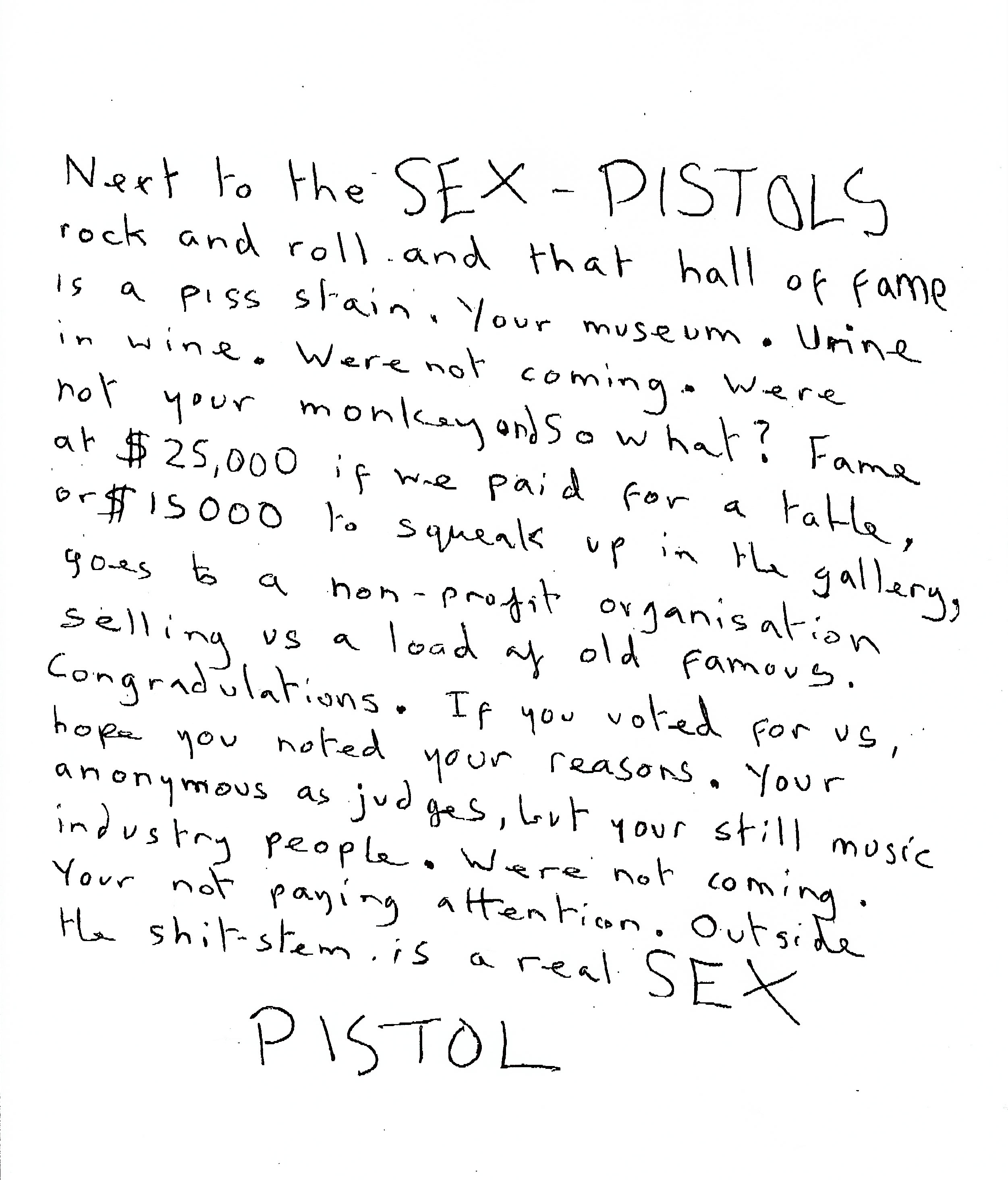
Whatever your feelings about Jann Wenner, Dave Marsh, Cleveland, or that the whole idea of a rock and roll hall of fame is indeed a “piss stain,” you will find yourself humbled and attentive once you make amends and go there.

Saturday, July 29, 2006

Dinner With Mike Watt

Ray Farrell, head of SST Record’s promotion department, called me one day while working at the college radio station. I was the program director there, and through the years at the station, I developed some pretty nice relationships with record labels and their employees. Ray had slighted me on a few occasions, or at least, I had felt that he had slighted me. It seemed that I could get whatever I wanted from record labels at the time; hell, I was prominently featured in fucking trade magazines as a “mover and shaker.” At least in my mind I was a mover and shaker. The reality, and Ray Farrell probably knew this, was somewhat different. Bottom line: Ray didn’t give me a ton of free shit. The label couldn’t afford it and I was probably presumptuous in asking for it. But whatever. I was young. I was movin’ and shakin.’
“firehose is going on tour and they’re coming to Iowa.” He explained. “You want to do a phone interview with Mike Watt?” Out of all the things Ray could have given me (free tickets, giveaways, a Raymond Pettibon print) the only thing he could come up with is a shitty sounding interview recorded over the phone line?! Fuck that. I had bigger plans.
I agreed to it and Ray gave me the phone number to Mike Watt’s house. “Call at [this time] on [this date].” He instructed. “Give me a call afterwards and let me know how it went.”
The bigger plan was this: I was going to parlay the phone interview into a full-fledged encounter with this, the man who played with the legendary Minutemen. I figured that I would invite him to dinner before the show in Iowa and treat him to a nice sit down dinner.


I called on the predetermined date and time only to hear about thirty minutes of busy signals. When I finally got through, a gruff sounding voice answered. “Hey Watt!” I announced, trying to sound cool, housed in a fairly clean Saccharine Trust t-shirt.
“I know you’ve probably been doin’ this all day long now…”
“Yeah, I’ve been on the phone all day…” he acknowledged.
“So whaddya say we cut this thing short and let’s just hook up here when you get to Iowa in a few weeks.”
“Oh, you mean like do an interview there at the station?” he asked.
I explained that the station I worked for was well over a hundred miles from where his band would be playing; therefore, it would be fairly impossible for him to stop by the station when they got into the state.
“What kind of food do you like?” I asked him.
“Mexican.” Was his short, to the point, and undebatable reply.
So with that, I told him that I would meet up with him before the show and take him to a nice Mexican restaurant where we could conduct the interview privately. Dinner, I added, was on me.
It goes without saying that the financial resources of most college students is fairly limited, and my role as Program Director for the student radio station paid a whopping one credit hour per semester. What that means is that I didn’t get paid, that actually, I was losing money at this gig. To supplement this lucrative salary, I worked for two other stations in the same market (under different names, to avoid that silly little non-compete clause) so that I could actually get a paycheck somehow.
I figured that I could afford to pay for Mike’s dinner and my own without much worry, and still have enough left over for gas, grass, and, well, that was about the extent of my budget right there.
I let Ray know to put me and my “producer” on the guest list for the show. I let my “producer,” a first year transfer student from somewhere around Omaha, know that he could come with me, but he’d have to buy his own dinner at the Mexican restaurant.
Before heading out, I called a few friends in the area to get their opinions as to what was the most authentic Mexican restaurant in the area. The consensus was that there was a little Mexican joint not too far from the venue that had a pretty authentic menu, and I was stoked that I’d be able to show Mike Watt how we do Mexican here in Iowa.
Now, before you start to giggle at the thought of “authentic Mexican food” and the state of Iowa together in the same sentence, let me explain that the part of Iowa where I’m originally from is close to a town that has some truly authentic Mexican restaurants. This was an area that heavily used Mexican migrant workers and the town actually built a fairly shitty subdivision to house them all in. A lot of families stayed there and continued their heritage with various community events, social clubs, and started a few restaurants so that the Iowa crackers could learn how to pronounce “Chimichanga” correctly.
On the way down to the firehouse show, I start to set the expectations of the interview with my “producer.” He had a tendency to try and take over my interviews, so I had to set him straight with this one. I also told him that he was not to mention anything about D. Boon. It was just a couple of years after Boon’s death and I wanted to avoid the topic entirely with Watt. I didn’t want to be “the guy that bummed out Mike Watt” and was afraid that any discussion of the topic would send him into a drop D chord, if you know what I mean…
I meet up with Watt and drummer George Hurley before the show and Mike actually remembered the prior arrangement. To my shock, Mike starts inviting everyone to dinner. George Hurley, Ed Crawford, the roadie, the t-shirt guy, I’m doing the math and it’s clear that I’ll be using my Dad’s Amoco card for a lot more than just gas for the next few weeks.
Thankfully, on the way to the Mexican restaurant, Ed Crawford decided that he didn’t want to run south of the border. He makes a beeline for a Subway and I’m secretly hoping that a few more in our group join him. They don’t, so the rest of us make our way into the “authentic” Mexican joint. I tell the “producer” that I may need to borrow a few bucks from him to cover the bill. He shows me a few twenties in his wallet and I breathe a sigh of relief. To show my appreciation, I let him sit next to me (I was going to put him next to the roadies) and we set up the recording equipment while everyone starts ordering from the menu.


Mike is very open and gregarious. He seems genuinely excited about the band, the tour, the record and he provides me with long, detailed answers. He even translates some Pedro-speak for me. I’m provided with a clear definition to what “We jam econo” means. “Econo” is short for “Econoline” as in Ford Econoline vans. Mike explains that they don’t need tour buses or other forms of fancy travel. For him, rock and roll as he understands it, is simply getting your gear together, throwing it into the Econoline, and getting out there and doing it. “You know, I read these things about other bands and how tough it is to go out on the road,” he preaches, “and how the concert industry is in a slump. That bands can’t make any money on tour anymore. The thing is: every tour that I’ve ever been a part of has made money. It’s about priorities, you understand.” He says these clarifying things a lot, like “You follow me?” “You know?” It had an almost teacher-to-student tone to it, like he was very aware of the impact that punk rock had on his life and that he was going to make damn sure you knew the ropes of the trade, in case you were in the market for an Econoline van too. I picked up on about half of this while the other half was spent hoping that the roadie didn’t order the steak fajitas.
Speaking of, the meal was positively lame. The food was far from fucking authentic and the hot sauce was a tad above tepid. I made a comment about the sauce and Mike concurred by declaring it “Weak” while his mouth was stuffed with food.
Let there be no question: Mike Watt can put down some food. And he can do it quickly. The man was done in no time flat and be made no attempt at trying to impress us with manners.
But Mike Watt has never been someone to try and impress anyone else. Aside from D. Boon, probably. That’s been part of his appeal, actually. This was a guy who really didn’t subscribe to the “punk formula” at all, and had the uncanny ability to read through the bullshit of these kinds of labels. So if a little bit of refried beans spills on his flannel, oh well.
After he ate, we talked some more about the band. Without any hesitation, he began to talk about D. Boon. The pain was still there, and some twenty years later, it appears that it never really left.
“It was D. Boon’s Mom that told me to play the bass.” He explained, with the same unison as the stories he told in “We Jam Econo.” That’s what struck me about the movie: the stories he told in front of the camera were the same stories, verbatim, that he told me nearly twenty years ago at a shitty Mexican restaurant in Iowa. His voice pause after each additional “You know?” I remained silent, occasionally nodding, letting Mike Watt spill another retelling of the tragedy to someone too young to fully appreciate the importance of the topic and too young to understand the pain that he overcame.
I paid for dinner with a few borrowed bills from the “producer.” Mike offered to pay for his crew, but I declined. I said that maybe we could work something out later on, maybe in the form of a free t-shirt or something. It seemed fair to me, but Mike explained that he couldn’t barter with his “merch.” It dawned on me. Every one of his tours made money. That $10 profit attributed to the bottom line. The stories he shared with me were worth more than a “weak” Mexican dinner.
We walked back to the venue. George and Mike worked on the set list (Ed, I learned, was not feeling well, and rarely spoke the entire night) while I snapped a few photos. We watched the soundcheck and snapped a few more before the doors opened. The “producer” rigged up a few microphones to record the show and we found a few good seats in back.
On the first song, Watt broke a string on his bass, and I witnessed an impressive example of d.i.y. He walked over to his amplifier and retrieved a new string from the top of the cabinet. He removed the broken string and strung a new one while continuing to play through the rest of the song.

Then another glitch occurred. A constant crackling noise started from Ed’s combo amp. A guitar tech came on stage in between songs to try and do a quick diagnosis, but nothing changed. This irritant, combined with Ed’s already sick demeanor, made for a very by-the-numbers set. George and Mike, on the other hand, probably had several additional years of these kinds of surprises and managed to maintain composure. They ended the performance with a cover of Public Enemy’s “Sophisticated Bitch,” which had Mike grinning from ear to ear and even prompted a smile from Ed.
After the show, I met up with Mike again to thank him for his time and to grab an autograph. There wasn’t a lot of chit chat offered, it was clear that he had more pressing things to do. Rather than spending some time with a couple of college kids in Iowa, Mike had to help with the band’s load out. Part of “jamming econo,” he explained, is also making sure that everyone helps out.
I quickly learn that my own lesson in “jamming econo” isn’t quite over yet.
“Grab those cables over there” he tells me.

Friday, July 28, 2006

Minutemen-We Jam Econo

I can’t tell you how important SST’s “The Blasting Concept” compilation albums were to me growing up. Priced at a mere $3.49, the album provided a glimpse of the SST Records roster. How could you go wrong? Certainly at that price, you’re sure to find a few tunes that you liked.
The album did more than that; it provided a glimpse into a different world of music. Meat Puppets, Black Flag, Husker Du, Saccharine Trust, and other SST labelmates were included on it. Starting it off was Minutemen’s “Paranoid Chant.”
“I try to talk to girls/And I keep thinking of world war three!” barked the singer. Underneath those effectively simplistic lyrics was a curious racket; a power trio that meshed together a unique version of punk rock that managed to epitomize the “paranoid” in “Paranoid Chant.”
For a young dude using a cheap compilation album to discover new music, the Minutemen were unlike anything else on the landscape. For an old dude talking about a new Minutemen documentary, they are still unlike anything else on the landscape.
You need Minutemen’s “Double Nickels On The Dime” in your record collection. It’s that simple. And once you’ve purchased that album, you may find yourself enamored in learning more about this power trio curio. That’s where the new documentary “We Jam Econo” comes in handy. For the novice, you’ll get to hear firsthand the Minutemen’s all-to-brief existence and you’ll learn of the incredible bond between bassist Mike Watt and guitarist D. Boon. If you’re already familiar with the oft-told story of the Minutemen, there are new stories to hear, concert footage to examine, and reminders as to why their legacy is so critical to underground music. If there ever was a band deserving of a documentary, the Minutemen are it.


The key is that even though “Double Nickels” stands sonically on it own, the Minutemen story is almost as critical. Even if the Boon/Watt story wasn’t part of the overall plot, you’d still have an important tale: Three ordinary guys from a blue-collar town whose musical inspirations far outweigh their potential. Their image, their political ideology, their musical lineage, their locale, their intelligence, all worked against them. It didn’t matter. Punk rock changed their lives.
Of course, the D. Boon story ends and begins with tragedy. The very moment this little band from Pedro was poised to go on to the next level, D. Boon dies in a car wreck, leaving his childhood friend Watt to spin briefly into a funk that seemed too deep to escape from.
It’s the magnitude of D. Boon’s death on Watt and how deep their friendship was that’s evident from the first five minutes of the film. Footage from 1985 shows the two talking about how they first met. Watt explains that he was walking along when Boon, literally, fell on him from out of a tree. A more recent shot then shows Watt walking the very same path and points to the exact tree where Boon fell on him. It’s heartbreaking. And it perfectly establishes how, almost twenty years after his best friend’s death, he’s still with him.
The only thing that’s really missing from the movie is an idea of how Boon’s death affected others. Sure, there are plenty of cameos from some of underground rock’s most elite names, but I know firsthand that the Minutemen were the catalyst for hundreds of upstarts and I know that Boon’s death ranks just as tragic as a Lennon, Cobain, or Strummer. We see the actual note that Henry Rollins sent Ian McKaye, notifying him of Boon’s passing. What I would have liked to have seen was a “soldier child’s” perspective too. I’ll never forget a conversation I had once with Dave Diebler about Minutemen. His band, House of Large Sizes, was clearly aligned with Minutemen’s d.i.y. ethos and his lyrics were clearly influenced by D. Boon’s. Diebler would go on about how important this band was to him and at the end of the conversation he shot me a look of sadness with an equal part of anger and said “Do you know that son of a bitch would still be with us if he had just put on his fucking seat belt?” I wanted to see just a few more examples of this in the documentary, for some reason. Some proof that it wasn’t just underground a-listers, art-types, and rock critics that felt something from this band, this artist. Their importance was felt all the way to Iowa, and it was large enough for others to start power trios of their own.
Nonetheless, this is a very good piece of work and there’s certainly more than enough information included to keep those who deem themselves to be familiar with everything Minutemen entertained. I wasn’t aware that “Double Nickels” contains a nod to both Pink Floyd’s “Ummagumma” and Sammy Hagar. I didn’t know that the reason Boon’s guitar was so trebly was because the band viewed the bass guitar and electric guitar as “sovereign states.” I didn’t know that legendary SST “producer” Spot was such a riot (I should have, if I’d only remembered side four of Black Flag’s “Everything Went Black” album). And I didn’t know that both Grant Hart and Richard Hell look like they’re one good vein away from an overdose. Greg Norton, on the other hand, looks pretty good lately.
The bonus material is excellent and I enjoyed almost all of the deleted scenes including Ed Crawford’s telling of how he literally called Watt up from Ohio after Boon’s death and pulled him back into where D. Boon would have wanted him to be: on stage with his “thunderbroom.”
The documentary ends where it should: a modern day Mike Watt driving around San Pedro in a Ford Econoline van. He narrates “So, December 22nd, 1985….” He starts to slowly shake his head, trying to ward off the approaching tears. He clears his throat and continues, “Heavy day for me.”
The shot continues and Watt tries to surmise it all by saying “Big change in my life…meetin’ D. Boon.”
We’ll never have the opportunity to meet D. Boon anymore. The only thing we can have is a chance to hear about him, and “We Jam Econo” is a great way to do just that.

Saturday, July 22, 2006

Brokedown Palace

After a fucking year on the market, Brokedown Palace is sold. I signed the paperwork yesterday and, what once was a proud abode overlooking the Mississippi River is now in the hands of, I think, the ex-wife of the dude that used to trim the English Walnut tree that was just outside of the dining room. The same dude that gave the ex a ride on his Harley after I moved out.
I made enough money to cover the mortgage and cover the expenses that I threw at it over the years. In short: I broke even. Understand, the town in which it was built is not the most frequented of spots. In fact, the town (and area) has shown a dramatic decline of the population thanks to people who move on to opportunities outside of the area. And let me explain, there are no opportunities within my former hometown. Unless you happen to have a meth lab in your basement.
Nonetheless, there is some scenery there and some history. But scenery and history only go so far, and so I relied on a couple of acquaintances to help me unload the property.
The first was a my divorce lawyer, a guy that happened to be the older brother of a friend of mine. The lawyer also lived a block away from the house, so when it came time to sock it to the ex because she didn't hold up her end of the bargain on the divorce, he seemed like a logical choice to help me deal with the legal bullshit surrounding the sale of the house. Apparently, timeliness and communication weren't part of his expertise; countless unanswered phone calls ensued as did a lack of urgency when it came time to get some paperwork filed before the closing of the house. I went boating with the guy on one occassion and learned that he was a Jimmy Buffett fan. The fact that he was a "Parrothead" should have clued me in, but since I'm a cheap prick, I opted to overlook this for the possibility of getting some friendly prices for his services.

The realtor who listed the house was actually the chick I took to the senior prom, many years ago. She was dating an older guy who ran the local stereo store and I was dating someone who's parents wouldn't let her stay out all night. For a couple of kids who viewed senior prom as an allnighter, it became clear that we needed to leave the romantic halves at home and go to the prom with each other.
The "theme" was "Can't Fight This Feeling" by R.E.O. Speedwagon, which was a step down from the prior year's "Just Between You And Me" by April Wine. Seriously, what feeling were they trying to fight? What the fuck does that have to do with prom? Anyway, the senior class had spoken and chose the theme, so I shouldn't be pissed that my (joke) vote for Kiss' "Heaven's On Fire" didn't win. Me and a few other people thought that would be a great choice, mainly because of the completely indulgent Paul Stanley opener on the song.
Understand, my decision to go with the pre-realtor chick was a completely superficial one: we were there to party. There was no chance/desire for hanky-panky. No drama for making sure everything went perfectly. The only drama was getting someone to buy us kegs of beer and then loading them up to a room at the Super 8 (life's great there!) without an adult noticing and calling the cops.
After the room, the beer, and the corsages were secured, we met up with some friends at a parent's house for dinner. It was one of those "Let us make you a fancy dinner so that we can take pictures of how cute you all look" type of events. If I recall, a bird pooped on the shoulder of one of my friend's tuxedoes while we were on the deck for obligatory snapshots. Now there's a Kodak moment!
When we were all set to leave, me and the chick decided to play Reeses Penut Butter Cups with our drugs (You've got cocaine in my weed! You've got weed in my cocaine! Shit, let's open up some Jack Daniels and make it three great tastes that taste great together!). Little did I know, my parents decided it would be a good idea to show up at the formal, right around the same time the cocaine paranoia hit me. That wasn't me smiling on those prom pictures Mom; that was me grinding me teeth.
The band playing at formal was unable to accomodate our requests for Black Flag and Dead Kennedy's songs. Christ, they couldn't even play "Heaven's On Fire." After a few quick slow dances and a few more pictures, we decided to head to the Super 8 where the beer should have been nice and cold.
We had reserved at least four rooms and it became a situation of musical parties at the Super 8, much to the chagrin of the other guests. About two in the morning, I went outside and passed out in a convertable Ford LTD. At three in the morning, the car began to move as we were suddenly transported to the local nightclub who had reserved the place for the benefit of the prom. I should point out that, by this time, I had no idea where my prom date was.
By six in the morning, we had retired back to the hotel in a futile attempt to get a few hours of sleep. When I say "futile" I mean that, by that time, a few of the hotel patron that had to endure the drunken tomfoolery of teenagers, now started to retaliate us by banging on the doors of our rooms. "Who the fuck is that?" I yelled, trying to get a few hours of sleep to help kill the oncoming hangover. I noticed that I was passed out in between a couple and wondered if I had drunkenly missed my only threeway. My friend went to the door and was immediately met by a very angry person who proceeded to chastise him/us for keeping her up all night. When I again asked who was at the door, without pause he turned to me and said "It's a lizard" before sticking out his tounge, mimicking the reptilian woman who continued to bark at him.
My lengthy point is this: me and the realtor lady had a history together. So I was hoping that this history would be more of a motivator to actually sell my home, despite the fact that a nice commission should be motivating enough. But no, I get all sorts of inept requests ("Maybe we should lower the listing price.") and examples of shitty work ethic.
But fuck it. It's sold. It's over. Now I can return to the community for the occasional visit as a former homeowner there, with more than a few stories to share.
Like this one: the 'Cocaine Senior Prom kegger at the Super 8 staring the Lizard Lady with music by R.E.O. Speedwagon' story.